\n
## Diagram: Federated Learning System
### Overview
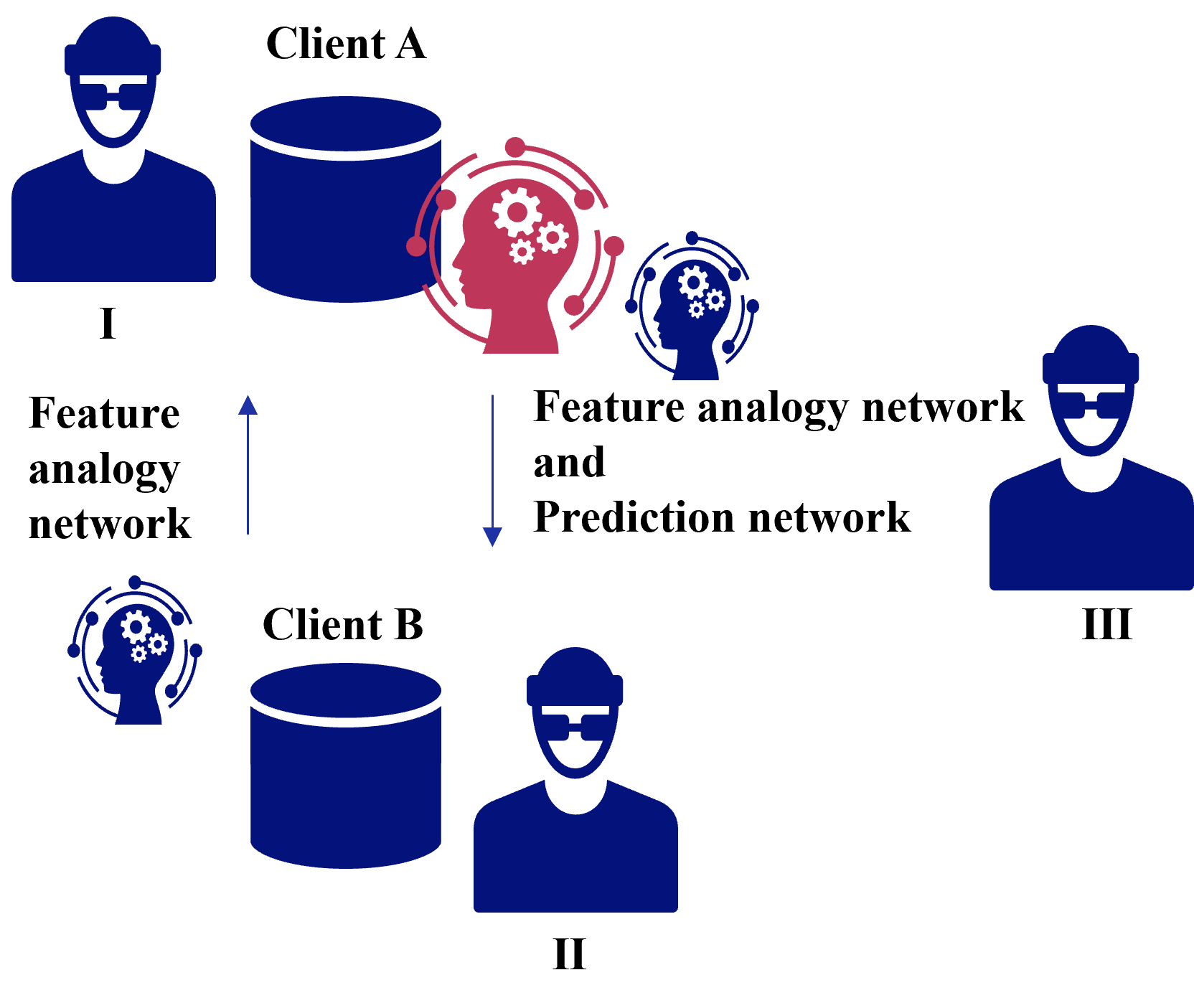
The image depicts a federated learning system involving two clients (Client A and Client B) and a central "Feature analogy network and Prediction network". The diagram illustrates the flow of data and model updates between the clients and the central network. It's a conceptual diagram, not a data-rich chart.
### Components/Axes
The diagram consists of the following components:
* **Client A:** Represented by a head-and-shoulders silhouette and a dark blue cylinder labeled "Client A".
* **Client B:** Represented by a head-and-shoulders silhouette and a dark blue cylinder labeled "Client B".
* **Feature analogy network and Prediction network:** Represented by a red, circular arrangement of gear and brain icons, labeled "Feature analogy network and Prediction network".
* **Feature analogy network:** Represented by a blue, circular arrangement of gear and flower icons, labeled "Feature analogy network".
* **Arrows:** Curved arrows indicate the direction of data flow and model updates.
* **Labels I, II, III:** Roman numerals are used to label the clients and the central network.
### Detailed Analysis or Content Details
The diagram shows a bidirectional flow between the clients and the central network.
* **Client A to Central Network:** An arrow originates from "Client A" and points towards the "Feature analogy network and Prediction network".
* **Central Network to Client A:** An arrow originates from the "Feature analogy network and Prediction network" and points towards "Client A".
* **Client B to Central Network:** An arrow originates from "Client B" and points towards the "Feature analogy network".
* **Feature analogy network to Client B:** An arrow originates from the "Feature analogy network" and points towards "Client B".
The central network appears to be composed of two sub-networks: a "Feature analogy network" and a "Prediction network", which are visually represented by different icon arrangements. The "Feature analogy network" is connected to Client B, while the "Feature analogy network and Prediction network" is connected to Client A.
### Key Observations
The diagram highlights a federated learning setup where model training occurs locally on each client (A and B) and then updates are aggregated or used by a central network. The use of separate networks for feature analogy and prediction suggests a potentially modular architecture. The diagram does not provide any quantitative data or specific details about the algorithms or data used.
### Interpretation
This diagram illustrates a federated learning paradigm. Federated learning is a machine learning technique that trains an algorithm across multiple decentralized edge devices or servers holding local data samples, without exchanging them. This approach contrasts with traditional centralized machine learning, where all the data is uploaded to one server.
The diagram suggests that Client A interacts with both the feature analogy and prediction components of the central network, while Client B primarily interacts with the feature analogy component. This could indicate that Client A provides data relevant to both feature extraction and prediction, while Client B's data is primarily used for feature learning.
The use of silhouettes for the clients suggests a focus on privacy and anonymity. The gear and brain icons within the networks likely represent the computational processes involved in feature extraction, analogy, and prediction. The arrows indicate a continuous cycle of learning and improvement, where clients contribute to the central network, and the central network provides updated models or insights back to the clients.
The diagram is a high-level conceptual representation and lacks specific details about the data, algorithms, or communication protocols used in the federated learning system. It serves as a visual aid for understanding the overall architecture and data flow.