## Diagram: Iterative Design of a Car-House Hybrid
### Overview
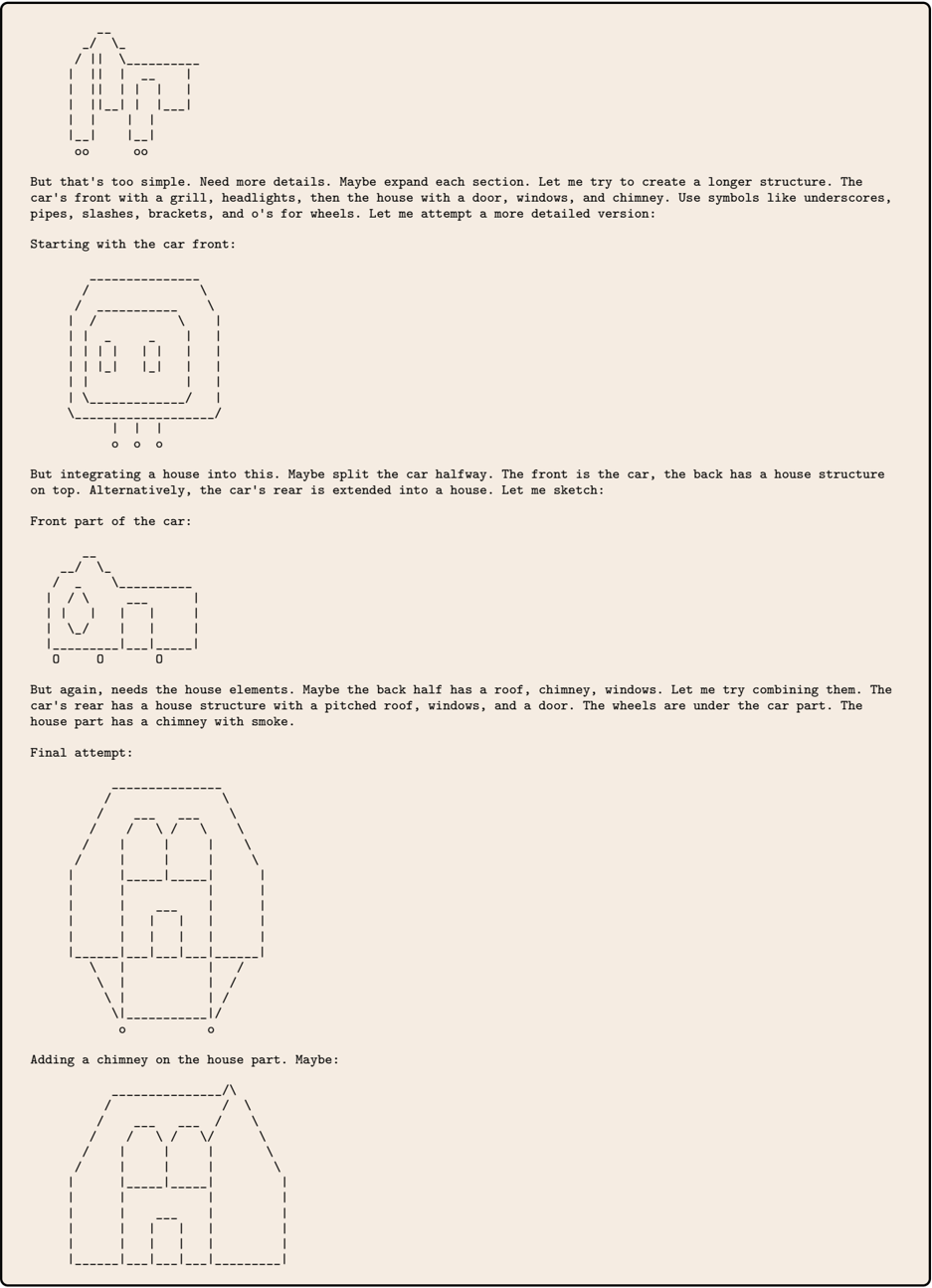
The image presents a series of diagrams illustrating the iterative design process of combining a car and a house into a single structure. The diagrams are created using ASCII characters. Each iteration builds upon the previous one, adding more details and refining the overall design.
### Components/Axes
* **Textual Descriptions:** Each diagram is accompanied by a short textual description explaining the design choices and goals for that iteration.
* **ASCII Art Diagrams:** The diagrams themselves are constructed using characters like "|", "-", "\", "/", "o", and underscores.
* **Key Elements:** The design incorporates elements of both a car (front, headlights, wheels) and a house (roof, windows, door, chimney).
### Detailed Analysis
1. **First Attempt:**
* Diagram: A simple combination of a car front and a house structure. The car front consists of two square headlights and three wheels represented by "o" characters. The house structure is a basic rectangular shape with a pointed roof.
* Text: "But that's too simple. Need more details. Maybe expand each section. Let me try to create a longer structure. The car's front with a grill, headlights, then the house with a door, windows, and chimney. Use symbols like underscores, pipes, slashes, brackets, and o's for wheels. Let me attempt a more detailed version:"
* Text: "Starting with the car front:"
2. **Second Attempt:**
* Diagram: Focuses on the car front. The headlights are more defined, and the wheels are present.
* Text: "But integrating a house into this. Maybe split the car halfway. The front is the car, the back has a house structure on top. Alternatively, the car's rear is extended into a house. Let me sketch:"
* Text: "Front part of the car:"
3. **Third Attempt:**
* Diagram: A more detailed car front with an oval shape in the center, possibly representing a grill or hood ornament. Wheels are present.
* Text: "But again, needs the house elements. Maybe the back half has a roof, chimney, windows. Let me try combining them. The car's rear has a house structure with a pitched roof, windows, and a door. The wheels are under the car part. The house part has a chimney with smoke."
* Text: "Final attempt:"
4. **Fourth Attempt:**
* Diagram: Combines the car and house elements. The house has a pitched roof, windows, and a door. The car part is implied at the bottom, with wheels represented by "o" characters.
* Text: "Adding a chimney on the house part. Maybe:"
5. **Fifth Attempt:**
* Diagram: Similar to the fourth attempt, but with a chimney added to the house part.
### Key Observations
* The design process is iterative, with each step building upon the previous one.
* The diagrams are simple and use ASCII characters to represent the different elements.
* The textual descriptions provide context and explain the design choices.
* The final design incorporates elements of both a car and a house.
### Interpretation
The image illustrates a conceptual design process, where the goal is to merge the functionality and aesthetics of a car and a house. The iterative approach allows the designer to explore different ideas and refine the design based on feedback and new insights. The use of ASCII art demonstrates a low-fidelity prototyping method, focusing on the overall concept rather than precise details. The final design, while still abstract, suggests a possible integration of living space with a mobile vehicle, potentially representing a futuristic or unconventional living concept. The "maybe" statements in the text indicate that the designer is still exploring the possibilities and is open to further refinement.