\n
## Diagram: Conceptual Sketches of a Car-House Hybrid
### Overview
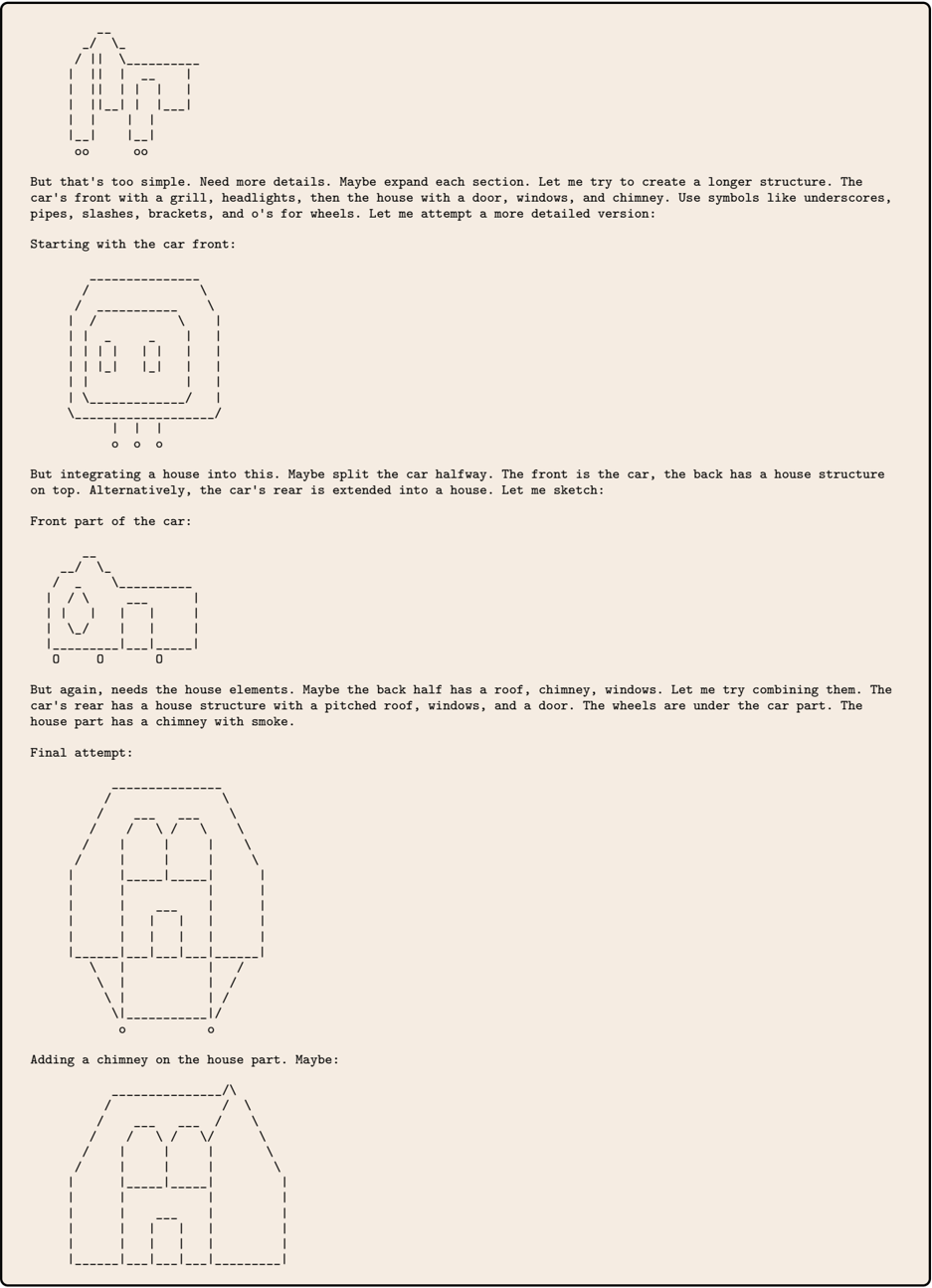
The image presents a series of hand-drawn sketches exploring the concept of merging a car and a house into a single structure. The sketches demonstrate a progressive design process, starting with simple shapes and gradually adding details. Accompanying the sketches is descriptive text outlining the thought process and design considerations.
### Components/Axes
The image does not contain axes or legends in the traditional sense. It consists of a sequence of sketches and textual descriptions. The sketches themselves are the primary components, with the text serving as annotations and explanations.
### Detailed Analysis or Content Details
The image is structured as a series of design iterations, each accompanied by text. Here's a breakdown of each stage:
1. **Initial Sketch:** A very basic representation of a car-like shape with two circles representing wheels.
Text: "But that's too simple. Need more details. Maybe expand each section. Let me try to create a longer structure. The car's front with a grill, headlights, then the house with a door, windows, and chimney. Use symbols like underscores, pipes, slashes, brackets, and o's for wheels. Let me attempt a more detailed version."
2. **First Detailed Attempt:** A more defined car front with a rectangular grill and headlights, transitioning into a house-like structure with a pitched roof. Three circles represent wheels.
Text: "Starting with the car front:"
3. **Second Attempt - Car/House Split:** A sketch showing a clear division between the car front and the house back. The car front is more detailed, and the house back has a pitched roof and a rectangular shape suggesting windows.
Text: "But integrating a house into this. Maybe split the car halfway. The front is the car, the back has a house structure on top. Alternatively, the car's rear is extended into a house. Let me sketch:"
Sub-text: "Front part of the car:"
4. **Third Attempt - Refined Split:** A slightly more refined version of the previous sketch, with more defined shapes for the car and house components.
Text: "But again, needs the house elements. Maybe the back half has a roof, chimney, windows, and a door. The wheels are under the car part. The house part has a chimney with smoke."
5. **Final Attempt:** A more complete sketch showing a car body seamlessly integrated with a house structure. The house has a pitched roof, chimney, windows, and a door. The wheels are positioned underneath the car section.
Text: "Final attempt:"
6. **Chimney Addition:** A sketch showing the house with a chimney.
Text: "Adding a chimney on the house part. Maybe:"
### Key Observations
The sketches demonstrate a clear progression from simple concepts to more detailed designs. The designer is actively exploring different ways to integrate the car and house elements, considering factors like structural integrity, aesthetics, and functionality. The use of basic symbols (circles for wheels, rectangles for windows) suggests a preliminary brainstorming phase. The iterative nature of the sketches highlights the design process.
### Interpretation
The image represents a conceptual exploration of a hybrid vehicle/dwelling. The sketches suggest a desire to combine the mobility of a car with the comfort and stability of a house. This could be interpreted as a response to themes of nomadic living, sustainable housing, or futuristic transportation. The sketches are not intended to be realistic blueprints but rather visual representations of an idea. The designer is grappling with the challenges of merging two fundamentally different structures, and the sketches reflect this struggle. The iterative process and accompanying text reveal a thoughtful and creative approach to problem-solving. The sketches are a visual record of the designer's thought process, showcasing the evolution of an idea from its initial conception to a more refined form. The lack of precise measurements or technical specifications indicates that this is a conceptual exploration rather than a detailed engineering plan. The sketches are a form of visual thinking, allowing the designer to explore possibilities and refine their ideas through drawing.