\n
## Document: Causal Relationship Determination Protocol
### Overview
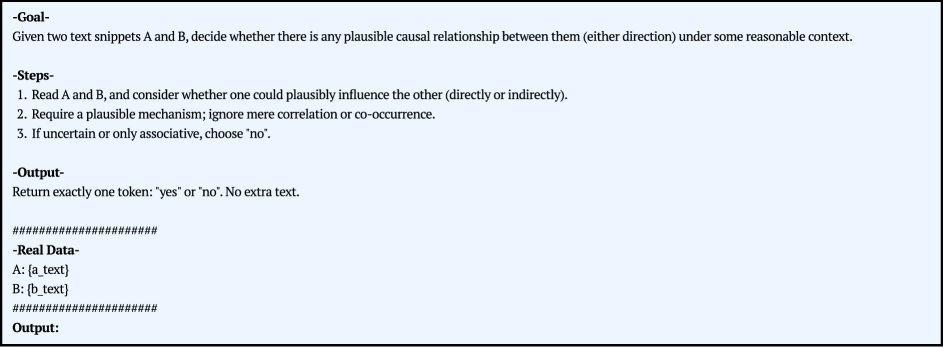
The image presents a structured document outlining a protocol for determining if a plausible causal relationship exists between two text snippets (A and B). It details the goal, steps, output format, and provides placeholders for real data and the final output. This is a procedural document, not a chart or diagram containing data to analyze.
### Components/Axes
The document is divided into sections, each labeled with a specific purpose:
* **-Goal-**: Defines the objective of the protocol.
* **-Steps-**: Lists the procedures to follow.
* **-Output-**: Specifies the expected output format.
* **-Real Data-**: Provides placeholders for input text snippets A and B.
* **Output:** Placeholder for the final result.
The steps are numbered 1 through 3. The document uses a consistent formatting style with labels prefixed by a hyphen.
### Detailed Analysis or Content Details
Here's a transcription of the document's content:
**-Goal-**
Given two text snippets A and B, decide whether there is any plausible causal relationship between them (either direction) under some reasonable context.
**-Steps-**
1. Read A and B, and consider whether one could plausibly influence the other (directly or indirectly).
2. Require a plausible mechanism; ignore mere correlation or co-occurrence.
3. If uncertain or only associative, choose ‘no’.
**-Output-**
Return exactly one token: ‘yes’ or ‘no’. No extra text.
#######################
**-Real Data-**
A: [a\_text]
B: [b\_text]
#######################
**Output:**
### Key Observations
The document is entirely procedural. It does not contain any data points or trends to analyze. It is a set of instructions. The formatting is consistent and clear, designed for a machine or human to follow a defined process.
### Interpretation
This document outlines a decision-making process for assessing causality between two pieces of text. It emphasizes the need for a *plausible mechanism* beyond simple correlation. The protocol is designed to be conservative, defaulting to "no" if there is any uncertainty. This suggests a focus on avoiding false positives in causal inference. The placeholders for "Real Data" indicate that this is a template intended to be populated with actual text snippets for analysis. The strict output requirement ("yes" or "no") suggests the protocol is intended for automated processing or a binary classification task. The document is a clear example of a rule-based system for evaluating a complex concept (causality) in a simplified manner.