## Text Prompt Template: Causal Relationship Detection Task
### Overview
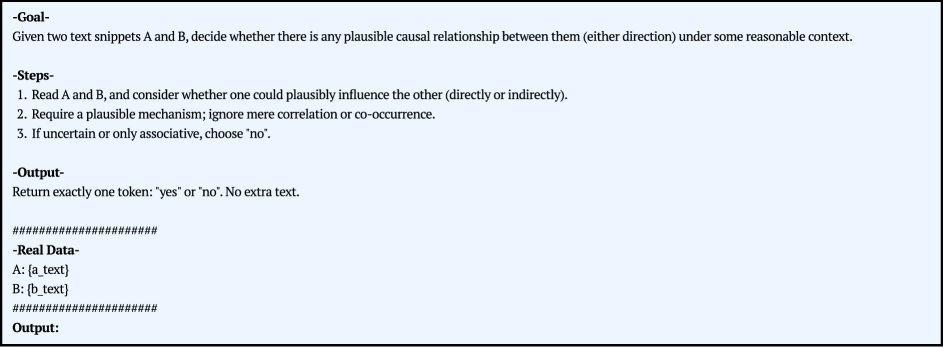
The image contains a structured prompt template for evaluating causal relationships between two text snippets (A and B). It outlines a goal, step-by-step reasoning process, output format, and placeholder data.
### Components/Axes
- **Sections**:
- `-Goal-`: Defines the task objective.
- `-Steps-`: Lists three reasoning steps for causal analysis.
- `-Output-`: Specifies the required response format.
- `-Real Data-`: Placeholder for input text snippets.
- **Textual Content**:
- No numerical data, charts, or diagrams present.
### Detailed Analysis
- **Goal**:
- Determine if there is a plausible causal relationship (direct or indirect) between two text snippets under a reasonable context.
- **Steps**:
1. Read A and B, and assess if one could plausibly influence the other.
2. Require a causal mechanism (ignore mere correlation or co-occurrence).
3. If uncertain or only associative, respond "no".
- **Output**:
- Return exactly one token: "yes" or "no". No additional text.
- **Real Data**:
- Placeholders: `A: {a_text}`, `B: {b_text}`.
### Key Observations
- The prompt enforces strict causal reasoning, excluding associative or correlational relationships.
- Output is binary ("yes"/"no") with no flexibility for explanation.
- Placeholders indicate the template is designed for dynamic input.
### Interpretation
This prompt template is designed to train or evaluate a model’s ability to distinguish causal relationships from spurious correlations. By requiring a "plausible mechanism" and penalizing associative reasoning, it aligns with causal inference principles in natural language processing. The strict output format ensures unambiguous results, critical for automated systems. The absence of numerical data suggests this is a qualitative task focused on logical reasoning rather than statistical analysis.