## Diagram: NeuroSymbolic AI
### Overview
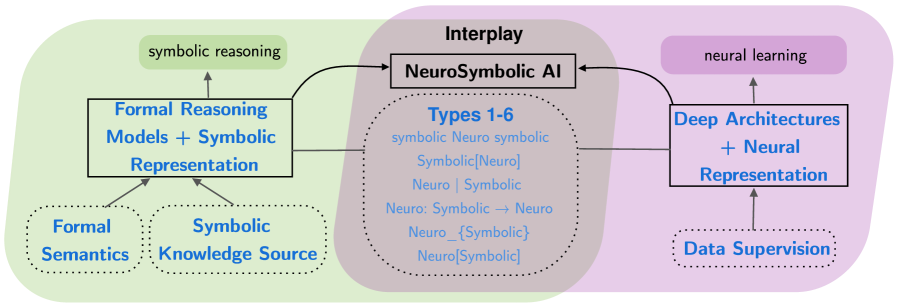
The image is a diagram illustrating the interplay between symbolic reasoning and neural learning in the context of NeuroSymbolic AI. It shows the flow of information and relationships between different components, including formal reasoning models, symbolic representation, deep architectures, and data supervision.
### Components/Axes
* **Background Regions:**
* Left: Light green region labeled "symbolic reasoning"
* Center: Light gray region labeled "Interplay"
* Right: Light purple region labeled "neural learning"
* **Nodes:**
* "Formal Reasoning Models + Symbolic Representation" (top-left, within the green region)
* "Formal Semantics" (bottom-left, within the green region)
* "Symbolic Knowledge Source" (bottom-center, within the green region)
* "NeuroSymbolic AI" (center, within the gray region)
* "Deep Architectures + Neural Representation" (top-right, within the purple region)
* "Data Supervision" (bottom-right, within the purple region)
* **Connections:**
* Arrows indicate the flow of information between the nodes.
* **Types 1-6:**
* Located in the center, within the gray "Interplay" region.
* Lists different types of NeuroSymbolic AI approaches.
### Detailed Analysis or ### Content Details
* **Symbolic Reasoning (Left, Green Region):**
* "Formal Semantics" and "Symbolic Knowledge Source" feed into "Formal Reasoning Models + Symbolic Representation".
* "Formal Semantics" and "Symbolic Knowledge Source" are enclosed in a dotted rounded rectangle.
* **Interplay (Center, Gray Region):**
* "NeuroSymbolic AI" is the central node.
* An arrow points from "Formal Reasoning Models + Symbolic Representation" to "NeuroSymbolic AI".
* An arrow points from "NeuroSymbolic AI" to "Deep Architectures + Neural Representation".
* "Types 1-6" lists the following approaches:
* symbolic Neuro symbolic
* Symbolic[Neuro]
* Neuro | Symbolic
* Neuro: Symbolic → Neuro
* Neuro_{Symbolic}
* Neuro[Symbolic]
* "Types 1-6" is enclosed in a dotted rounded rectangle.
* **Neural Learning (Right, Purple Region):**
* "Data Supervision" feeds into "Deep Architectures + Neural Representation".
* "Data Supervision" is enclosed in a dotted rounded rectangle.
### Key Observations
* The diagram highlights the interaction between symbolic reasoning and neural learning in NeuroSymbolic AI.
* The "Interplay" region emphasizes the integration of these two approaches.
* "Types 1-6" provides examples of different ways to combine symbolic and neural methods.
### Interpretation
The diagram illustrates the concept of NeuroSymbolic AI, which aims to combine the strengths of symbolic reasoning (e.g., interpretability, logical inference) with those of neural learning (e.g., pattern recognition, adaptability). The diagram shows how formal reasoning models and symbolic representations can be integrated with deep architectures and neural representations to create more powerful and versatile AI systems. The "Types 1-6" section suggests different strategies for achieving this integration, ranging from embedding neural components within symbolic systems to using symbolic knowledge to guide neural learning. The diagram suggests that NeuroSymbolic AI is a promising direction for future AI research, as it has the potential to overcome the limitations of purely symbolic or purely neural approaches.