\n
## Diagram: NeuroSymbolic AI Interplay
### Overview
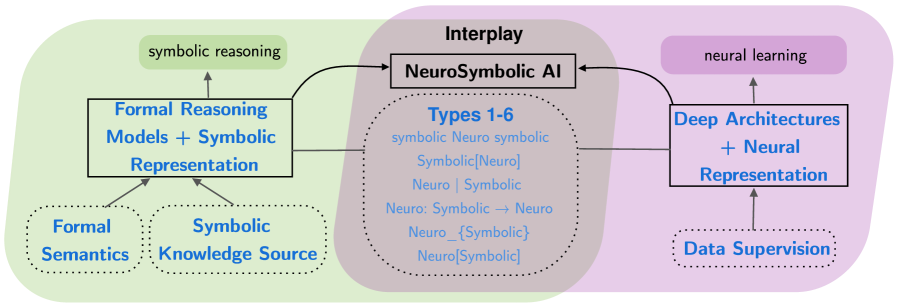
The image is a diagram illustrating the interplay between symbolic reasoning and neural learning within the field of NeuroSymbolic AI. It depicts two main approaches – Formal Reasoning Models and Deep Architectures – converging through NeuroSymbolic AI, with different types of interactions listed. The diagram uses color-coding to differentiate the two approaches and their respective components.
### Components/Axes
The diagram consists of four main areas:
1. **Left (Green):** Formal Reasoning Models + Symbolic Representation. Includes "Formal Semantics" and "Symbolic Knowledge Source".
2. **Center (Light Green):** "Interplay" and "NeuroSymbolic AI" with "Types 1-6" listed.
3. **Right (Pink):** Deep Architectures + Neural Representation. Includes "Data Supervision".
4. **Arrows:** Represent the flow of information and interaction between the components.
The diagram also includes the following labels:
* "symbolic reasoning" (above the left box)
* "neural learning" (above the right box)
### Detailed Analysis or Content Details
The diagram shows a flow of information:
* **From Left to Center:** An arrow labeled "symbolic reasoning" points from the "Formal Reasoning Models + Symbolic Representation" box to the "NeuroSymbolic AI" box.
* **From Right to Center:** An arrow labeled "neural learning" points from the "Deep Architectures + Neural Representation" box to the "NeuroSymbolic AI" box.
* **Within the Left Box:** A dotted arrow points from "Symbolic Knowledge Source" to "Formal Semantics".
* **Within the Right Box:** A dotted arrow points from "Data Supervision" to "Deep Architectures + Neural Representation".
The "NeuroSymbolic AI" box contains the text "Types 1-6" followed by a list of interaction types:
* symbolic Neuro symbolic
* Symbolic[Neuro]
* Neuro | Symbolic
* Neuro: Symbolic -> Neuro
* Neuro_{Symbolic}
* Neuro[Symbolic]
### Key Observations
The diagram emphasizes the integration of two distinct AI approaches: symbolic reasoning and neural learning. The "NeuroSymbolic AI" area acts as a central point of interaction, with "Types 1-6" suggesting a categorization of different integration strategies. The dotted arrows within the left and right boxes indicate internal feedback or dependency within each approach.
### Interpretation
This diagram illustrates a conceptual framework for NeuroSymbolic AI, which aims to combine the strengths of symbolic AI (reasoning, explainability) and neural networks (learning from data, pattern recognition). The diagram suggests that NeuroSymbolic AI isn't a single technique but rather a spectrum of approaches ("Types 1-6") that vary in how they integrate symbolic and neural components. The arrows indicate a bidirectional flow of information, implying that symbolic reasoning can benefit from neural learning and vice versa. The "Symbolic Knowledge Source" and "Data Supervision" elements highlight the different types of input required for each approach. The diagram doesn't provide quantitative data, but it visually represents a conceptual model of how these two paradigms can be combined to create more robust and intelligent AI systems. The listing of "Types 1-6" suggests a need for further categorization and understanding of the different ways to achieve NeuroSymbolic integration.