## Document Analysis: Financial Statement Data and Reasoning
### Overview
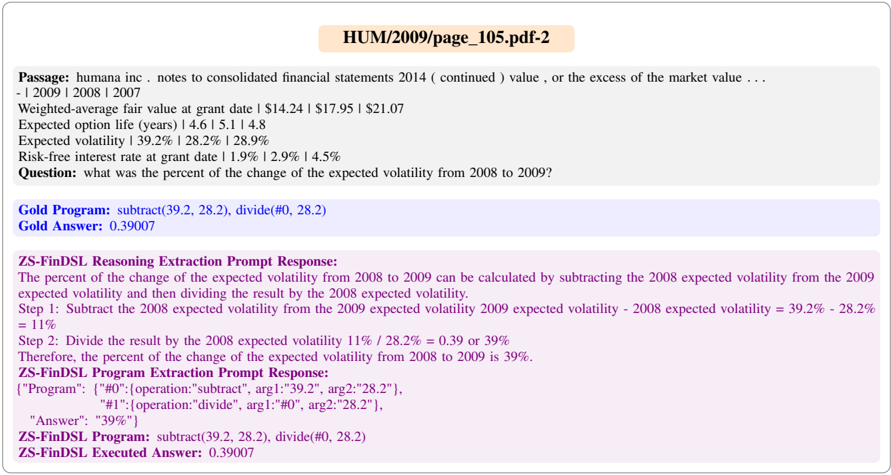
The image presents a snippet from a technical document, specifically a page (page_105.pdf-2) related to Humana Inc.'s consolidated financial statements for 2014. It includes financial data for the years 2009, 2008, and 2007, focusing on weighted-average fair value, expected option life, expected volatility, and risk-free interest rate. The document also features a question about the percentage change in expected volatility from 2008 to 2009, along with a "Gold Program" and a "ZS-FinDSL Reasoning Extraction Prompt Response" that provide solutions and reasoning.
### Components/Axes
* **Header:** "HUM/2009/page\_105.pdf-2"
* **Passage:** Contains introductory text and financial data.
* Years: 2009, 2008, 2007
* Weighted-average fair value at grant date: $14.24 (2009), $17.95 (2008), $21.07 (2007)
* Expected option life (years): 4.6 (2009), 5.1 (2008), 4.8 (2007)
* Expected volatility: 39.2% (2009), 28.2% (2008), 28.9% (2007)
* Risk-free interest rate at grant date: 1.9% (2009), 2.9% (2008), 4.5% (2007)
* **Question:** "what was the percent of the change of the expected volatility from 2008 to 2009?"
* **Gold Program:** Presents a calculation to answer the question.
* Program: subtract(39.2, 28.2), divide(#0, 28.2)
* Answer: 0.39007
* **ZS-FinDSL Reasoning Extraction Prompt Response:** Provides a step-by-step explanation of the calculation.
* Step 1: 39.2% - 28.2% = 11%
* Step 2: 11% / 28.2% = 0.39 or 39%
* **ZS-FinDSL Program Extraction Prompt Response:** Presents the calculation in a JSON-like format.
* Program: subtract(39.2, 28.2), divide(#0, 28.2)
* Answer: 39%
* **ZS-FinDSL Executed Answer:** 0.39007
### Detailed Analysis or Content Details
The document provides financial data for Humana Inc. over three years (2009, 2008, 2007). The weighted-average fair value at grant date decreased from $21.07 in 2007 to $14.24 in 2009. The expected option life fluctuated, reaching 5.1 years in 2008. The expected volatility was highest in 2009 at 39.2%. The risk-free interest rate decreased from 4.5% in 2007 to 1.9% in 2009.
The question focuses on calculating the percentage change in expected volatility from 2008 to 2009. The "Gold Program" and "ZS-FinDSL Reasoning Extraction Prompt Response" both provide methods to calculate this change. The "Gold Program" uses the formula: subtract(39.2, 28.2), divide(#0, 28.2), which results in an answer of 0.39007. The "ZS-FinDSL Reasoning Extraction Prompt Response" breaks down the calculation into two steps: first, subtracting the 2008 volatility from the 2009 volatility (39.2% - 28.2% = 11%), and then dividing the result by the 2008 volatility (11% / 28.2% = 0.39 or 39%).
The "ZS-FinDSL Program Extraction Prompt Response" presents the same calculation in a JSON-like format, which is likely used for automated processing. The "ZS-FinDSL Executed Answer" confirms the result of the calculation as 0.39007.
### Key Observations
* The weighted-average fair value at grant date decreased over the three years.
* The expected volatility increased significantly from 2008 to 2009.
* The risk-free interest rate decreased over the three years.
* Both the "Gold Program" and "ZS-FinDSL" methods arrive at the same answer for the percentage change in expected volatility.
### Interpretation
The document snippet appears to be part of a financial analysis or report. The data suggests a changing financial landscape for Humana Inc. between 2007 and 2009. The decrease in weighted-average fair value and risk-free interest rate, coupled with the increase in expected volatility, could indicate increased market uncertainty or specific challenges faced by the company during that period.
The inclusion of the question and the detailed calculation methods ("Gold Program" and "ZS-FinDSL") suggests an effort to explain or verify the percentage change in expected volatility. The "ZS-FinDSL" responses, particularly the JSON-like format, indicate the use of automated tools for financial analysis and reasoning. The consistency between the different calculation methods reinforces the accuracy of the result.