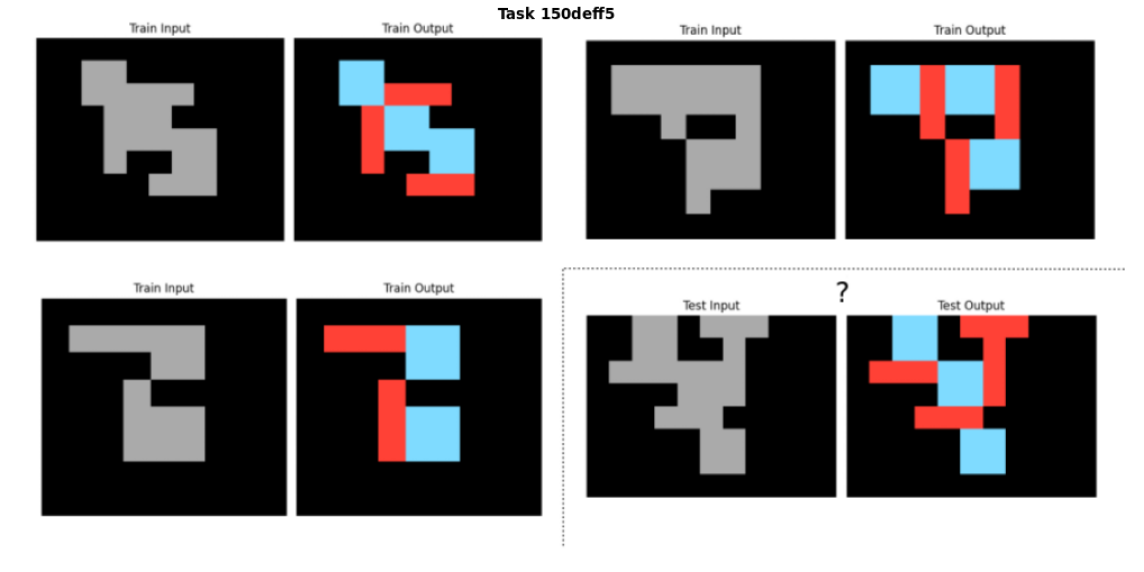
## Diagram: Task 1500deff5 Transformation Process
### Overview
The image depicts a six-panel diagram illustrating a transformation process for geometric shapes. The panels are divided into two sections: four "Train" examples (top row) and two "Test" examples (bottom row), separated by a dotted line. Each panel shows a gray input shape on the left and a transformed output on the right, using red and blue blocks. A question mark appears between the Test Input and Output panels, indicating uncertainty about the transformation logic.
### Components/Axes
- **Panels**:
- Top row:
1. Train Input (gray shape)
2. Train Output (red/blue blocks)
3. Train Input (gray shape)
4. Train Output (red/blue blocks)
- Bottom row:
1. Test Input (gray shape)
2. Test Output (red/blue blocks with question mark)
- **Colors**:
- Gray: Input shapes
- Red: Horizontal/rectangular blocks in outputs
- Blue: Square blocks in outputs
- **No explicit legend** explaining color meanings or transformation rules.
### Detailed Analysis
1. **Train Examples**:
- **Panel 1**: A complex gray shape (irregular L-shape with protrusions) transforms into a configuration with 3 red blocks and 2 blue blocks.
- **Panel 2**: A simpler gray shape (T-like form) becomes 2 red blocks and 2 blue blocks.
- **Panel 3**: A vertical gray shape (resembling a rotated "I") converts to 1 red block and 3 blue blocks.
- **Panel 4**: A horizontal gray shape (resembling a "Z") becomes 3 red blocks and 1 blue block.
2. **Test Examples**:
- **Test Input**: A gray shape similar to Panel 1 but with a different protrusion pattern.
- **Test Output**: A configuration with 2 red blocks and 3 blue blocks, differing from the Train Output pattern.
### Key Observations
- **Consistency in Train Examples**:
- Red blocks dominate in outputs for shapes with horizontal/elongated features.
- Blue blocks dominate for shapes with vertical/stacked features.
- **Anomaly in Test Output**:
- The Test Output (2 red, 3 blue) does not follow the Train Output pattern (e.g., Panel 1: 3 red, 2 blue).
- The question mark suggests the transformation rule may not apply here or an error exists.
### Interpretation
The diagram demonstrates a shape-to-block transformation task where:
1. **Training Phase**: Input shapes are converted into red/blue block configurations based on geometric features (e.g., horizontal vs. vertical orientation).
2. **Testing Phase**: The Test Input follows the same structural logic as Train Inputs but produces an output that contradicts the established pattern. This discrepancy could indicate:
- A novel transformation rule for edge cases
- An error in the Test Output generation
- An intentional outlier to test model robustness
3. **Uncertainty**: The absence of a legend leaves the exact transformation criteria ambiguous. The question mark explicitly highlights this uncertainty, suggesting the need for further validation or rule clarification.
## Additional Notes
- **Language**: All text is in English.
- **Spatial Grounding**:
- Legend colors (red/blue) are embedded in the output panels but lack explicit labeling.
- The question mark is centrally positioned between Test Input and Output, emphasizing the anomaly.
- **Trend Verification**:
- Train Outputs show a consistent pattern where red blocks correlate with horizontal features and blue with vertical features.
- Test Output breaks this trend, requiring further investigation.