## Diagram: SwarmSys Collaborative Reasoning Process
### Overview
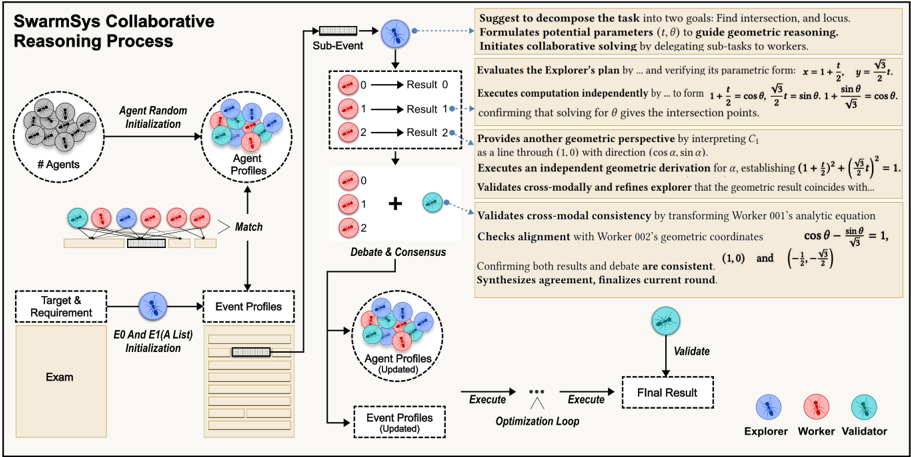
The image is a flowchart illustrating the SwarmSys Collaborative Reasoning Process. It outlines the steps involved in a multi-agent system where agents collaborate to solve a task. The process involves initialization, matching, debate, optimization, and validation, with different types of agents (Explorers, Workers, Validators) playing specific roles.
### Components/Axes
The diagram consists of the following components:
1. **Title:** "SwarmSys Collaborative Reasoning Process" (top-left)
2. **Agent Random Initialization:**
* "# Agents": A cluster of gray agents.
* "Agent Profiles": A cluster of agents with different colors (red, blue, teal).
3. **Match:** An arrow pointing from "Agent Profiles" to a matching process, where agents are aligned and compared.
4. **Target & Requirement:**
* "Exam": A box representing the initial problem or task.
* "E0 And E1(A List) Initialization": An agent (blue) initializing the event profiles.
5. **Event Profiles:** A list of event profiles.
6. **Sub-Event:** A small process box leading to a blue agent.
7. **Decomposition and Geometric Reasoning:** A series of text boxes describing the steps taken by the agents:
* "Suggest to decompose the task into two goals: Find intersection, and locus."
* "Formulates potential parameters (t, θ) to guide geometric reasoning."
* "Initiates collaborative solving by delegating sub-tasks to workers."
8. **Explorer's Plan Evaluation:** A text box describing the Explorer's role:
* "Evaluates the Explorer's plan by... and verifying its parametric form: x = 1 + t/2, y = (√3/2)t."
* "Executes computation independently by ... to form 1 + t/2 = cos θ, (√3/2)t = sin θ. 1 + (sin θ/√3) = cos θ."
* "confirming that solving for θ gives the intersection points."
9. **Debate & Consensus:**
* A series of red agents labeled 0, 1, and 2.
* A plus sign (+) combining the red agents with a blue agent.
10. **Geometric Perspective:** A text box describing the geometric interpretation:
* "Provides another geometric perspective by interpreting C₁ as a line through (1,0) with direction (cos α, sin α)."
* "Executes an independent geometric derivation for α, establishing (1 + t/2)² + ((√3/2)t)² = 1."
* "Validates cross-modally and refines explorer that the geometric result coincides with..."
11. **Cross-Modal Consistency:** A text box describing the cross-modal validation:
* "Validates cross-modal consistency by transforming Worker 001's analytic equation"
* "Checks alignment with Worker 002's geometric coordinates cos θ - (sin θ/√3) = 1,"
* "Confirming both results and debate are consistent. (1,0) and (-1/2, -√3/2)"
* "Synthesizes agreement, finalizes current round."
12. **Agent Profiles (Updated):** A cluster of agents with different colors (red, blue, teal).
13. **Event Profiles (Updated):** A list of updated event profiles.
14. **Optimization Loop:** An iterative process labeled "Optimization Loop" with "Execute" steps.
15. **Final Result:** A box representing the final outcome.
16. **Agent Roles:**
* "Explorer" (blue agent)
* "Worker" (red agent)
* "Validator" (teal agent)
### Detailed Analysis or ### Content Details
* **Agent Initialization:** The process starts with a group of agents, which are then profiled based on their characteristics.
* **Matching:** The agent profiles are matched against the target and requirements.
* **Event Profiles:** The matching process generates event profiles, which are then initialized.
* **Sub-Event Decomposition:** The task is decomposed into sub-events, and geometric reasoning is applied.
* **Explorer's Plan:** The Explorer agent evaluates a plan and verifies its parametric form.
* **Debate & Consensus:** Agents debate and reach a consensus on the solution.
* **Geometric Perspective:** Another geometric perspective is provided, and an independent geometric derivation is executed.
* **Cross-Modal Consistency:** Cross-modal consistency is validated by transforming equations and checking alignment.
* **Optimization Loop:** The process enters an optimization loop, where the solution is refined iteratively.
* **Final Result:** The final result is validated and presented.
### Key Observations
* The diagram illustrates a complex collaborative reasoning process involving multiple agents with different roles.
* The process involves both geometric reasoning and cross-modal validation.
* The optimization loop ensures that the solution is refined iteratively.
### Interpretation
The diagram depicts a sophisticated multi-agent system designed for collaborative problem-solving. The SwarmSys Collaborative Reasoning Process leverages the strengths of different agent types (Explorers, Workers, Validators) to achieve a robust and validated solution. The process emphasizes geometric reasoning, cross-modal consistency, and iterative optimization, suggesting a focus on problems that can be approached from multiple perspectives and require continuous refinement. The use of debate and consensus-building mechanisms highlights the importance of collaboration and agreement among the agents. The overall process aims to ensure that the final result is both accurate and reliable.