\n
## Diagram: SwarmSys Collaborative Reasoning Process
### Overview
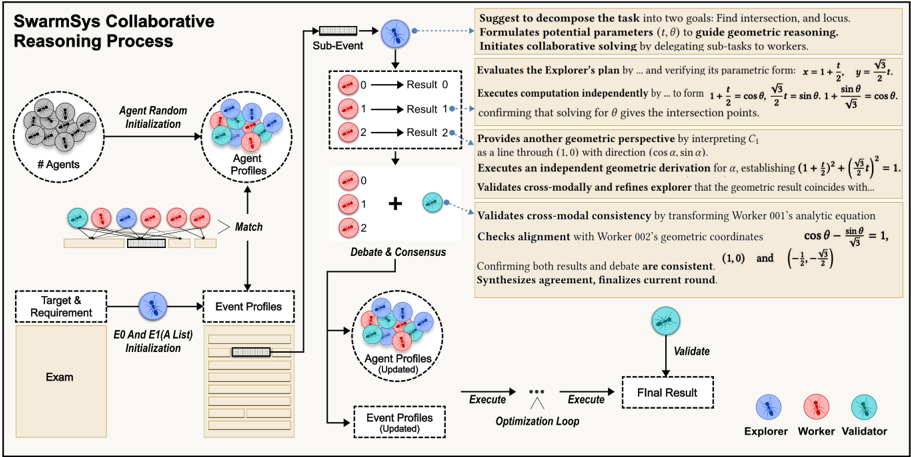
This diagram illustrates the SwarmSys collaborative reasoning process, depicting a multi-stage workflow involving agent initialization, profile matching, debate & consensus, and optimization. The process appears to be iterative, with an optimization loop refining results based on validation. The diagram is segmented into distinct phases, each with visual representations of data structures and process steps. The right side of the diagram contains a block of text detailing the mathematical reasoning involved.
### Components/Axes
The diagram is structured around four main sections:
1. **Agent Random Initialization:** Depicts a collection of circular nodes representing agents. A label "# Agents" is present.
2. **Match:** Shows agent profiles (represented by colored circles) being matched with event profiles.
3. **Debate & Consensus:** Illustrates a process of debate and consensus building, with colored circles representing different outcomes (0, 1, 2).
4. **Optimization Loop:** Depicts an iterative loop involving agent profiles, event profiles (updated), execution, and validation.
Key elements include:
* **Agent Profiles:** Represented by colored circles (red, blue, green).
* **Event Profiles:** Represented by colored circles.
* **Target & Requirement:** Represented by a circular node with a label "Exam".
* **Sub-Event:** A section with three outcomes labeled 0, 1, and 2, corresponding to "Result 0", "Result 1", and "Result 2" respectively.
* **Explorer & Worker:** Two distinct entities involved in the reasoning process.
* **Mathematical Equations:** A block of text on the right side containing geometric equations.
### Detailed Analysis or Content Details
**Agent Random Initialization:**
* A cluster of approximately 20 circular nodes representing agents.
* Label: "# Agents"
**Match:**
* Agent profiles (red, blue, green circles) are connected by lines to event profiles.
* Label: "Agent Profiles"
* Label: "Match"
* Label: "Event Profiles"
* Label: "Target & Requirement"
* Label: "E0 And E1(A List) Initialization"
* Label: "Exam"
**Debate & Consensus:**
* Three outcomes are represented by colored circles (red, blue, green) labeled 0, 1, and 2.
* Outcomes are associated with labels: "Result 0", "Result 1", "Result 2".
* Label: "Debate & Consensus"
**Optimization Loop:**
* Agent profiles and event profiles (updated) are shown within a rectangular block.
* An arrow indicates execution, leading to validation.
* Label: "Agent Profiles (Updated)"
* Label: "Event Profiles (Updated)"
* Label: "Execute"
* Label: "Validate"
* Label: "Final Result"
* Label: "Optimization Loop"
**Mathematical Reasoning (Right Side):**
The text block contains the following equations and statements:
* "Suggest to decompose the task into two goals: Find intersection, and locus."
* "Formulates potential parameters (t, θ) to guide geometric reasoning."
* "Initiates collaborative solving by delegating sub-tasks to workers."
* "Evaluates the Explorer’s plan by… and verifying its parametric form: x = 1 + (y/√3), y = 1 + sinθ/ √3"
* "Executes computation independently by… to form 1 + = cosθ, 1 + sinθ = cosθ"
* "Confirming that solving for θ gives the intersection points."
* "Provides another geometric perspective by interpreting C₁ as a line through (1, 0) with direction (cos α, sin α)."
* "Executes an independent geometric derivation for α, establishing (1 + √3)² + (√3/3)² = 1."
* "Validates cross-modally and refines explorer that the geometric result coincides with…"
* "Validates cross-modal consistency by transforming Worker 001’s analytic equation"
* "Checks alignment with Worker 002’s geometric coordinates cos θ - sin θ = 1, (1, 0) and (-1/3, -1/√3)"
* "Confirming both results and debate are consistent."
* "Synthesizes agreement, finalizes current round."
**Explorer & Worker:**
* The diagram labels "Explorer" and "Worker" as distinct entities involved in the process.
### Key Observations
* The process is highly iterative, with the optimization loop suggesting continuous refinement.
* The use of colored circles to represent agent and event profiles indicates categorization or state.
* The mathematical reasoning section highlights the geometric foundation of the problem-solving approach.
* The diagram emphasizes collaboration between an "Explorer" and "Worker" roles.
* The "Debate & Consensus" phase suggests a mechanism for resolving discrepancies or uncertainties.
### Interpretation
The diagram depicts a sophisticated reasoning system that leverages a swarm of agents to solve complex problems, likely involving geometric constraints. The process begins with random agent initialization and proceeds through profile matching, debate, and iterative optimization. The mathematical equations suggest that the system is capable of performing geometric calculations and validating results through cross-modal consistency checks. The roles of "Explorer" and "Worker" imply a division of labor, where the Explorer proposes solutions and the Worker validates them. The iterative nature of the optimization loop suggests that the system is designed to converge towards an optimal solution through continuous refinement. The "Debate & Consensus" phase is crucial for ensuring that the system reaches a consistent and reliable outcome. The diagram suggests a robust and adaptable reasoning framework capable of tackling complex tasks by combining the strengths of multiple agents and leveraging geometric principles. The use of color coding for agent and event profiles likely represents different states or characteristics, enabling the system to differentiate and process information effectively. The overall design emphasizes collaboration, validation, and iterative refinement as key principles of the SwarmSys reasoning process.