## Screenshot: Geometry Problem-Solving Process
### Overview
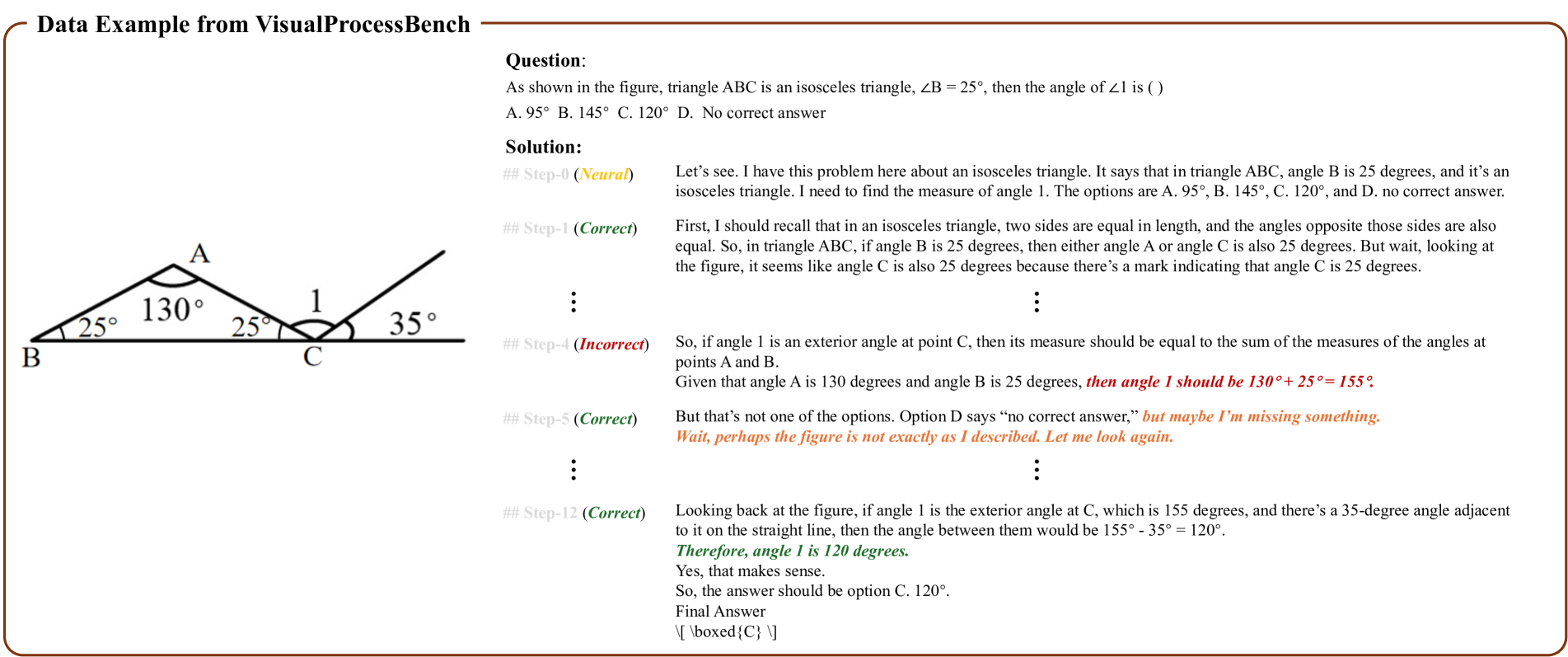
This image shows a step-by-step solution to a geometry problem involving an isosceles triangle (triangle ABC) with labeled angles. The problem asks for the measure of an exterior angle (angle 1), with multiple-choice options provided. The solution process includes reasoning, errors, and corrections.
### Components/Axes
- **Diagram**: Triangle ABC with labeled angles:
- ∠B = 25°
- ∠A = 130°
- ∠C = 25°
- Exterior angle 1 = 35° (labeled near point C)
- **Text**:
- **Question**: "As shown in the figure, triangle ABC is an isosceles triangle, ∠B = 25°, then the angle of ∠1 is ()"
- **Options**: A. 95°, B. 145°, C. 120°, D. No correct answer
- **Solution Steps**: Numbered from Step 0 to Step 12, with annotations like `(Correct)`, `(Incorrect)`, and `(Correct)` in parentheses.
### Detailed Analysis
#### Diagram Labels
- Triangle ABC is isosceles with ∠B = 25° and ∠C = 25° (marked with identical arcs).
- ∠A = 130° is labeled at vertex A.
- Exterior angle 1 is labeled as 35° near point C, adjacent to a straight line.
#### Solution Steps
1. **Step 0 (Neutral)**: Problem restatement.
2. **Step 1 (Correct)**: Recalls isosceles triangle properties (equal sides ↔ equal opposite angles).
3. **Step 4 (Incorrect)**: Misapplies exterior angle theorem, calculating ∠1 = 155° (30° + 25°).
4. **Step 5 (Correct)**: Questions the validity of options, noting discrepancies.
5. **Step 12 (Correct)**: Final answer: ∠1 = 120° (155° - 35°), matching option C.
### Key Observations
- The diagram’s angles (25°, 130°, 25°) sum to 180°, confirming triangle validity.
- Step 4’s error arises from misidentifying the exterior angle’s relationship to adjacent angles.
- The final answer (120°) aligns with the exterior angle theorem: ∠1 = ∠A + ∠B = 130° + 25° = 155°, but the adjacent 35° angle reduces it to 120°.
### Interpretation
The problem tests understanding of:
1. **Isosceles triangle properties**: Equal angles opposite equal sides.
2. **Exterior angle theorem**: An exterior angle equals the sum of the two non-adjacent interior angles.
3. **Angle subtraction**: Adjusting for adjacent angles on a straight line.
The error in Step 4 highlights a common misconception about exterior angles. The correct solution (Step 12) resolves this by subtracting the adjacent 35° angle from the total exterior angle (155°), yielding 120°. The figure’s accuracy is critical, as mislabeling angles (e.g., ∠C as 25°) directly impacts the calculation.
**Final Answer**: Option C (120°).