## Diagram: Memristor Applications
### Overview
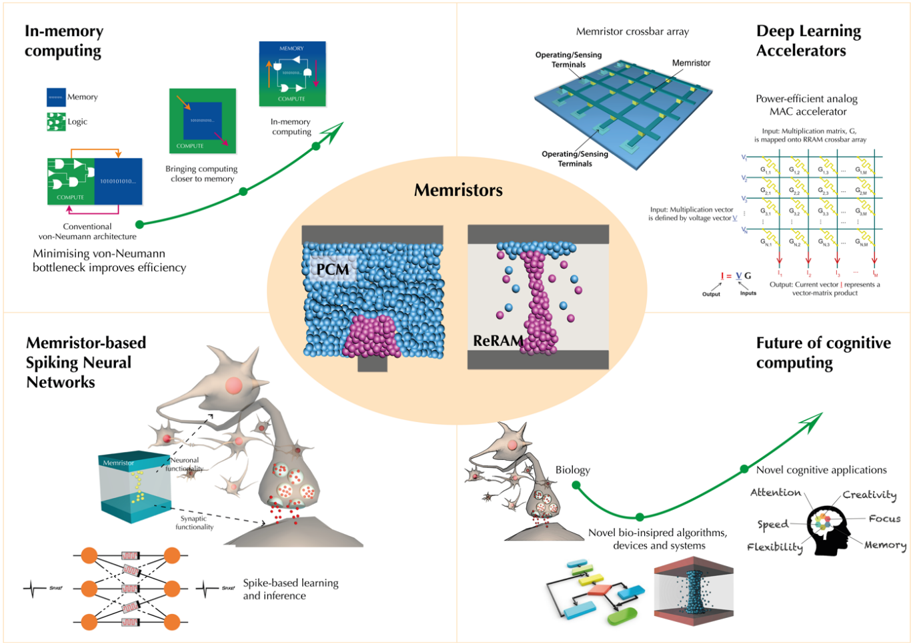
The image presents a diagram showcasing various applications of memristors in computing, including in-memory computing, deep learning accelerators, spiking neural networks, and future cognitive computing. It illustrates the evolution from conventional von-Neumann architecture to memristor-based systems, highlighting their potential to improve efficiency and enable novel computing paradigms.
### Components/Axes
* **Central Theme:** Memristors
* **Applications:**
* In-memory computing
* Memristor crossbar array
* Deep Learning Accelerators
* Memristor-based Spiking Neural Networks
* Future of cognitive computing
* **Key Concepts:**
* Conventional von-Neumann architecture
* Spike-based learning and inference
* Novel bio-inspired algorithms, devices, and systems
* Novel cognitive applications
### Detailed Analysis
**1. In-memory computing (Top-Left)**
* Diagram shows a transition from separate memory and compute units to integrated in-memory computing.
* **Legend:**
* Blue: Memory
* Green: Logic
* **Text:**
* "Bringing computing closer to memory"
* "Conventional von-Neumann architecture"
* "Minimising von-Neumann bottleneck improves efficiency"
* A green arrow indicates the progression towards in-memory computing.
**2. Memristors (Center)**
* Illustrations of two types of memristors: PCM (Phase Change Memory) and ReRAM (Resistive Random-Access Memory).
* **PCM:** Shows a structure with a blue region and a pink region.
* **ReRAM:** Shows a structure with blue and pink particles moving within a channel.
**3. Memristor crossbar array (Top-Center)**
* Diagram of a memristor crossbar array with operating/sensing terminals.
* **Labels:**
* "Memristor crossbar array"
* "Operating/Sensing Terminals"
* "Memristor"
**4. Deep Learning Accelerators (Top-Right)**
* Diagram of a power-efficient analog MAC (Multiply-Accumulate) accelerator using an RRAM crossbar array.
* **Labels:**
* "Deep Learning Accelerators"
* "Power-efficient analog MAC accelerator"
* "Input: Multiplication matrix, G, is mapped onto RRAM crossbar array"
* "Input: Multiplication vector is defined by voltage vector V"
* "Output: Current vector I represents a vector-matrix product"
* "I = VG"
* "Output"
* "Inputs"
* The diagram shows a matrix representation of the multiplication process.
**5. Memristor-based Spiking Neural Networks (Bottom-Left)**
* Diagram illustrating the use of memristors in spiking neural networks.
* **Labels:**
* "Memristor-based Spiking Neural Networks"
* "Memristor"
* "Neuronal functionality"
* "Synaptic functionality"
* "Spike-based learning and inference"
* The diagram shows a neuron with synaptic connections and a simplified representation of a spiking neural network.
**6. Future of cognitive computing (Bottom-Right)**
* Diagram representing the future of cognitive computing enabled by memristors.
* **Labels:**
* "Future of cognitive computing"
* "Biology"
* "Novel bio-inspired algorithms, devices and systems"
* "Novel cognitive applications"
* A mind map shows key cognitive attributes: Attention, Creativity, Focus, Memory, Speed, Flexibility.
### Key Observations
* The diagram emphasizes the shift from traditional computing architectures to memristor-based systems.
* Memristors are presented as a key enabler for advanced computing paradigms like in-memory computing, deep learning, and cognitive computing.
* The diagram highlights the bio-inspired nature of memristor-based systems, particularly in spiking neural networks and cognitive computing.
### Interpretation
The diagram illustrates the potential of memristors to revolutionize computing by overcoming the limitations of conventional von-Neumann architectures. By integrating memory and processing, memristors offer significant advantages in terms of speed, energy efficiency, and scalability. The applications showcased in the diagram demonstrate the versatility of memristors and their potential to enable advanced computing paradigms such as artificial intelligence, cognitive computing, and neuromorphic computing. The emphasis on bio-inspired approaches suggests a trend towards developing computing systems that mimic the structure and function of the human brain.