## Diagram: Memristor-Based Computing Landscape
### Overview
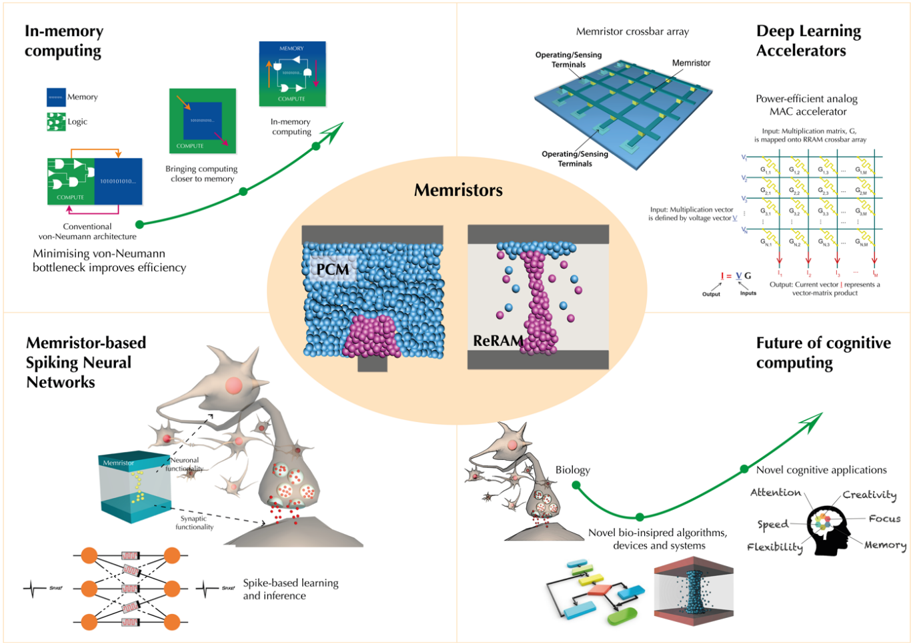
This diagram illustrates the landscape of memristor-based computing, showcasing its various applications and underlying principles. It highlights the shift from conventional von Neumann architecture to in-memory computing, the role of memristors in deep learning acceleration and spiking neural networks, and the potential for future cognitive computing. The diagram is organized around a central depiction of memristors, with radiating sections detailing different aspects of the technology.
### Components/Axes
The diagram is divided into several key sections:
* **In-memory computing:** Illustrates the integration of memory and computation.
* **Memristors:** Central focus, depicting different types (PCM, ReRAM).
* **Deep Learning Accelerators:** Shows a memristor crossbar array and its function in a MAC accelerator.
* **Memristor-based Spiking Neural Networks:** Depicts memristors mimicking synaptic functionality within a neural network.
* **Future of cognitive computing:** Illustrates the potential applications in cognitive abilities.
There are no explicit axes in the traditional sense, but the diagram uses spatial arrangement to convey relationships between components.
### Detailed Analysis or Content Details
**1. In-memory computing (Top-Left):**
* Depicts a transition from separate "Memory" and "Logic" blocks to an integrated "In-memory" block.
* Text: "Bringing computing closer to memory".
* Text: "Conventional von-Neumann architecture Minimising von-Neumann bottleneck improves efficiency".
**2. Memristors (Center):**
* Visual representation of different memristor types:
* **PCM (Phase Change Memory):** Depicted as a layered structure with red and blue spheres.
* **ReRAM (Resistive Random Access Memory):** Depicted as a layered structure with blue and red spheres.
* Label: "Memristors" is prominently displayed over the central image.
**3. Deep Learning Accelerators (Top-Right):**
* **Memristor crossbar array:** A grid of memristors with "Operating/Sensing Terminals" labeled.
* **Power-efficient analog MAC accelerator:** Illustrates the use of memristors in a matrix-vector multiplication.
* Equation: "I = VG" (Output current is proportional to input voltage).
* Text: "Input Multiplication matrix C is mapped onto ReRAM crossbar array".
* Text: "Input Multiplication vector is defined by voltage vector V".
* Text: "Output: current I represents a vector-matrix product".
**4. Memristor-based Spiking Neural Networks (Bottom-Left):**
* Depiction of a neural network with memristors acting as synapses.
* Text: "Memristor functionality".
* Text: "Synaptic functionality".
* Diagram of spiking neurons with input and output signals.
* Text: "Spike-based learning and inference".
**5. Future of cognitive computing (Bottom-Right):**
* Illustration of a human brain silhouette with various cognitive attributes highlighted.
* Attributes: "Attention", "Creativity", "Speed", "Focus", "Flexibility", "Memory".
* Text: "Novel cognitive applications".
* Depiction of bio-inspired algorithms, devices, and systems.
* Text: "Novel bio-inspired algorithms, devices and systems".
* Image of a circuit board with various components.
* Text: "Biology".
### Key Observations
* The diagram emphasizes the potential of memristors to overcome the limitations of the von Neumann architecture.
* The central placement of memristors highlights their crucial role in various computing paradigms.
* The diagram showcases a wide range of applications, from deep learning acceleration to cognitive computing.
* The use of visual representations of memristor structures (PCM, ReRAM) provides insight into their physical characteristics.
* The equation "I = VG" suggests a simple linear relationship between input voltage and output current in the MAC accelerator.
### Interpretation
The diagram presents a compelling vision of the future of computing, where memristors play a central role in enabling more efficient and intelligent systems. The shift from conventional von Neumann architecture to in-memory computing is presented as a key enabler for overcoming the limitations of traditional computing. The diagram suggests that memristors can be used to accelerate deep learning algorithms, mimic the functionality of biological neurons, and ultimately create systems with human-like cognitive abilities. The inclusion of "Biology" in the bottom section suggests that the design of these systems is inspired by the natural world. The diagram is a high-level overview and does not delve into the specific challenges and complexities of implementing these technologies. The diagram is a promotional piece, and as such, it presents a very optimistic view of the technology.