## Diagram: Memristor-Based Computing Architectures and Applications
### Overview
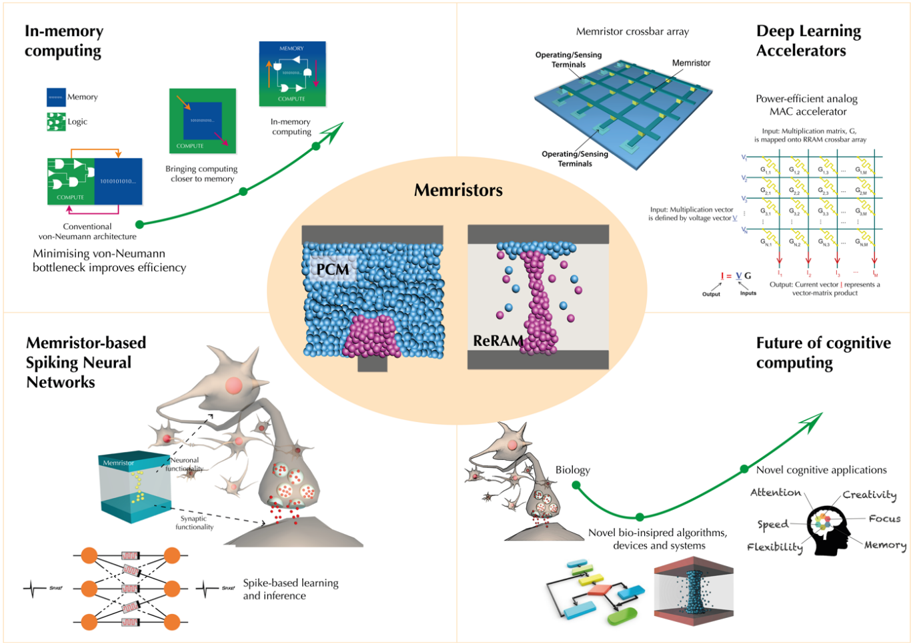
The image presents a conceptual framework for memristor-based computing technologies, divided into four quadrants surrounding a central oval labeled "Memristors." Each quadrant explores a distinct application or architectural approach, emphasizing efficiency improvements, neural network implementations, and future cognitive computing paradigms.
---
### Components/Axes
1. **Central Oval (Memristors)**
- Contains two material diagrams:
- **PCM (Phase-Change Memory)**: Blue spheres with a pink core.
- **ReRAM (Resistive RAM)**: Pink spheres with a blue core.
- Text: "Memristors" (bold black font).
2. **Quadrant Labels**
- **Top-Left**: "In-memory computing"
- **Top-Right**: "Memristor crossbar array" and "Deep Learning Accelerators"
- **Bottom-Left**: "Memristor-based Spiking Neural Networks"
- **Bottom-Right**: "Future of cognitive computing"
3. **Diagram Elements**
- **Top-Left**:
- Conventional von-Neumann architecture (green box with "COMPUTE" and "MEMORY" labels).
- Arrows indicate data flow: "Bringing computing closer to memory."
- Text: "Minimising von-Neumann bottleneck improves efficiency."
- **Top-Right**:
- Memristor crossbar array (grid of green lines with yellow nodes labeled "Memristor").
- "Operating/Sensing Terminals" labeled on grid edges.
- Equations for analog MAC accelerator:
- Input: Multiplication matrix **G** mapped to RRAM crossbar.
- Output: Current vector **I** = **Y·G** (vector-matrix product).
- **Bottom-Left**:
- Neuron-like structure with dendritic spines (pink/red dots) and synaptic terminals.
- Text: "Spike-based learning and inference."
- **Bottom-Right**:
- Brain silhouette with labeled cognitive traits: "Attention," "Creativity," "Speed," "Focus," "Flexibility," "Memory."
- Green arrow pointing to "Novel bio-inspired algorithms, devices and systems."
---
### Detailed Analysis
1. **Top-Left (In-memory computing)**
- Conventional architecture shows separation between memory (blue) and logic (green).
- Memristor integration reduces data movement, improving efficiency.
2. **Top-Right (Memristor crossbar array)**
- Grid structure represents crossbar arrays with memristors at intersections.
- Analog MAC accelerator equations suggest parallel computation capabilities.
3. **Bottom-Left (Spiking Neural Networks)**
- Neuron model includes dendritic spines (pink/red) and synaptic terminals.
- Memristor array acts as synaptic weights for spike-based learning.
4. **Bottom-Right (Future cognitive computing)**
- Brain silhouette emphasizes human-like cognitive traits.
- Green arrow links memristors to bio-inspired systems.
---
### Key Observations
- **Color Coding**:
- Blue (PCM), Pink (ReRAM), Green (crossbar arrays), Orange (neurons).
- **Efficiency Focus**: All quadrants emphasize reducing energy consumption (e.g., "power-efficient analog MAC accelerator").
- **Biological Inspiration**: Spiking neural networks and brain-like cognitive traits suggest neuromorphic computing goals.
---
### Interpretation
The diagram illustrates memristors as a foundational technology for next-generation computing systems. By integrating memory and logic (top-left), enabling analog crossbar arrays (top-right), and mimicking biological neural processes (bottom-left), memristors address von-Neumann bottlenecks and enable energy-efficient AI. The bottom-right quadrant ties these advancements to broader cognitive applications, suggesting memristors could underpin systems with human-like adaptability and creativity. The emphasis on "novel bio-inspired algorithms" implies a shift toward neuromorphic computing paradigms that prioritize parallelism and low-power operation.