## Screenshot: Multi-Panel Q&A Interface with Image Analysis
### Overview
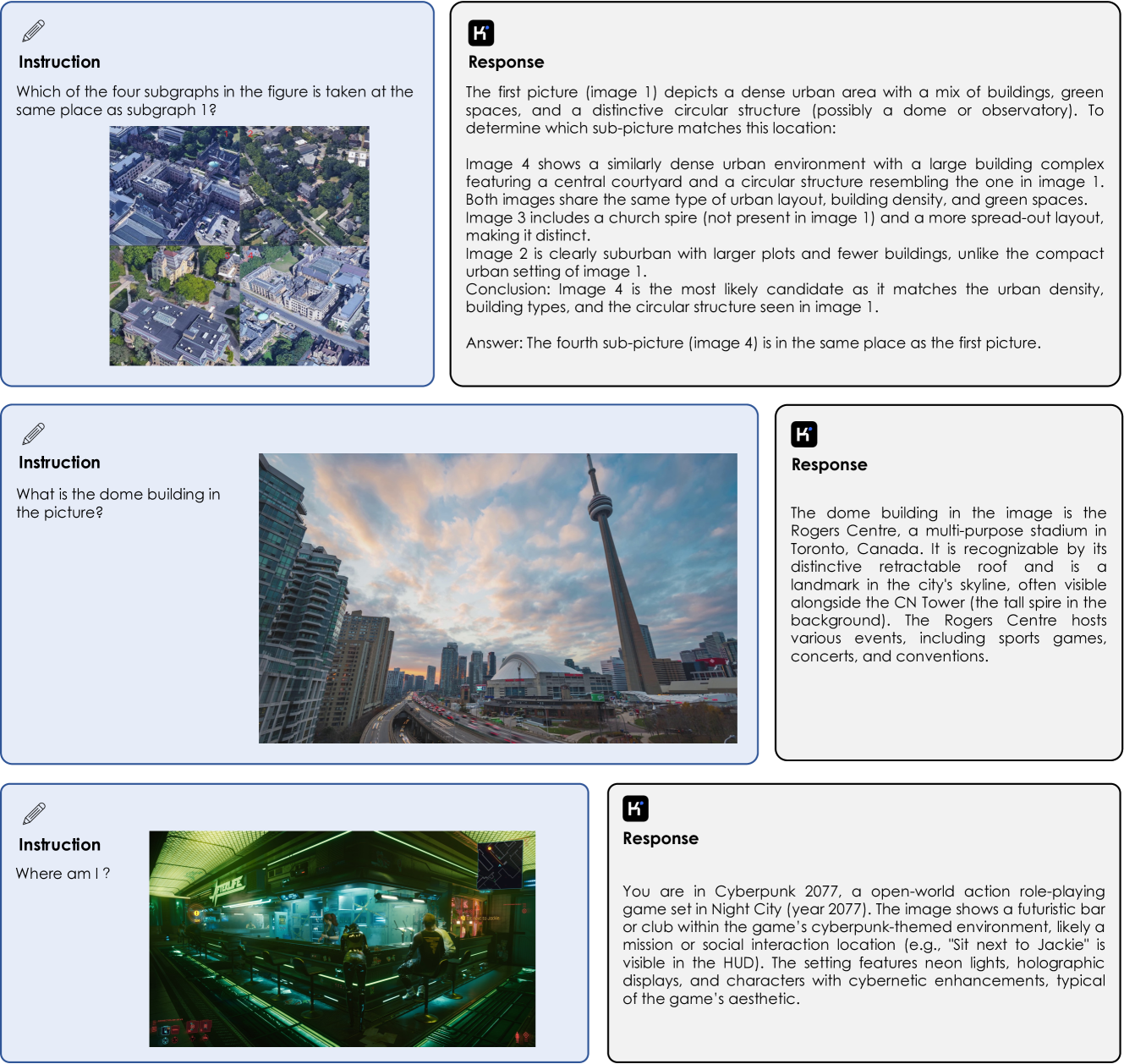
The image displays a structured interface with three distinct panels, each containing an instruction, a visual element (image or diagram), and a corresponding response. The layout suggests a question-answering system that analyzes visual content to provide contextual explanations.
### Components/Axes
1. **Panel 1 (Top-Left)**
- **Instruction**: "Which of the four subgraphs in the figure is taken at the same place as subgraph 1?"
- **Visual**: A 2x2 grid of aerial photographs showing urban landscapes with varying densities of buildings, green spaces, and architectural features.
- **Response**:
- Analyzes urban density, building types, and circular structures (e.g., domes, spires).
- Concludes that **Image 4** matches the urban density, building types, and circular structure of Image 1.
2. **Panel 2 (Center)**
- **Instruction**: "What is the dome building in the picture?"
- **Visual**: A cityscape featuring a tall, slender tower (CN Tower) and a large dome-shaped structure (Rogers Centre) in Toronto, Canada.
- **Response**:
- Identifies the dome as the **Rogers Centre**, a multi-purpose stadium with a retractable roof.
- Notes its proximity to the CN Tower and its role in hosting sports events and conventions.
3. **Panel 3 (Bottom-Left)**
- **Instruction**: "Where am I?"
- **Visual**: A futuristic, neon-lit bar interior with holographic displays and cybernetic enhancements, resembling a scene from a video game.
- **Response**:
- Identifies the setting as **Night City** from *Cyberpunk 2077* (2077), a cyberpunk-themed environment with neon lighting and cybernetic characters.
- Mentions mission/social interaction cues (e.g., "Sit next to Jackie").
### Content Details
- **Panel 1**:
- Image 1: Dense urban area with a circular structure (possibly a dome/observatory).
- Image 2: Suburban layout with large plots and fewer buildings.
- Image 3: Urban layout with a church spire and spread-out design.
- Image 4: Matches Image 1’s density, building types, and circular structure.
- **Panel 2**:
- Rogers Centre: Landmark in Toronto, recognizable by its retractable roof and proximity to the CN Tower.
- **Panel 3**:
- Cyberpunk 2077: Open-world RPG game set in a dystopian future (2077).
- Key features: Neon lights, holographic displays, cybernetic enhancements.
### Key Observations
1. **Panel 1**: The response correctly identifies Image 4 as the match for Image 1 based on shared urban density and architectural features.
2. **Panel 2**: The Rogers Centre is accurately described, including its functional and geographical context.
3. **Panel 3**: The response aligns with the visual cues (neon, cybernetics) and contextual clues (game-specific references).
### Interpretation
The interface demonstrates a system capable of analyzing visual content to infer location, architectural identity, and contextual narratives. The responses rely on:
- **Spatial Analysis**: Comparing urban density, building types, and structural features (e.g., circular vs. spire).
- **Cultural/Geographical Knowledge**: Recognizing landmarks like the Rogers Centre and CN Tower.
- **Pop Culture References**: Linking the cyberpunk aesthetic to *Cyberpunk 2077*.
The system’s accuracy suggests robust image recognition and contextual reasoning capabilities, though it lacks explicit uncertainty quantification (e.g., confidence scores for matches). The absence of numerical data or interactive elements implies a focus on descriptive analysis rather than quantitative modeling.