## Diagram: τ-Bench Continuous Improvement Cycle
### Overview
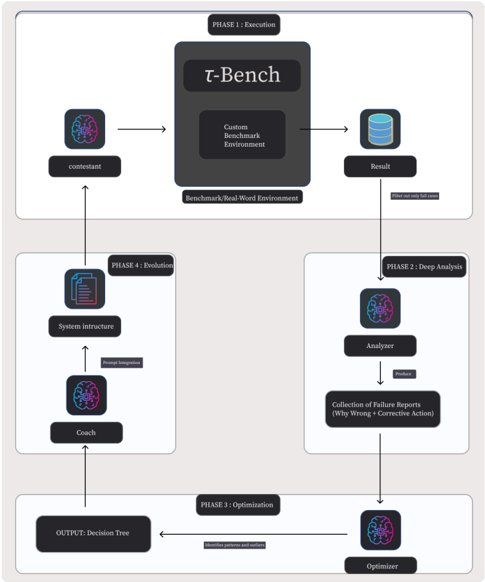
This diagram illustrates a four-phase cyclical process for the continuous improvement of a system, likely an AI or machine learning model, using a benchmarking tool called "τ-Bench". The process involves execution, deep analysis of failures, optimization based on identified patterns, and evolution of the system's instructions.
### Components and Phases
The diagram is structured into four distinct phases, each contained within a labeled block. Arrows indicate the flow of information and control between components and phases.
**PHASE 1: Execution**
* **Components:**
* **contestant:** Represented by a brain icon with a circuit pattern. This is the system being tested.
* **τ-Bench:** A central block containing "Custom Benchmark Environment". It is labeled below as "Benchmark/Real-Word Environment".
* **Result:** Represented by a database cylinder icon.
* **Flow:** The "contestant" is input into the "τ-Bench" environment. The output of this execution is stored in the "Result".
**PHASE 2: Deep Analysis**
* **Components:**
* **Analyzer:** Represented by a brain icon.
* **Collection of Failure Reports (Why Wrong + Corrective Action):** A text block representing the output of the analysis.
* **Flow:** Data from the "Result" block in Phase 1 is fed into the "Analyzer". An arrow labeled "Filter out only fail cases" indicates that only unsuccessful executions are analyzed. The "Analyzer" then produces the "Collection of Failure Reports", as indicated by an arrow labeled "Produce".
**PHASE 3: Optimization**
* **Components:**
* **Optimizer:** Represented by a brain icon.
* **OUTPUT: Decision Tree:** A text block representing the final output of this phase.
* **Flow:** The "Collection of Failure Reports" from Phase 2 is input into the "Optimizer". The "Optimizer" processes these reports, with an arrow labeled "Identifies patterns and outliers" pointing to the "OUTPUT: Decision Tree".
**PHASE 4: Evolution**
* **Components:**
* **Coach:** Represented by a brain icon.
* **System Intructure:** Represented by a document icon with a gear.
* **Flow:** The "OUTPUT: Decision Tree" from Phase 3 is used by the "Coach". The "Coach" then updates the "System Intructure", indicated by an arrow labeled "Prompt Integration". Finally, the updated "System Intructure" is fed back into the "contestant" component in Phase 1, completing the cycle.
### Detailed Analysis of the Flow
The process begins in **PHASE 1 (Execution)**, where a "contestant" (presumably an AI model or agent) is run within the "τ-Bench" custom benchmark environment. The outcomes of these runs are collected in the "Result" database.
The flow moves to **PHASE 2 (Deep Analysis)**. The system filters the "Result" data to isolate only the failure cases. These failures are then passed to an "Analyzer" component, which generates a "Collection of Failure Reports". These reports detail *why* the failures occurred and suggest potential *corrective actions*.
Next, in **PHASE 3 (Optimization)**, the "Collection of Failure Reports" is processed by an "Optimizer". This component identifies underlying patterns and outliers in the failures and synthesizes this information into an "OUTPUT: Decision Tree". This decision tree likely encodes rules or logic to avoid similar failures in the future.
Finally, in **PHASE 4 (Evolution)**, the "OUTPUT: Decision Tree" is used by a "Coach" component. The "Coach" integrates these new insights into the "System Intructure" (likely the prompts, rules, or configuration governing the contestant). This updated "System Intructure" is then used to improve the "contestant" for the next round of execution in Phase 1, thus closing the loop and enabling continuous improvement.
### Key Observations
* **Cyclical Nature:** The entire process is a closed loop, indicating a continuous, iterative approach to system improvement.
* **Focus on Failures:** The analysis and optimization phases specifically target failure cases ("Filter out only fail cases"), emphasizing learning from mistakes.
* **Automated Improvement:** The use of components like "Analyzer," "Optimizer," and "Coach" suggests a high degree of automation in the improvement process, moving from raw results to actionable system updates.
* **Decision Tree Output:** The optimization phase produces a "Decision Tree," which is a structured and interpretable way to represent the learned logic for avoiding future failures.
### Interpretation
The diagram outlines a sophisticated, automated feedback loop for improving an AI system using the τ-Bench benchmarking tool. By systematically executing the system, isolating failures, analyzing root causes, identifying patterns, and updating the system's instructions (prompts), the process aims to progressively enhance the "contestant's" performance in the benchmark environment. This approach aligns with principles of iterative development and reinforcement learning, where systems learn and adapt based on their performance and errors.