## Flowchart: Iterative Performance Evaluation and Optimization System
### Overview
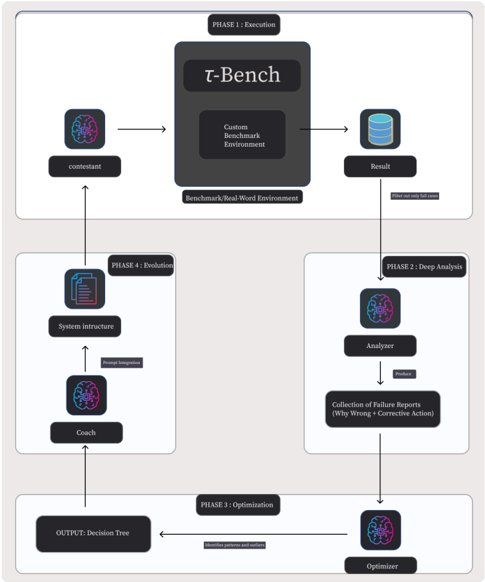
The flowchart depicts a cyclical process for evaluating, analyzing, and optimizing performance in a benchmark environment. It consists of four interconnected phases: Execution, Evolution, Analysis, and Optimization. The system integrates AI components (contestant, coach, analyzer, optimizer) with a custom benchmark environment (τ-Bench) to iteratively refine decision-making capabilities.
### Components/Axes
1. **Phases**:
- **Phase 1: Execution** (Top)
- **Phase 4: Evolution** (Left)
- **Phase 2: Deep Analysis** (Right)
- **Phase 3: Optimization** (Bottom)
2. **Key Elements**:
- **τ-Bench**: Central benchmark/real-world environment
- **Contestant**: AI agent undergoing evaluation
- **Analyzer**: Processes failure reports
- **Optimizer**: Generates decision trees
- **Coach**: Integrates system intructure and prompts
- **System Intructure**: Technical framework for prompt integration
3. **Flow Direction**:
- Solid arrows indicate primary workflow
- Dashed arrows represent feedback loops
- Bidirectional connections between phases
### Detailed Analysis
1. **Phase 1: Execution**
- Contestant interacts with τ-Bench (custom benchmark environment)
- Outputs results stored in a database
- Filtering mechanism selects only "fail cases" for further analysis
2. **Phase 2: Deep Analysis**
- Analyzer processes failure reports
- Extracts "Why Wrong" diagnostics and corrective actions
- Produces structured failure data for optimization
3. **Phase 3: Optimization**
- Optimizer uses failure data to build decision trees
- Identifies patterns and outliers in performance
- Outputs refined decision-making frameworks
4. **Phase 4: Evolution**
- Coach integrates system intructure with prompt engineering
- Receives optimized decision trees from Phase 3
- Feeds improved strategies back to contestant via τ-Bench
### Key Observations
1. **Cyclical Nature**: The system forms a closed-loop process with continuous feedback between phases
2. **Failure-Driven Improvement**: Only failed cases from Phase 1 trigger deeper analysis
3. **Multi-Stage Refinement**: Each phase builds on previous outputs (results → analysis → optimization → evolution)
4. **Human-AI Collaboration**: The Coach component bridges technical systems with strategic prompt engineering
5. **Modular Architecture**: Components operate independently but interconnect through defined interfaces
### Interpretation
This flowchart represents an advanced AI training pipeline that combines:
- **Controlled Testing**: τ-Bench provides a standardized evaluation environment
- **Failure Analysis**: Systematic diagnosis of errors through the Analyzer
- **Adaptive Learning**: Optimizer creates decision trees to address identified weaknesses
- **Strategic Integration**: Coach component ensures human-guided prompt engineering enhances AI capabilities
The system emphasizes iterative improvement through:
1. **Data-Driven Refinement**: Each phase processes outputs from the previous stage
2. **Failure-Centric Learning**: Focus on error cases drives continuous improvement
3. **Human-AI Synergy**: The Coach component maintains strategic oversight while leveraging automated optimization
Notable design choices include:
- Bidirectional arrows between phases suggesting dynamic adjustment capabilities
- Database symbol indicating persistent storage of results and failure data
- Explicit separation of analytical and optimization functions for specialized processing
This architecture demonstrates a sophisticated approach to AI development that balances automated optimization with human strategic guidance, creating a robust framework for developing adaptive, high-performance AI systems.