## Screenshot: Sentence Credibility Analysis Interface
### Overview
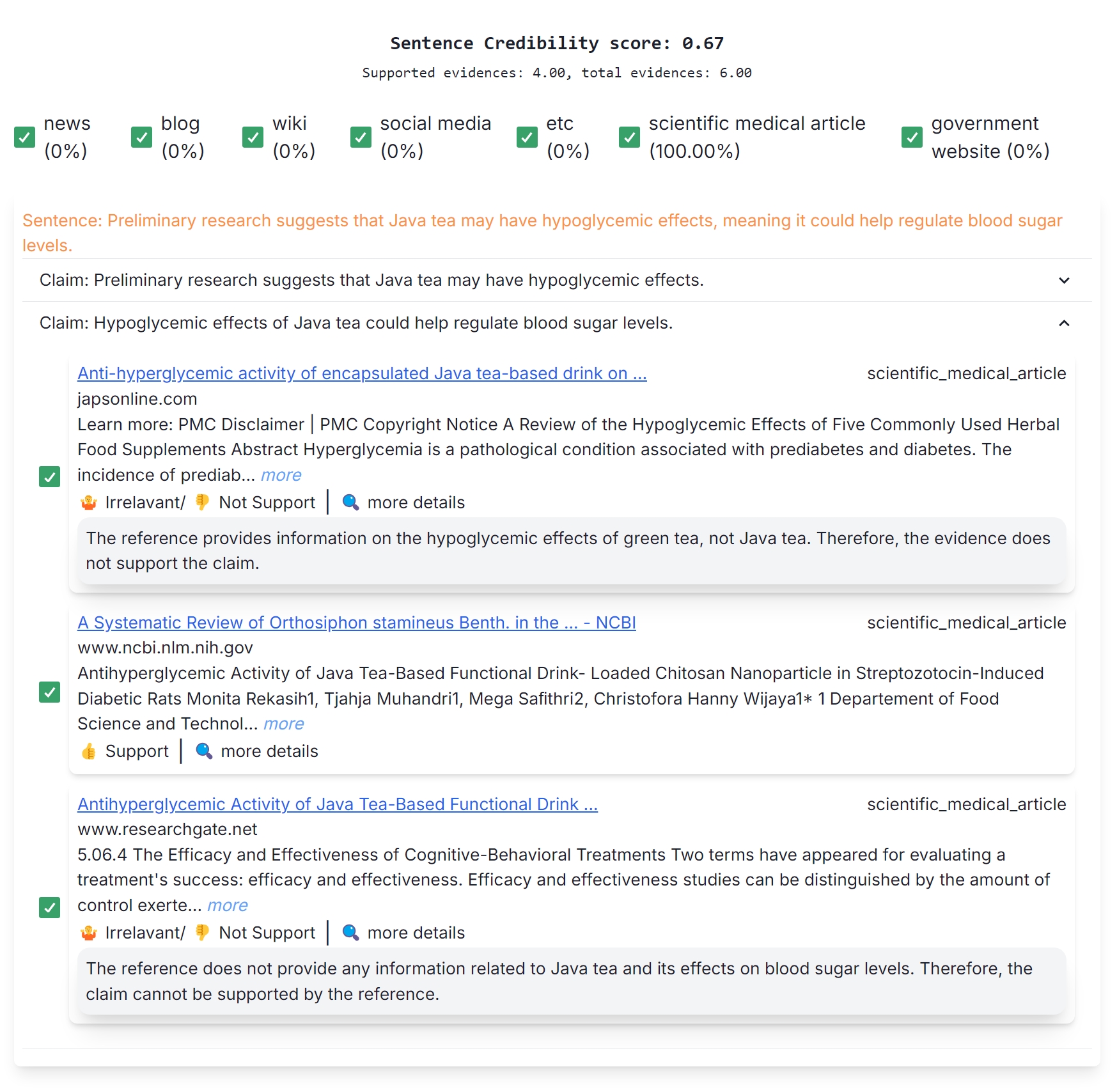
The image displays a web interface for a credibility analysis tool. It evaluates a specific sentence about the hypoglycemic effects of Java tea, providing a credibility score, a breakdown of supporting evidence by source type, and detailed entries for individual evidence sources with verdicts on their relevance to the claim.
### Components/Axes
The interface is structured vertically with the following key components:
1. **Header Section:** Contains the overall credibility score and evidence summary.
2. **Source Type Legend:** A horizontal row of checkboxes with labels and percentages.
3. **Analyzed Sentence & Claims:** The original sentence and its decomposed claims.
4. **Evidence List:** A series of expandable cards for each evidence source, containing titles, URLs, text snippets, and verdicts.
### Detailed Analysis
**1. Header Section (Top of Image):**
* **Title:** `Sentence Credibility score: 0.67`
* **Subtitle:** `Supported evidences: 4.00, total evidences: 6.00`
**2. Source Type Legend (Below Header):**
A row of seven source types, each with a green checkmark icon, a label, and a percentage in parentheses. All percentages are 0% except one.
* `news (0%)`
* `blog (0%)`
* `wiki (0%)`
* `social media (0%)`
* `etc (0%)`
* `scientific medical article (100.00%)`
* `government website (0%)`
**3. Analyzed Sentence & Claims:**
* **Sentence (in orange text):** `Preliminary research suggests that Java tea may have hypoglycemic effects, meaning it could help regulate blood sugar levels.`
* **Claim 1 (collapsed):** `Claim: Preliminary research suggests that Java tea may have hypoglycemic effects.`
* **Claim 2 (expanded):** `Claim: Hypoglycemic effects of Java tea could help regulate blood sugar levels.`
**4. Evidence List (for Claim 2):**
Three evidence cards are visible, all categorized as `scientific_medical_article`.
* **Evidence Card 1:**
* **Title (Hyperlink):** `Anti-hyperglycemic activity of encapsulated Java tea-based drink on ...`
* **Source:** `japsonline.com`
* **Snippet:** `Learn more: PMC Disclaimer | PMC Copyright Notice A Review of the Hypoglycemic Effects of Five Commonly Used Herbal Food Supplements Abstract Hyperglycemia is a pathological condition associated with prediabetes and diabetes. The incidence of prediab... more`
* **Verdict:** `🦆 Irrelavant/ 👎 Not Support | 🔍 more details`
* **Analysis Note:** `The reference provides information on the hypoglycemic effects of green tea, not Java tea. Therefore, the evidence does not support the claim.`
* **Evidence Card 2:**
* **Title (Hyperlink):** `A Systematic Review of Orthosiphon stamineus Benth. in the ... - NCBI`
* **Source:** `www.ncbi.nlm.nih.gov`
* **Snippet:** `Antihyperglycemic Activity of Java Tea-Based Functional Drink- Loaded Chitosan Nanoparticle in Streptozotocin-Induced Diabetic Rats Monita Rekasih1, Tjahja Muhandri1, Mega Safithri2, Christofora Hanny Wijaya1* 1 Departement of Food Science and Technol... more`
* **Verdict:** `👍 Support | 🔍 more details`
* **Evidence Card 3:**
* **Title (Hyperlink):** `Antihyperglycemic Activity of Java Tea-Based Functional Drink ...`
* **Source:** `www.researchgate.net`
* **Snippet:** `5.06.4 The Efficacy and Effectiveness of Cognitive-Behavioral Treatments Two terms have appeared for evaluating a treatment's success: efficacy and effectiveness. Efficacy and effectiveness studies can be distinguished by the amount of control exerte... more`
* **Verdict:** `🦆 Irrelavant/ 👎 Not Support | 🔍 more details`
* **Analysis Note:** `The reference does not provide any information related to Java tea and its effects on blood sugar levels. Therefore, the claim cannot be supported by the reference.`
### Key Observations
1. **Source Concentration:** 100% of the evidence considered (6 total, 4 supporting) comes from the `scientific medical article` category. All other source types (news, blog, etc.) have 0% representation.
2. **Mixed Evidence Support:** Of the three visible evidence entries for the second claim, only one (from NCBI) is marked as `Support`. The other two are marked as `Irrelavant/ Not Support`.
3. **Evidence Relevance Issues:** The analysis notes for two of the three evidence cards explicitly state they are irrelevant—one discusses green tea instead of Java tea, and the other appears to be about cognitive-behavioral treatments, not blood sugar.
4. **Credibility Score:** The overall score is 0.67, derived from 4 supported evidences out of 6 total. This suggests a moderate level of support, but the score is heavily reliant on the unseen 3 additional evidence entries.
### Interpretation
This interface demonstrates a fact-checking or claim verification system focused on scientific literature. The analysis of the claim "Hypoglycemic effects of Java tea could help regulate blood sugar levels" reveals a nuanced picture.
* **What the data suggests:** There is some scientific literature directly supporting the hypoglycemic activity of Java tea-based products (as seen in the NCBI study). However, the system also flags significant noise in the evidence pool, where search results may be tangentially related (e.g., discussing herbal supplements generally or other treatments) but do not substantiate the specific claim about Java tea.
* **How elements relate:** The credibility score (0.67) is a quantitative summary, but the qualitative evidence list is crucial for interpretation. The high percentage of "scientific medical article" sources lends authority, but the individual verdicts show that not all scientific articles are relevant or supportive. The system performs a secondary layer of analysis beyond simple source categorization.
* **Notable implications:** The tool highlights a common challenge in automated fact-checking: retrieving sources that are topically related but semantically irrelevant. The user must look beyond the aggregate score to the specific evidence and its relevance verdicts to make an informed judgment. The claim appears to have a basis in specific research but is not universally supported by all literature returned by a search.