## Line Graph: Average Iterations vs. Sample Complexity (k)
### Overview
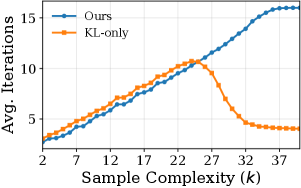
The image is a line graph comparing the performance of two methods ("Ours" and "KL-only") across varying sample complexities (k). The x-axis represents sample complexity (k), ranging from 2 to 37, while the y-axis represents average iterations, scaled from 0 to 15. Two data series are plotted: a blue line labeled "Ours" and an orange line labeled "KL-only".
### Components/Axes
- **X-axis (Sample Complexity, k)**:
- Labels: "Sample Complexity (k)".
- Ticks: 2, 7, 12, 17, 22, 27, 32, 37.
- Scale: Linear increments of 5.
- **Y-axis (Average Iterations)**:
- Labels: "Avg. Iterations".
- Ticks: 0, 5, 10, 15.
- Scale: Linear increments of 5.
- **Legend**:
- Position: Top-right corner.
- Entries:
- Blue line: "Ours".
- Orange line: "KL-only".
### Detailed Analysis
- **Blue Line ("Ours")**:
- Starts at approximately (2, 2) and increases steadily.
- At k=37, reaches ~15 iterations.
- Slope: Consistent upward trend with no plateaus or declines.
- **Orange Line ("KL-only")**:
- Starts similarly to "Ours" but peaks at ~10 iterations around k=22.
- Declines sharply after k=22, reaching ~4 iterations by k=37.
- Notable inflection point: k=22 (peak) followed by a steep drop.
### Key Observations
1. **Divergence at k=22**: The "KL-only" method peaks at k=22 (~10 iterations) and then declines, while "Ours" continues to rise.
2. **Performance Gap**: By k=37, "Ours" achieves ~15 iterations, whereas "KL-only" drops to ~4 iterations.
3. **Initial Similarity**: Both methods start with nearly identical performance at low k values (e.g., k=2–7).
### Interpretation
The data suggests that the "Ours" method scales more effectively with increasing sample complexity compared to "KL-only". The "KL-only" method exhibits a performance ceiling, peaking at moderate k values before degrading, potentially due to overfitting or inefficiency at higher complexities. In contrast, "Ours" maintains a linear improvement, indicating robustness or adaptive optimization. This divergence highlights a critical threshold (k≈22) where "KL-only" becomes less viable, while "Ours" remains consistently effective. The results imply that "Ours" may be preferable for high-complexity scenarios, whereas "KL-only" might suffice for simpler tasks but fails to generalize.