\n
## Line Chart: Percentage of Errors with C Over Epochs
### Overview
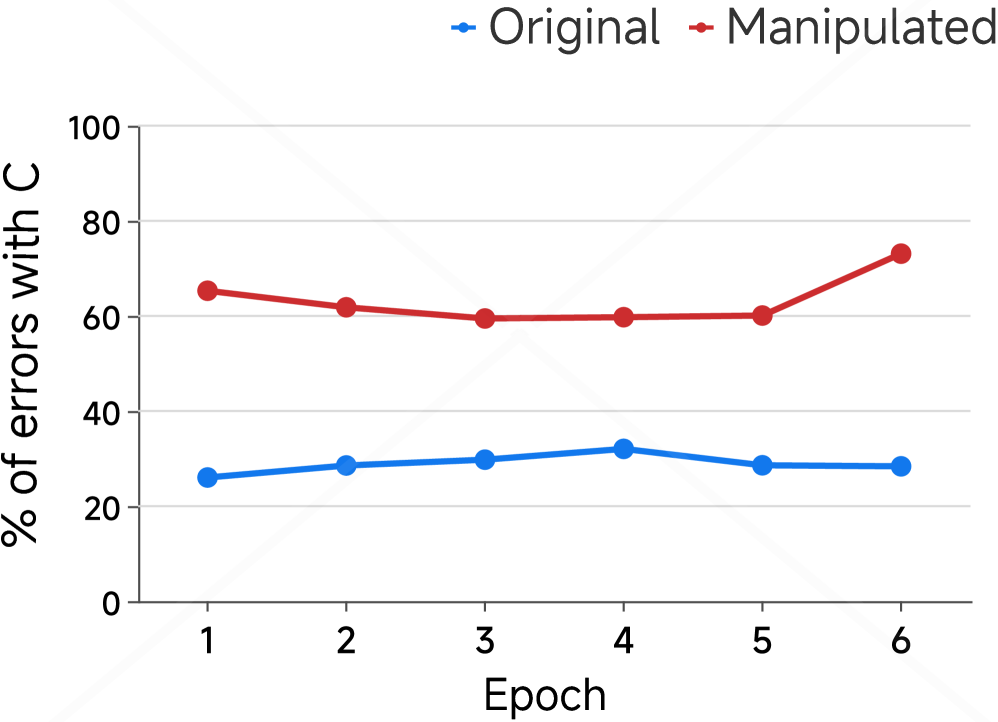
The image displays a line chart comparing two conditions, "Original" and "Manipulated," across six epochs. The chart tracks the percentage of errors associated with a variable or category labeled "C." The "Manipulated" condition consistently shows a significantly higher error rate than the "Original" condition throughout all observed epochs.
### Components/Axes
* **Chart Type:** Line chart with markers.
* **Y-Axis (Vertical):**
* **Label:** "% of errors with C"
* **Scale:** Linear scale from 0 to 100.
* **Major Tick Marks:** 0, 20, 40, 60, 80, 100.
* **X-Axis (Horizontal):**
* **Label:** "Epoch"
* **Scale:** Discrete epochs numbered 1 through 6.
* **Tick Marks:** 1, 2, 3, 4, 5, 6.
* **Legend:**
* **Position:** Top-center of the chart area.
* **Series 1:** "Original" - Represented by a blue line with circular markers.
* **Series 2:** "Manipulated" - Represented by a red line with circular markers.
### Detailed Analysis
**Data Series: Original (Blue Line)**
* **Visual Trend:** The line is relatively flat, showing minor fluctuations around a stable baseline. It exhibits a very slight upward trend from Epoch 1 to Epoch 4, followed by a slight decline.
* **Approximate Data Points:**
* Epoch 1: ~26%
* Epoch 2: ~29%
* Epoch 3: ~30%
* Epoch 4: ~32% (Peak for this series)
* Epoch 5: ~29%
* Epoch 6: ~28%
**Data Series: Manipulated (Red Line)**
* **Visual Trend:** The line starts high, shows a slight downward trend until Epoch 3, remains flat through Epoch 5, and then exhibits a sharp upward spike at Epoch 6.
* **Approximate Data Points:**
* Epoch 1: ~65%
* Epoch 2: ~62%
* Epoch 3: ~60%
* Epoch 4: ~60%
* Epoch 5: ~60%
* Epoch 6: ~73% (Significant increase, peak for this series)
### Key Observations
1. **Consistent Disparity:** The "Manipulated" condition's error rate is consistently 30-45 percentage points higher than the "Original" condition at every epoch.
2. **Divergent Final Behavior:** The two series show opposite trends between Epoch 5 and Epoch 6. The "Original" series decreases slightly, while the "Manipulated" series increases sharply.
3. **Stability vs. Volatility:** The "Original" series is stable, with a total range of approximately 6 percentage points (26% to 32%). The "Manipulated" series is more volatile, with a range of approximately 13 percentage points (60% to 73%), driven almost entirely by the final epoch's increase.
4. **Plateau:** The "Manipulated" series plateaus at approximately 60% from Epoch 3 to Epoch 5 before its final rise.
### Interpretation
The data strongly suggests that the "Manipulated" condition introduces a factor that substantially increases the likelihood of errors related to "C." This effect is not transient; it persists across all measured epochs.
The most critical finding is the **divergent behavior at Epoch 6**. While the "Original" condition's error rate remains controlled, the "Manipulated" condition experiences a significant degradation in performance (a ~13% increase from its plateau). This could indicate:
* A **cumulative or delayed effect** of the manipulation, where its negative impact becomes pronounced only after a certain threshold of time or iterations (epochs).
* An **instability** introduced by the manipulation that manifests under prolonged conditions.
* That the manipulation makes the system more susceptible to a specific type of error ("C") that becomes more prevalent or detectable in later stages.
The chart provides clear evidence that the manipulation is detrimental to performance regarding errors of type "C," with the most severe consequences appearing in the final observed epoch.