## Table: System Comparison
### Overview
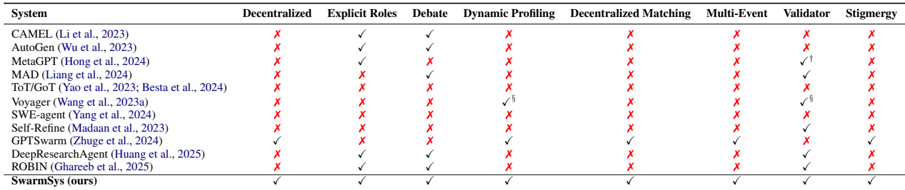
The image presents a table comparing different systems based on several features: Decentralized, Explicit Roles, Debate, Dynamic Profiling, Decentralized Matching, Multi-Event, Validator, and Stigmergy. The table uses checkmarks and crosses to indicate whether a system possesses a particular feature.
### Components/Axes
* **Rows:** Represent different systems, including CAMEL, AutoGen, MetaGPT, MAD, ToT/GoT, Voyager, SWE-agent, Self-Refine, GPTSwarm, DeepResearchAgent, ROBIN, and SwarmSys. Each system is accompanied by a citation.
* **Columns:** Represent the features being compared: Decentralized, Explicit Roles, Debate, Dynamic Profiling, Decentralized Matching, Multi-Event, Validator, and Stigmergy.
* **Symbols:**
* A checkmark (✓) indicates that the system possesses the feature.
* A cross (X) indicates that the system does not possess the feature.
* A section symbol (§) is used for Voyager in Dynamic Profiling and Validator.
* A dagger symbol (†) is used for MetaGPT in Validator.
### Detailed Analysis or ### Content Details
Here's a breakdown of each system and its features:
* **CAMEL (Li et al., 2023):**
* Decentralized: X
* Explicit Roles: ✓
* Debate: ✓
* Dynamic Profiling: X
* Decentralized Matching: X
* Multi-Event: X
* Validator: X
* Stigmergy: X
* **AutoGen (Wu et al., 2023):**
* Decentralized: X
* Explicit Roles: ✓
* Debate: ✓
* Dynamic Profiling: X
* Decentralized Matching: X
* Multi-Event: X
* Validator: X
* Stigmergy: X
* **MetaGPT (Hong et al., 2024):**
* Decentralized: X
* Explicit Roles: ✓
* Debate: X
* Dynamic Profiling: X
* Decentralized Matching: X
* Multi-Event: X
* Validator: ✓†
* Stigmergy: X
* **MAD (Liang et al., 2024):**
* Decentralized: X
* Explicit Roles: X
* Debate: X
* Dynamic Profiling: X
* Decentralized Matching: X
* Multi-Event: X
* Validator: ✓
* Stigmergy: X
* **ToT/GoT (Yao et al., 2023; Besta et al., 2024):**
* Decentralized: X
* Explicit Roles: X
* Debate: X
* Dynamic Profiling: X
* Decentralized Matching: X
* Multi-Event: X
* Validator: X
* Stigmergy: X
* **Voyager (Wang et al., 2023a):**
* Decentralized: X
* Explicit Roles: X
* Debate: X
* Dynamic Profiling: ✓§
* Decentralized Matching: X
* Multi-Event: X
* Validator: ✓§
* Stigmergy: X
* **SWE-agent (Yang et al., 2024):**
* Decentralized: X
* Explicit Roles: X
* Debate: X
* Dynamic Profiling: X
* Decentralized Matching: X
* Multi-Event: X
* Validator: X
* Stigmergy: X
* **Self-Refine (Madaan et al., 2023):**
* Decentralized: X
* Explicit Roles: X
* Debate: X
* Dynamic Profiling: X
* Decentralized Matching: X
* Multi-Event: X
* Validator: ✓
* Stigmergy: ✓
* **GPTSwarm (Zhuge et al., 2024):**
* Decentralized: ✓
* Explicit Roles: ✓
* Debate: ✓
* Dynamic Profiling: ✓
* Decentralized Matching: X
* Multi-Event: X
* Validator: X
* Stigmergy: X
* **DeepResearchAgent (Huang et al., 2025):**
* Decentralized: X
* Explicit Roles: ✓
* Debate: ✓
* Dynamic Profiling: X
* Decentralized Matching: X
* Multi-Event: X
* Validator: ✓
* Stigmergy: X
* **ROBIN (Ghareeb et al., 2025):**
* Decentralized: X
* Explicit Roles: ✓
* Debate: ✓
* Dynamic Profiling: X
* Decentralized Matching: X
* Multi-Event: X
* Validator: ✓
* Stigmergy: X
* **SwarmSys (ours):**
* Decentralized: ✓
* Explicit Roles: ✓
* Debate: ✓
* Dynamic Profiling: ✓
* Decentralized Matching: ✓
* Multi-Event: ✓
* Validator: ✓
* Stigmergy: ✓
### Key Observations
* SwarmSys (ours) is the only system that possesses all the listed features.
* Several systems (CAMEL, AutoGen, DeepResearchAgent, ROBIN) share a similar profile, having Explicit Roles and Debate, but lacking other features.
* Most systems do not have Decentralized Matching, Multi-Event, or Stigmergy.
* Voyager has a special symbol (§) for Dynamic Profiling and Validator.
* MetaGPT has a special symbol (†) for Validator.
### Interpretation
The table provides a comparative analysis of different systems based on their architectural and functional features. SwarmSys appears to be the most comprehensive system, incorporating all the listed features. The prevalence of crosses in the Decentralized Matching, Multi-Event, and Stigmergy columns suggests that these features are less commonly implemented in the systems analyzed. The special symbols (§ and †) might indicate conditional or partial support for the respective features in Voyager and MetaGPT. The data highlights the design choices and priorities in the development of each system, offering insights into the evolving landscape of these technologies.