\n
## Text Log: DEFLATE Decompression Output
### Overview
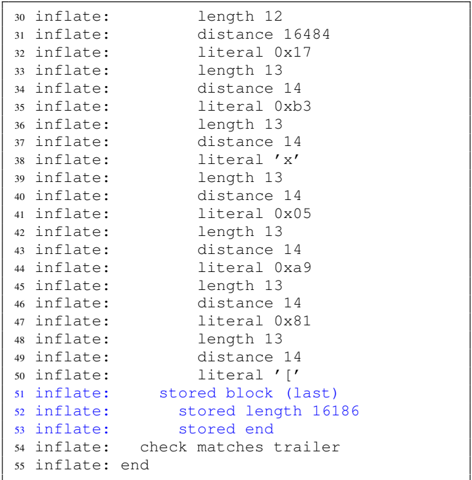
The image displays a text-based log output, likely from a command-line utility or debugging tool performing a DEFLATE decompression operation (commonly used in formats like gzip or zlib). The log shows a sequence of low-level operations, culminating in the successful decompression of a stored block of data. The text is presented in a monospaced font, typical of terminal or console output.
### Components/Axes
The output is structured as a vertical list with two implicit columns:
1. **Line Numbers:** A sequential integer counter on the far left (30 to 55).
2. **Log Messages:** The main content, prefixed with the constant string `inflate:`. The messages describe specific actions or states within the decompression process.
A visual distinction is made using color:
* Most lines are in a default (likely black or dark gray) text color.
* Lines 51, 52, and 53 are displayed in **blue text**, indicating a significant phase change or summary information within the log.
### Detailed Analysis / Content Details
The log details the step-by-step execution of the inflate algorithm. Here is the precise transcription of all text:
```
30 inflate: length 12
31 inflate: distance 16484
32 inflate: literal 0x17
33 inflate: length 13
34 inflate: distance 14
35 inflate: literal 0xb3
36 inflate: length 13
37 inflate: distance 14
38 inflate: literal 'x'
39 inflate: length 13
40 inflate: distance 14
41 inflate: literal 0x05
42 inflate: length 13
43 inflate: distance 14
44 inflate: literal 0xa9
45 inflate: length 13
46 inflate: distance 14
47 inflate: literal 0x81
48 inflate: length 13
49 inflate: distance 14
50 inflate: literal '['
51 inflate: stored block (last)
52 inflate: stored length 16186
53 inflate: stored end
54 inflate: check matches trailer
55 inflate: end
```
**Process Breakdown:**
* **Lines 30-50:** Show a repetitive pattern of operations. The algorithm is processing a series of "length/distance" pairs (which back-reference previously seen data) interspersed with "literal" values (raw bytes). The literals are represented in hexadecimal (`0x17`, `0xb3`, `0x05`, `0xa9`, `0x81`) or as ASCII characters (`'x'`, `'['`).
* **Lines 51-53 (Blue Text):** Mark the processing of a "stored block." This is a type of DEFLATE block where data is stored uncompressed. The log specifies it is the `(last)` block, has a `stored length` of 16186 bytes, and its processing has ended (`stored end`).
* **Lines 54-55:** Indicate final verification steps. The decompressed data's checksum is validated against the trailer (`check matches trailer`), and the entire inflate process concludes (`end`).
### Key Observations
1. **Repetitive Pattern:** The sequence from lines 33 to 50 is highly regular, consisting of a `length 13` followed by a `distance 14`, then a `literal` value. This suggests the decompression of a highly repetitive or patterned segment of the source data.
2. **Block Type Transition:** The log transitions from processing what appears to be a dynamic Huffman-coded block (lines 30-50) to explicitly handling a stored (uncompressed) block (lines 51-53).
3. **Color Coding:** The use of blue for the stored block summary (lines 51-53) highlights it as a key milestone or a different category of log message within the stream.
4. **Final Validation:** The process includes an integrity check (`check matches trailer`), confirming the decompressed data matches the expected checksum, which is a standard part of formats like gzip.
### Interpretation
This log provides a granular, low-level view into the mechanics of the DEFLATE decompression algorithm. It demonstrates the algorithm's dual nature: using LZ77-style back-references (length/distance pairs) for repeated sequences and literal encoding for unique bytes. The presence of a stored block indicates the compressor chose to output a chunk of data verbatim, which can be more efficient for incompressible data.
The repetitive `length 13 / distance 14` pattern is particularly notable. It implies the source data contained a sequence where a 13-byte segment was repeated, and the new copy was located 14 bytes prior to the current position in the output stream. This is a common pattern when decompressing data with short, frequent repetitions.
The successful `check matches trailer` and `end` messages confirm the operation completed without errors. For a developer or systems engineer, this log is invaluable for debugging compression issues, verifying algorithm implementation, or understanding the compression ratio and characteristics of a specific data stream. It moves beyond a simple "success/fail" message to reveal the internal rhythm and structure of the data transformation.