## Causal Diagram: Fairness in Machine Learning Models
### Overview
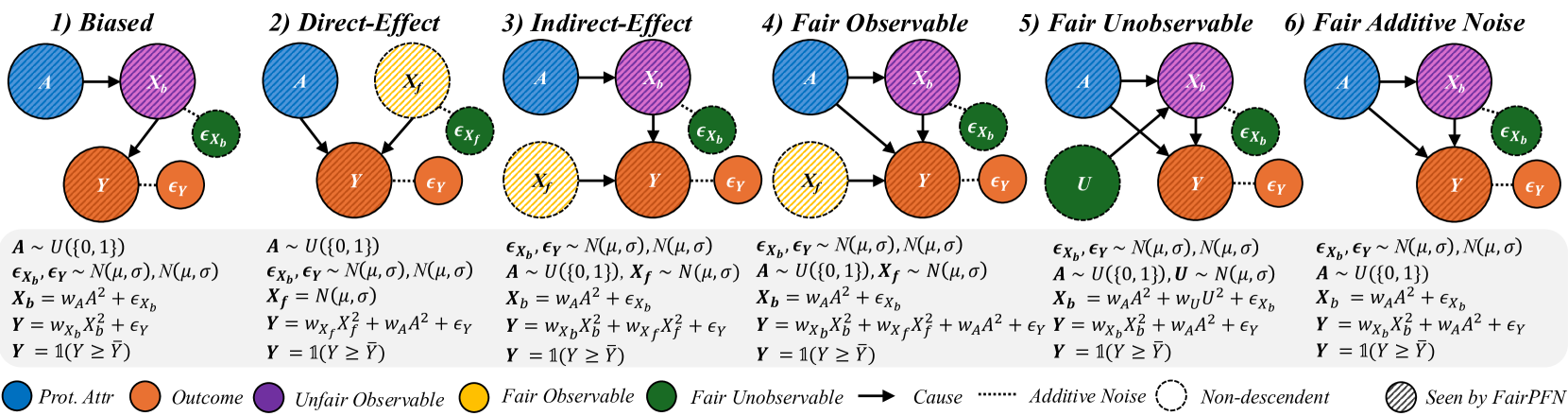
The image presents six causal diagrams illustrating different fairness scenarios in machine learning models. Each panel represents a distinct causal structure with variables, equations, and fairness constraints. The diagrams use color-coded nodes and arrows to depict relationships between protected attributes (A), outcomes (Y), and confounding variables (X_b, X_f). Equations quantify these relationships, while a legend at the bottom explains color/symbol meanings.
### Components/Axes
- **Panels**: Six labeled scenarios (1-6) with distinct causal structures.
- **Nodes**:
- **Blue**: Protected Attribute (A)
- **Purple**: Unfair Observable (X_b)
- **Yellow**: Fair Observable (X_f)
- **Green**: Fair Unobservable (U)
- **Orange**: Outcome (Y)
- **Arrows**: Indicate causal relationships (solid = direct cause, dashed = additive noise).
- **Equations**: Mathematical formulations of relationships under each panel.
- **Legend**: Located at the bottom, mapping colors/symbols to concepts (e.g., "Fair Observable," "Additive Noise").
### Detailed Analysis
#### Panel 1: Biased
- **Structure**: A → X_b → Y with noise terms (ε_Xb, ε_Y).
- **Equations**:
- X_b = w_A*A² + ε_Xb
- Y = w_Xb*X_b² + ε_Y
- Y = 1(Y ≥ Ÿ)
- **Key Features**: Direct bias from A to Y via X_b.
#### Panel 2: Direct-Effect
- **Structure**: A → X_f → Y with X_b as a confounder.
- **Equations**:
- X_f ~ N(μ,σ)
- X_b = w_A*A² + ε_Xb
- Y = w_Xf*X_f² + w_A*A² + ε_Y
- **Key Features**: Introduces fair observable X_f to mitigate bias.
#### Panel 3: Indirect-Effect
- **Structure**: A → X_b → Y and A → X_f → Y.
- **Equations**:
- X_b = w_A*A² + ε_Xb
- X_f ~ N(μ,σ)
- Y = w_Xb*X_b² + w_Xf*X_f² + ε_Y
- **Key Features**: Combines direct and indirect effects of A.
#### Panel 4: Fair Observable
- **Structure**: A → X_b → Y with X_f as a fair observable.
- **Equations**:
- X_b = w_A*A² + ε_Xb
- X_f ~ N(μ,σ)
- Y = w_Xb*X_b² + w_Xf*X_f² + w_A*A² + ε_Y
- **Key Features**: Explicitly models fair observables to address bias.
#### Panel 5: Fair Unobservable
- **Structure**: A → X_b → Y with unobservable U.
- **Equations**:
- U ~ N(μ,σ)
- X_b = w_A*A² + ε_Xb
- Y = w_Xb*X_b² + w_A*U² + ε_Y
- **Key Features**: Accounts for unobservable confounders (U).
#### Panel 6: Fair Additive Noise
- **Structure**: A → X_b → Y with additive noise.
- **Equations**:
- X_b = w_A*A² + ε_Xb
- Y = w_Xb*X_b² + w_A*A² + ε_Y
- **Key Features**: Adds noise to balance fairness constraints.
### Key Observations
1. **Color Consistency**: All panels use the same color scheme (blue for A, orange for Y, etc.), ensuring cross-panel comparability.
2. **Noise Terms**: ε_Xb and ε_Y appear in all panels, representing inherent variability.
3. **Fairness Mechanisms**:
- Panels 2-6 introduce fairness constraints (e.g., X_f, U, additive noise) to counteract bias.
- Panels 4-6 explicitly model fairness observables/unobservables.
4. **Equation Complexity**: Later panels (4-6) include more terms, reflecting advanced fairness adjustments.
### Interpretation
The diagrams illustrate progressive strategies to address bias in causal models:
- **Panel 1** represents a naive, biased model where A directly influences Y through X_b.
- **Panels 2-3** introduce fairness observables (X_f) to disentangle direct/indirect effects.
- **Panels 4-5** address observability challenges by incorporating fair unobservables (U) or adjusting for confounders.
- **Panel 6** uses additive noise to balance fairness, ensuring Y is not disproportionately influenced by A.
The equations reveal that fairness interventions often involve adding terms (e.g., w_A*A²) or noise to neutralize bias. The use of "FairPFN" (Fair Probabilistic Fairness Notion) in the legend suggests a framework for evaluating these models. Notably, all panels condition Y on a threshold (Y ≥ Ÿ), implying a focus on binary outcomes or fairness thresholds.