## Text Document: Arabic Political Statement
### Overview
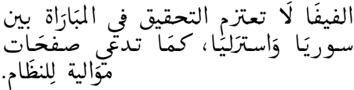
The image contains a single line of Arabic text presented in a standard digital font against a plain white background. The text appears to be a declarative statement, likely from a political or social commentary context, referencing a person or entity named "Al-Munif" and making claims about their actions or stance in relation to Syria, Australia, and a regime.
### Content Details
**Language:** Arabic (Modern Standard Arabic)
**Original Arabic Transcription:**
> المنيف لا تعتذر التحقوق في البارارة بن سوريا وأستراليا، كما تدعي صفحات متواصلة للنظام.
**English Translation:**
> Al-Munif does not apologize for the rights in the parliament in Syria and Australia, as claimed by pages continuous to the regime.
**Textual Analysis & Notes:**
* **"المنيف" (Al-Munif):** This is likely a proper noun, possibly a surname or a title. It is the subject of the sentence.
* **"لا تعتذر" (does not apologize):** The verb is in the feminine singular form ("تعتذر"), which could indicate that "المنيف" is being referred to as a feminine entity (e.g., a woman, a group, or an organization grammatically treated as feminine), or it could be a grammatical construct specific to the context.
* **"التحقوق في البارارة" (the rights in the parliament):** This phrase contains potential typographical errors or non-standard usage.
* "التحقوق" is likely intended to be "الحقوق" (al-huquq), meaning "the rights."
* "البارارة" is likely intended to be "البرلمان" (al-barlaman), meaning "the parliament," or possibly "البارزة" (the prominent one). The provided spelling is non-standard.
* **"بن سوريا وأستراليا" (in Syria and Australia):** The preposition "بن" (bin) is unusual here; it typically means "son of." The intended preposition is likely "في" (fi), meaning "in."
* **"كما تدعي صفحات متواصلة للنظام" (as claimed by pages continuous to the regime):** This suggests the initial statement is a claim attributed to online pages or accounts ("صفحات") that are aligned with or in contact with ("متواصلة") a governing "regime" ("النظام").
### Key Observations
1. **Text-Only Content:** The image contains no charts, diagrams, data tables, or graphical elements. It is purely textual.
2. **Potential Errors:** The Arabic text contains what appear to be spelling or grammatical irregularities ("التحقوق", "البارارة", "بن"), which may indicate it is a direct quote from an informal source, a transcription error, or a specific dialectical usage.
3. **Attribution of Claim:** The sentence structure frames the entire statement ("Al-Munif does not apologize...") as a claim made by pro-regime online pages, not necessarily as an objective fact.
### Interpretation
The text presents a fragment of a political narrative. It portrays an entity, "Al-Munif," as taking a defiant or unapologetic stance regarding "rights" connected to the political spheres of Syria and Australia. Crucially, the sentence attributes this portrayal to sources ("pages") that are aligned with a "regime." This suggests the text is likely a piece of media criticism, a rebuttal, or a report on information warfare, where one side is accusing another of making specific claims. The mention of both Syria and Australia could imply a diaspora context, international relations, or the involvement of foreign-based actors or interests. The irregularities in the text might reflect the informal, rapid, or propagandistic nature of the source material being quoted. Without broader context, the precise identities of "Al-Munif" and the "regime," and the specific "rights" in question, remain ambiguous.