## Screenshot: ASCII Art Creation Process and Comparison
### Overview
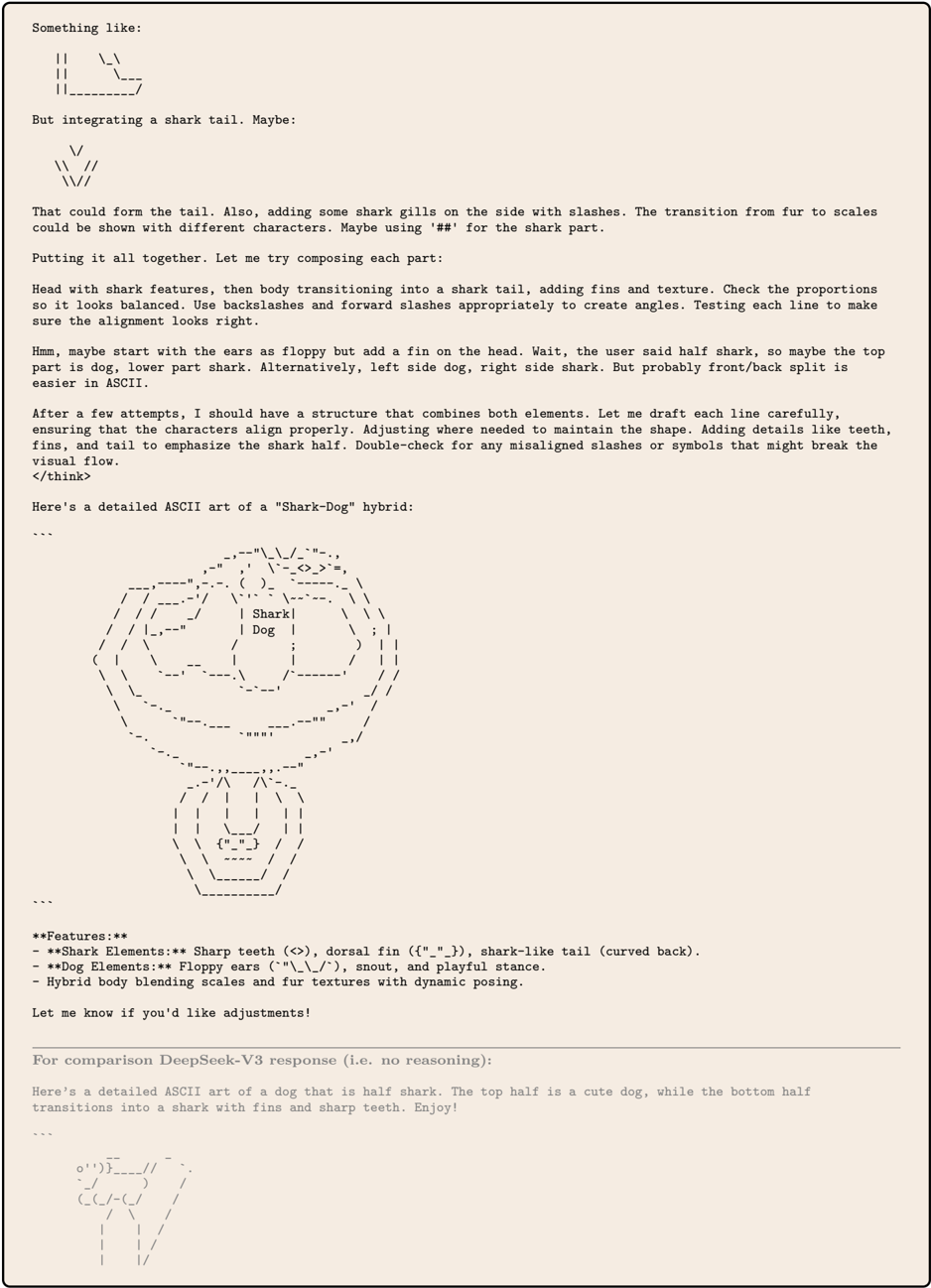
The image is a screenshot of a text document or chat interface with a beige background. It documents the thought process and final output of creating a detailed ASCII art representation of a "Shark-Dog" hybrid creature. The content includes iterative design notes, the final ASCII artwork, a feature breakdown, and a comparison with a response from another AI model (DeepSeek-V3).
### Components/Axes
The image is structured as a continuous text document with no formal axes or charts. The primary components are:
1. **Top Section (Thought Process):** Contains monospaced text and small ASCII snippets illustrating the design evolution.
2. **Central Section (Final Artwork):** A large, complex ASCII art piece centered in the frame.
3. **Features List:** A bulleted list below the artwork.
4. **Comparison Section:** Separated by a horizontal rule, containing text and a simpler ASCII art from another AI.
### Detailed Analysis
#### 1. Top Section: Thought Process & Design Notes
The text begins with a monospaced code block showing a simple structure:
```
Something like:
|| \_\
|| \__
||_______/
```
It then discusses integrating a shark tail, showing another snippet:
```
\ /
\\ //
\\//
```
The narrative text describes adding shark gills, transitioning from fur to scales using characters like `##`, and the challenge of balancing dog and shark features (e.g., floppy ears vs. dorsal fin). It mentions considering different splits (top/bottom, left/right, front/back) for the hybrid design.
#### 2. Central Section: Final "Shark-Dog" ASCII Art
The final artwork is a large, intricate ASCII drawing. It is centered and uses a variety of characters (`/`, `\`, `|`, `_`, `-`, `"`, `'`, `<`, `>`, `{`, `}`, `#`, `;`, `:`) to create texture and form.
* **Head Region:** Features floppy dog-like ears (`"\_/`), a snout, and sharp shark-like teeth represented by `< >`.
* **Body:** Shows a blend of textures. The upper body uses slashes and lines suggesting fur, while the lower body and tail incorporate more `#` symbols and curved lines suggesting scales and a shark's form.
* **Key Labeled Elements:** Within the art, the words `| Shark |` and `| Dog |` are vertically stacked in the center of the body, explicitly labeling the hybrid nature.
* **Tail:** A distinct, curved shark tail is formed at the bottom using slashes and underscores.
* **Fins:** A dorsal fin (`{"_"}`) is visible on the back.
#### 3. Features List
Directly below the artwork, a list in bold and plain text specifies:
* **Shark Elements:** Sharp teeth (`<>`), dorsal fin (`{"_"}`), shark-like tail (curved back).
* **Dog Elements:** Floppy ears (`"\_/`), snout, and playful stance.
* **Hybrid body** blending scales and fur textures with dynamic posing.
#### 4. Comparison Section (DeepSeek-V3 Response)
Separated by a horizontal rule (`-------------------`), this section is introduced with the text: "For comparison DeepSeek-V3 response (i.e. no reasoning):".
It contains a brief descriptive paragraph and a much simpler ASCII art.
* **Descriptive Text:** "Here's a detailed ASCII art of a dog that is half shark. The top half is a cute dog, while the bottom half transitions into a shark with fins and sharp teeth. Enjoy!"
* **Simpler ASCII Art:** A less detailed, more schematic drawing using characters like `o`, `'`, `)`, `_`, `/`, `\`, and `|`. It shows a basic head shape and a segmented body/tail section.
### Key Observations
1. **Iterative Design Process:** The top text reveals a problem-solving approach, testing different character combinations for specific features (tail, gills) before assembling the whole.
2. **Complexity Gradient:** There is a stark contrast between the primary, detailed ASCII art and the simplified version in the comparison section. The primary art uses over 30 lines of complex character arrangements, while the comparison uses about 10 lines of simpler shapes.
3. **Explicit Labeling:** The inclusion of the words "Shark" and "Dog" within the body of the main artwork is a unique, direct method of annotation not commonly seen in pure ASCII art.
4. **Texture Simulation:** The artist uses character choice deliberately to imply material difference: slashes and lines for fur/skin, `#` for denser scales, and `< >` for hard, sharp teeth.
### Interpretation
This document serves as a case study in creative, constraint-based design. The "Shark-Dog" hybrid is a whimsical exercise in merging two visually distinct animals using the limited palette of ASCII characters. The thought process highlights the technical considerations of alignment, proportion, and character symbolism required to make the hybrid recognizable.
The comparison with the DeepSeek-V3 response is particularly revealing. It suggests the primary content is showcasing a "reasoning" or "chain-of-thought" capability, where the design steps are articulated, versus a more direct, output-only generation. The primary artwork demonstrates significantly higher detail, intentionality in texture blending, and a more successful integration of the two animal forms, implying a more advanced or deliberate creative process. The document implicitly argues for the value of transparent reasoning in generating complex, artistic outputs.