## Text-Based Conversation: ASCII Art of a Shark-Dog Hybrid
### Overview
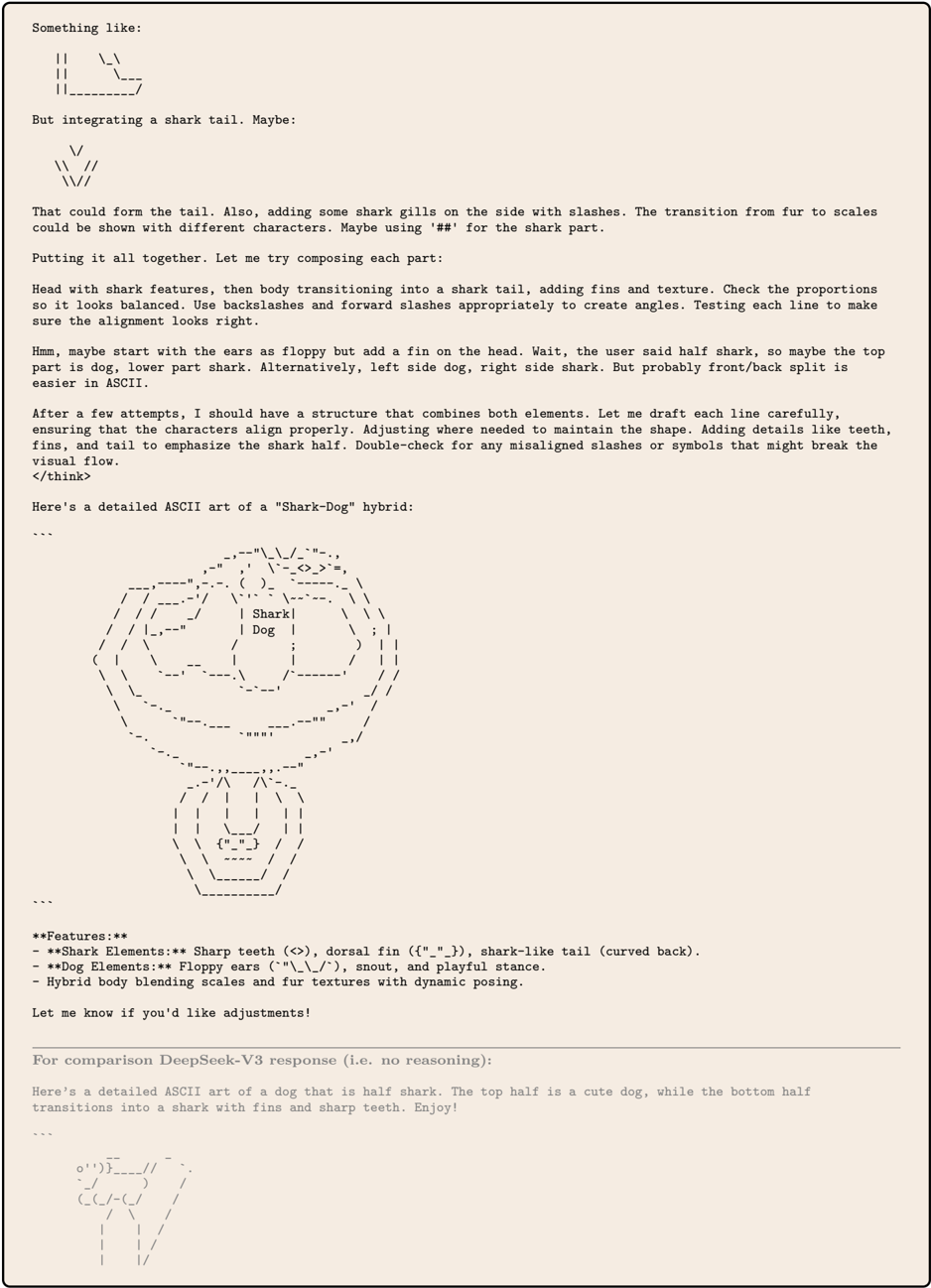
The image contains a text-based conversation where a user iteratively designs an ASCII art representation of a "Shark-Dog" hybrid. The discussion includes brainstorming techniques for blending shark and dog features, a final ASCII art output, and a comparison with a simplified response from "DeepSeek-V3."
---
### Components/Axes
#### Key Labels and Descriptions
1. **User's Brainstorming Process**:
- Descriptions of shark features: sharp teeth (`<>), dorsal fin (`"\_), shark-like tail (`curved back`).
- Dog features: floppy ears (`\_/), snout, playful stance.
- Hybrid body blending scales and fur textures with dynamic posing.
2. **Final ASCII Art Output**:
- A stylized ASCII art of a shark-dog hybrid, labeled with features like sharp teeth, dorsal fin, and shark-like tail.
- Text annotations: `**Features:**`, `**Shark Elements:**`, `**Dog Elements:**`, and `**Hybrid body blending...`.
3. **DeepSeek-V3 Response**:
- A simplified ASCII art of a "half shark" dog, with the top half as a "cute dog" and the bottom half transitioning into a shark with fins and sharp teeth.
---
### Detailed Analysis
#### User's ASCII Art and Features
- **Shark Elements**:
- Sharp teeth (`<>), dorsal fin (`"\_), shark-like tail (`curved back`).
- **Dog Elements**:
- Floppy ears (`\_/), snout, playful stance.
- **Hybrid Body**:
- Blending scales and fur textures with dynamic posing.
#### DeepSeek-V3 Response
- **Structure**:
- Top half: "cute dog" with floppy ears and snout.
- Bottom half: Transition to shark features (fins, sharp teeth).
- **Simplified Approach**:
- No explicit mention of texture blending or dynamic posing.
---
### Key Observations
1. **Complexity**:
- The user’s ASCII art is highly detailed, emphasizing anatomical accuracy (e.g., dorsal fin placement, tail curvature).
- DeepSeek-V3’s response is minimalist, focusing on a clear split between dog and shark halves.
2. **Technical Execution**:
- The user uses ASCII characters (`\, /, _, >, <) to simulate textures (scales, fur) and anatomical details.
- DeepSeek-V3’s art uses fewer characters, resulting in a less nuanced representation.
3. **User Intent**:
- The user seeks feedback on adjustments, indicating a focus on iterative refinement.
- DeepSeek-V3’s response lacks this iterative process, presenting a static output.
---
### Interpretation
The conversation highlights a contrast in approaches to hybrid ASCII art creation:
- **User’s Method**: Prioritizes anatomical precision and texture blending, using ASCII characters to simulate scales, fur, and dynamic poses. This suggests a focus on realism and artistic detail.
- **DeepSeek-V3’s Response**: Emphasizes simplicity and clarity, splitting the hybrid into distinct dog and shark halves. This reflects a more straightforward, less nuanced interpretation.
The user’s iterative process and attention to detail (e.g., sharp teeth, dorsal fin placement) indicate a goal of creating a visually cohesive and anatomically plausible hybrid. In contrast, DeepSeek-V3’s response prioritizes simplicity, possibly for faster generation or broader accessibility.
---
### Final Notes
- **ASCII Art as a Medium**: The use of text characters to simulate visual elements demonstrates creativity within technical constraints.
- **Hybrid Design Challenges**: Balancing shark and dog features requires careful alignment of proportions and textures, as noted in the user’s brainstorming.
- **Comparison Insight**: The user’s detailed approach may appeal to audiences valuing realism, while DeepSeek-V3’s simplicity suits contexts requiring quick, clear visuals.