## Diagram: EG-MLA Neural Network Architecture
### Overview
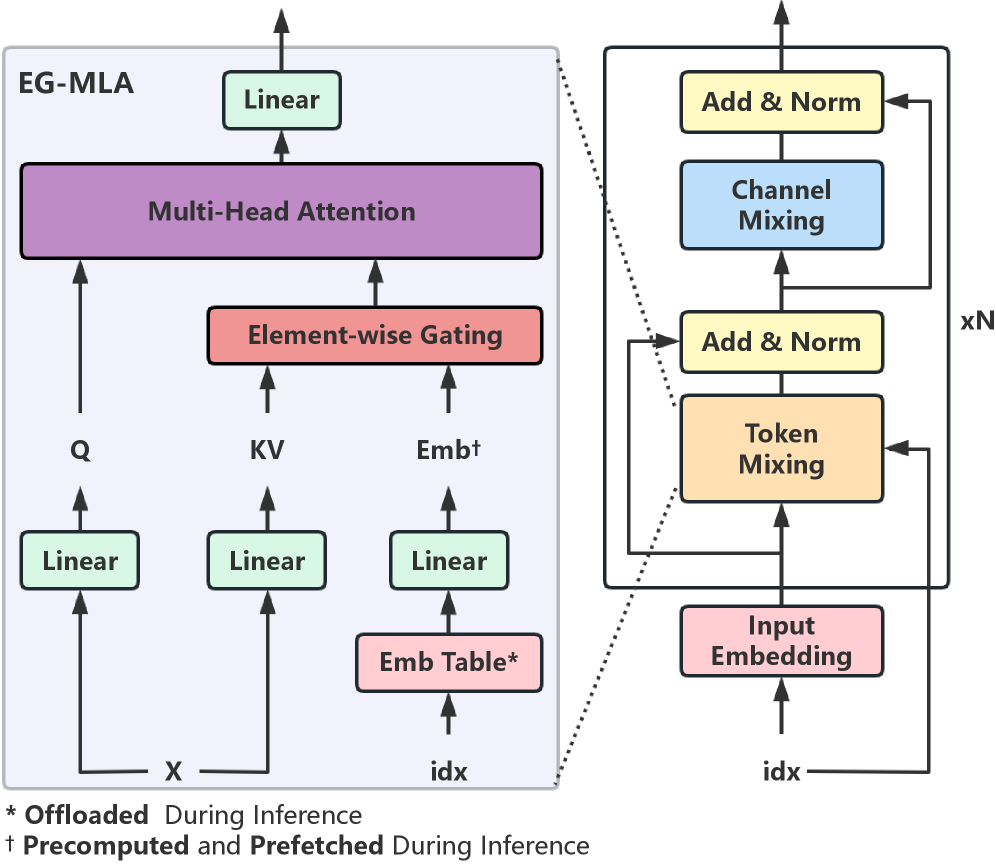
The diagram illustrates a technical architecture for an EG-MLA (Efficient Gating-Multi-Head Attention) neural network. It is divided into two main sections:
1. **Left Side (EG-MLA Core)**: Contains components for attention mechanisms, gating, and embeddings.
2. **Right Side (Processing Flow)**: Shows data flow through token and channel mixing layers with normalization.
### Components/Axes
#### Left Side (EG-MLA Core):
- **Linear Layers**:
- Three green "Linear" blocks labeled **Q**, **KV**, and **Emb+** (input embeddings).
- Connected to a **Multi-Head Attention** block (purple).
- **Element-wise Gating**:
- Red block labeled **Element-wise Gating**, receiving input from Multi-Head Attention.
- **Embed Table**:
- Pink block labeled **Emb Table***, connected to **Emb+** via a linear layer.
- Marked with an asterisk (*) indicating it is **precomputed and prefetched during inference**.
- **Offloaded Components**:
- Linear layers for **Q**, **KV**, and **Emb+** are marked with an asterisk (*) as **offloaded during inference**.
#### Right Side (Processing Flow):
- **Input Embedding**:
- Pink block labeled **Input Embedding**, receiving input **idx**.
- **Token Mixing**:
- Orange block labeled **Token Mixing**, connected to **Input Embedding**.
- **Channel Mixing**:
- Blue block labeled **Channel Mixing**, connected to Token Mixing.
- **Add & Norm**:
- Two yellow blocks labeled **Add & Norm**, positioned between Token Mixing and Channel Mixing.
- **xN Multiplier**:
- Label **xN** at the top of the right side, indicating scaling.
### Detailed Analysis
- **Data Flow**:
- Input **idx** → **Input Embedding** → **Token Mixing** → **Add & Norm** → **Channel Mixing** → **Add & Norm** → **xN**.
- Parallel flow from **EG-MLA Core** (Q, KV, Emb+) → **Multi-Head Attention** → **Element-wise Gating** → merged with the right-side flow.
- **Key Connections**:
- **Emb+** (from EG-MLA) is combined with **Input Embedding** (right side) via **Token Mixing**.
- **Multi-Head Attention** and **Element-wise Gating** outputs are integrated into the processing pipeline.
### Key Observations
1. **Efficiency Optimizations**:
- **Precomputed/Prefetched**: The **Emb Table** is precomputed to reduce inference latency.
- **Offloaded**: Linear layers for Q, KV, and Emb+ are offloaded during inference, likely to reduce computational load.
2. **Modular Design**:
- The architecture separates attention/gating logic (left) from token/channel processing (right), suggesting modularity for scalability.
3. **Normalization**:
- **Add & Norm** blocks are used twice, indicating residual connections and layer normalization for stability.
### Interpretation
This architecture combines transformer-like attention mechanisms (Multi-Head Attention) with efficiency optimizations for inference. By offloading certain linear operations and precomputing the embedding table, the model reduces runtime computation. The integration of **Element-wise Gating** suggests a gating mechanism to control information flow, potentially improving performance on specific tasks. The **xN** scaling implies the output is amplified, possibly for task-specific adjustments.
The diagram emphasizes a balance between computational efficiency (via offloading/precomputation) and model complexity (via attention and gating), making it suitable for resource-constrained environments.