## Diagram: Convolutional Neural Network Block Diagram
### Overview
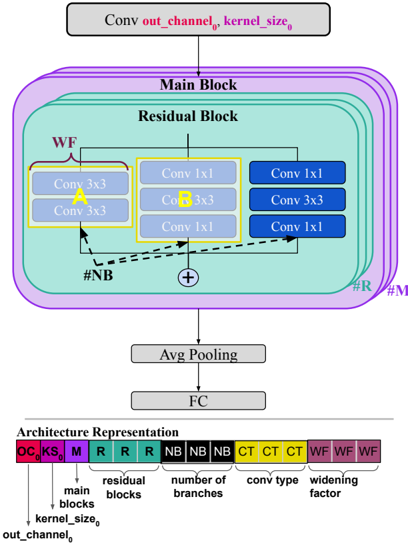
The image is a block diagram illustrating the architecture of a convolutional neural network (CNN). It depicts the flow of data through different layers and blocks, including convolutional layers, residual blocks, pooling layers, and fully connected layers. The diagram also includes an "Architecture Representation" section that summarizes the network's structure using abbreviations.
### Components/Axes
* **Top Block:** "Conv out\_channel₀, kernel\_size₀" (Gray rounded rectangle)
* **Main Block:** A series of nested rounded rectangles, labeled "Main Block" (Purple outline).
* **Residual Block:** Located within the Main Block (Teal outline).
* **Convolutional Layers:** Represented as rectangles labeled "Conv 1x1", "Conv 3x3", and "Co 3x3". These are arranged in parallel within the Residual Block.
* **Addition Operator:** A circled plus sign (+) indicating element-wise addition.
* **Avg Pooling:** A gray rectangle labeled "Avg Pooling".
* **FC:** A gray rectangle labeled "FC" (Fully Connected Layer).
* **Architecture Representation:** A horizontal sequence of colored blocks with abbreviations.
* OC₀KS₀ (Red): Represents out\_channel₀ and kernel\_size₀.
* M (Purple): Represents main blocks.
* R (Green): Represents residual blocks.
* NB (Black): Represents the number of branches.
* CT (Yellow): Represents conv type.
* WF (Teal): Represents the widening factor.
* **Arrows:** Indicate the flow of data between the blocks and layers.
* **Labels:**
* WF: Widening Factor
* \#NB: Number of Branches
* \#R: Number of Residual Blocks
* \#M: Number of Main Blocks
### Detailed Analysis
* **Top Block:** The diagram starts with a convolutional layer, denoted as "Conv out\_channel₀, kernel\_size₀".
* **Main Block:** The data flows into the "Main Block," which contains multiple "Residual Blocks." The number of main blocks is indicated by #M.
* **Residual Block:** Each "Residual Block" contains parallel convolutional layers. One branch contains "Conv 3x3", "Co 3x3", and "Conv 3x3" (yellow outline). Another branch contains "Conv 1x1", "Conv 3x3", and "Conv 1x1" (blue outline). The output of these branches is added together using the addition operator (+). The number of residual blocks is indicated by #R.
* **Number of Branches:** The number of branches is indicated by #NB.
* **Widening Factor:** The widening factor is indicated by WF.
* **Avg Pooling:** After the "Residual Block," the data passes through an "Avg Pooling" layer.
* **FC:** Finally, the data is fed into a "FC" (Fully Connected) layer.
* **Architecture Representation:** This section provides a compact representation of the network's architecture. It shows the sequence of main blocks (M), residual blocks (R), number of branches (NB), conv type (CT), and widening factor (WF). The number of each type of block is indicated by the number of consecutive blocks of the same color.
### Key Observations
* The diagram highlights the use of residual connections in the network architecture.
* The "Architecture Representation" provides a concise summary of the network's structure.
* The diagram shows the flow of data through different layers and blocks, making it easy to understand the network's architecture.
### Interpretation
The diagram illustrates a CNN architecture that utilizes residual connections to improve performance. The residual blocks allow the network to learn more complex features by adding the input of a block to its output. The "Architecture Representation" provides a way to easily specify and compare different network architectures. The diagram is useful for understanding the structure and flow of data in the CNN.