## Line Chart: Shannon and Bayesian Surprises
### Overview
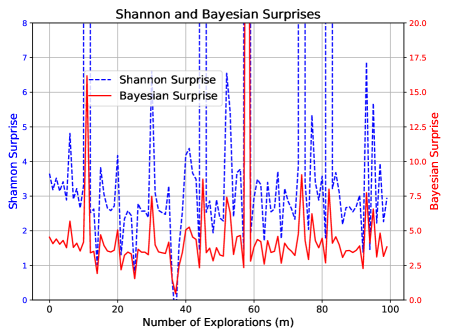
The image presents a line chart comparing Shannon Surprise and Bayesian Surprise over a number of explorations. The chart displays two distinct lines representing each surprise metric, plotted against the number of explorations (m). A dual y-axis is used, with Shannon Surprise on the left and Bayesian Surprise on the right.
### Components/Axes
* **Title:** "Shannon and Bayesian Surprises" - positioned at the top-center of the chart.
* **X-axis:** "Number of Explorations (m)" - ranging from approximately 0 to 100, with tick marks at intervals of 10.
* **Left Y-axis:** "Shannon Surprise" - ranging from 0 to 8, with tick marks at intervals of 1.
* **Right Y-axis:** "Bayesian Surprise" - ranging from 0 to 20, with tick marks at intervals of 2.5.
* **Legend:** Located at the top-center of the chart.
* "Shannon Surprise" - represented by a dashed blue line.
* "Bayesian Surprise" - represented by a solid red line.
* **Gridlines:** Present to aid in reading values.
### Detailed Analysis
**Shannon Surprise (Blue Dashed Line):**
The Shannon Surprise line exhibits a highly fluctuating pattern. It generally stays between 1 and 3 for the first 20 explorations. Around exploration 20, it spikes to approximately 7, then drops back down. There are several other spikes throughout the chart, reaching peaks around 6-7 at explorations 30, 50, 60, 70, 80, and 90. The line ends around a value of 3.5 at exploration 100.
**Bayesian Surprise (Red Solid Line):**
The Bayesian Surprise line also fluctuates, but generally remains lower than the Shannon Surprise. It starts around 1.5 and increases to approximately 5 by exploration 20. It then experiences a significant drop to around 1 at exploration 40. A large peak occurs around exploration 50, reaching approximately 18. After this peak, the line generally decreases, fluctuating between 2 and 8 until exploration 100, where it ends around 5.
**Specific Data Points (Approximate):**
| Exploration (m) | Shannon Surprise | Bayesian Surprise |
|---|---|---|
| 0 | 1.5 | 1.5 |
| 10 | 2.0 | 2.5 |
| 20 | 7.0 | 5.0 |
| 30 | 6.0 | 4.0 |
| 40 | 1.0 | 1.0 |
| 50 | 5.5 | 18.0 |
| 60 | 6.5 | 7.0 |
| 70 | 6.0 | 5.0 |
| 80 | 6.5 | 4.0 |
| 90 | 6.0 | 6.0 |
| 100 | 3.5 | 5.0 |
### Key Observations
* The Bayesian Surprise generally exhibits larger peaks than the Shannon Surprise.
* Both surprise metrics show significant fluctuations, indicating a dynamic exploration process.
* There is no clear correlation between the peaks of the two surprise metrics. Sometimes they peak together (e.g., around exploration 60), while other times they peak independently (e.g., exploration 20 for Shannon, exploration 50 for Bayesian).
* The Bayesian Surprise has a much larger range of values (0-18) compared to the Shannon Surprise (0-7).
### Interpretation
The chart suggests that the exploration process reveals information that is sometimes surprising from both a Shannon and Bayesian perspective. The fluctuations in both surprise metrics indicate that the information gained during exploration is not consistent; some explorations yield more surprising results than others. The lack of correlation between the peaks suggests that the information surprising from a Shannon perspective (information content) is not necessarily the same as the information surprising from a Bayesian perspective (deviation from prior beliefs). The larger range of the Bayesian Surprise suggests that the prior beliefs are being significantly updated during the exploration process. The large peak in Bayesian Surprise at exploration 50 could indicate a particularly significant discovery that drastically changed the understanding of the system being explored. The chart provides insight into the information gain during an exploration process, highlighting the dynamic nature of learning and discovery.