## Table: Clue Words, Answer Words, Explanations, and Scores
### Overview
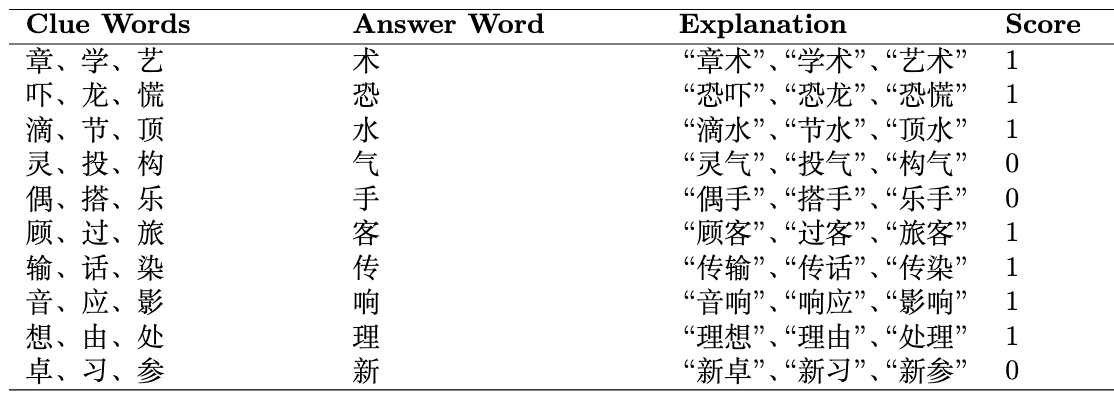
The image is a table presenting clue words, corresponding answer words, explanations of the answer words in relation to the clues, and a score associated with each set of words. The table appears to be related to a word association or puzzle game. The language used is primarily Chinese, with English column headers.
### Components/Axes
The table has the following columns:
1. **Clue Words**: A list of three Chinese words that serve as clues.
2. **Answer Word**: A single Chinese word that is the answer to the clue.
3. **Explanation**: Provides the explanation of how the answer word relates to each of the clue words, in Chinese.
4. **Score**: A numerical score (either 0 or 1) associated with the answer.
### Detailed Analysis
Here's a breakdown of each row in the table:
* **Row 1:**
* Clue Words: 章、学、艺
* Answer Word: 术
* Explanation: “章术”、“学术”、“艺术” (zhāng shù, xué shù, yì shù) - "Chapter Art", "Academic", "Art"
* Score: 1
* **Row 2:**
* Clue Words: 吓、龙、慌
* Answer Word: 恐
* Explanation: “恐吓”、“恐龙”、“恐慌” (kǒng hè, kǒng lóng, kǒng huāng) - "Intimidation", "Dinosaur", "Panic"
* Score: 1
* **Row 3:**
* Clue Words: 滴、节、顶
* Answer Word: 水
* Explanation: “滴水”、“节水”、“顶水” (dī shuǐ, jié shuǐ, dǐng shuǐ) - "Dripping Water", "Water Saving", "Top Water"
* Score: 1
* **Row 4:**
* Clue Words: 灵、投、构
* Answer Word: 气
* Explanation: “灵气”、“投气”、“构气” (líng qì, tóu qì, gòu qì) - "Aura", "Throwing Air", "Constructing Air"
* Score: 0
* **Row 5:**
* Clue Words: 偶、搭、乐
* Answer Word: 手
* Explanation: “偶手”、“搭手”、“乐手” (ǒu shǒu, dā shǒu, lè shǒu) - "Puppet Hand", "Helping Hand", "Musician"
* Score: 0
* **Row 6:**
* Clue Words: 顾、过、旅
* Answer Word: 客
* Explanation: “顾客”、“过客”、“旅客” (gù kè, guò kè, lǚ kè) - "Customer", "Passerby", "Traveler"
* Score: 1
* **Row 7:**
* Clue Words: 输、话、染
* Answer Word: 传
* Explanation: “传输”、“传话”、“传染” (chuán shū, chuán huà, chuán rǎn) - "Transmission", "Message", "Infection"
* Score: 1
* **Row 8:**
* Clue Words: 音、应、影
* Answer Word: 响
* Explanation: “音响”、“响应”、“影响” (yīn xiǎng, xiǎng yìng, yǐng xiǎng) - "Sound System", "Response", "Influence"
* Score: 1
* **Row 9:**
* Clue Words: 想、由、处
* Answer Word: 理
* Explanation: “理想”、“理由”、“处理” (lǐ xiǎng, lǐ yóu, chǔ lǐ) - "Ideal", "Reason", "Handle"
* Score: 1
* **Row 10:**
* Clue Words: 卓、习、参
* Answer Word: 新
* Explanation: “新卓”、“新习”、“新参” (xīn zhuō, xīn xí, xīn cān) - "New Excellence", "New Habit", "New Participation"
* Score: 0
### Key Observations
* The scores are binary (0 or 1).
* The explanations provide context for the relationship between the clue words and the answer word.
* The language used is primarily Chinese.
### Interpretation
The table presents a word association game or exercise. The "Clue Words" provide hints, and the "Answer Word" is the solution. The "Explanation" clarifies the connection between the clues and the answer. The "Score" likely indicates whether the association is considered correct or relevant, with 1 indicating a valid association and 0 indicating otherwise. The exercise seems designed to test vocabulary and understanding of word relationships in Chinese.