## Table: Chinese Word Formation Exercise
### Overview
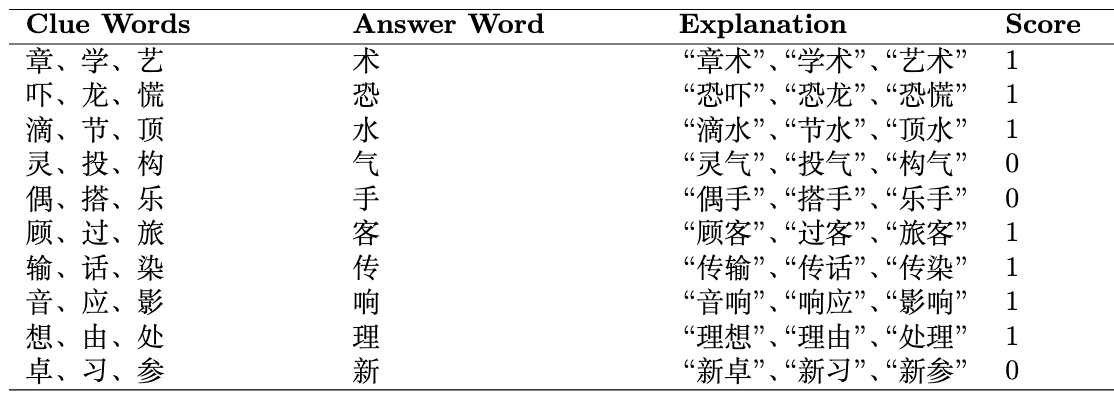
The image displays a structured table with four columns, presenting a linguistic exercise or test. The content involves Chinese characters, where sets of "Clue Words" are meant to combine with an "Answer Word" to form valid compound words or phrases. An "Explanation" column shows the resulting combinations, and a "Score" column indicates correctness (1 for valid, 0 for invalid).
### Components/Axes
The table has a clear header row and ten data rows.
* **Column Headers (Top Row):**
* **Clue Words:** Lists three Chinese characters per row.
* **Answer Word:** Lists a single Chinese character per row.
* **Explanation:** Shows three compound words/phrases formed by combining the Answer Word with each of the Clue Words.
* **Score:** A numerical score (0 or 1) for the row.
* **Spatial Layout:** The table is centered. The headers are in bold. The data is aligned in columns beneath each header.
### Detailed Analysis
**Language:** The primary language is **Chinese (Mandarin)**. All characters, clues, answers, and explanations are in Chinese. An English translation is provided below for each entry.
**Row-by-Row Data Extraction:**
| Row | Clue Words (Chinese) | Answer Word (Chinese) | Explanation (Chinese) | Score | English Translation & Analysis |
| :-- | :--- | :--- | :--- | :--- | :--- |
| 1 | 章、学、艺 | 术 | 章术、学术、艺术 | 1 | **Clues:** chapter, study, art. **Answer:** art/technique. **Phrases:** "chapter technique" (archaic), "academics", "art". **Score: 1 (Valid)**. "学术" and "艺术" are common, valid words. |
| 2 | 吓、龙、慌 | 恐 | 恐吓、恐龙、恐慌 | 1 | **Clues:** scare, dragon, panic. **Answer:** fear. **Phrases:** "intimidate", "dinosaur", "panic". **Score: 1 (Valid)**. All are standard compound words. |
| 3 | 滴、节、顶 | 水 | 滴水、节水、顶水 | 1 | **Clues:** drip, node/section, top. **Answer:** water. **Phrases:** "dripping water", "water conservation", "carrying water on the head" (a specific action). **Score: 1 (Valid)**. All are meaningful combinations. |
| 4 | 灵、投、构 | 气 | 灵气、投气、构气 | 0 | **Clues:** spirit, invest/throw, construct. **Answer:** air/gas/spirit. **Phrases:** "spiritual aura", "投气" (not a standard word; "投缘" means to get along), "构气" (not a standard word). **Score: 0 (Invalid)**. Only the first combination is a common word. |
| 5 | 偶、搭、乐 | 手 | 偶手、搭手、乐手 | 0 | **Clues:** idol/occasional, build/play music, music/happy. **Answer:** hand. **Phrases:** "偶手" (not standard), "lend a hand", "musician". **Score: 0 (Invalid)**. Only "乐手" is a standard word. |
| 6 | 顾、过、旅 | 客 | 顾客、过客、旅客 | 1 | **Clues:** look after, pass, travel. **Answer:** guest. **Phrases:** "customer", "passerby", "traveler". **Score: 1 (Valid)**. All are common, correct words. |
| 7 | 输、话、染 | 传 | 传输、传话、传染 | 1 | **Clues:** lose/transport, word/speak, dye/infect. **Answer:** transmit. **Phrases:** "transmission", "pass on a message", "infect/contagion". **Score: 1 (Valid)**. All are standard terms. |
| 8 | 音、应、影 | 响 | 音响、响应、影响 | 1 | **Clues:** sound, respond, shadow/image. **Answer:** sound/response. **Phrases:** "audio/sound system", "response", "influence". **Score: 1 (Valid)**. All are high-frequency words. |
| 9 | 想、由、处 | 理 | 理想、理由、处理 | 1 | **Clues:** think, from/reason, place/handle. **Answer:** reason/manage. **Phrases:** "ideal", "reason", "handle/deal with". **Score: 1 (Valid)**. All are fundamental vocabulary. |
| 10 | 卓、习、参 | 新 | 新卓、新习、新参 | 0 | **Clues:** excellent, practice, participate. **Answer:** new. **Phrases:** "新卓" (not standard), "新习" (not standard), "新参" (not standard). **Score: 0 (Invalid)**. None of these are recognized compound words. |
### Key Observations
1. **Score Distribution:** Out of 10 rows, 7 are scored as correct (1) and 3 are scored as incorrect (0).
2. **Pattern of Validity:** The rows scored "1" contain Answer Words that form at least two, and usually three, common and recognizable Chinese compound words with the given Clue Words. The rows scored "0" contain Answer Words that form only one or no standard compounds with the clues.
3. **Linguistic Pattern:** The exercise tests morphological productivity—how freely a character (the Answer Word) can combine with others to create meaning. Characters like 术, 恐, 水, 客, 传, 响, and 理 are highly productive morphemes. The character 新 in this context appears less productive with the given clues.
4. **Anomaly:** Row 3 ("顶水") is less common in everyday language than the other valid examples but is a recognized phrase describing a specific action, hence its valid score.
### Interpretation
This table is likely from a **Chinese language learning or cognitive assessment tool**. It evaluates a learner's or subject's knowledge of **word formation (构词法)** and **collocation**.
* **What it demonstrates:** The data shows a clear distinction between productive and non-productive character combinations in modern Chinese. It highlights that knowing a character's meaning is not enough; one must also know its common lexical partnerships.
* **How elements relate:** The "Clue Words" act as test probes. The "Answer Word" is the variable being tested for its combinatorial ability. The "Explanation" provides the evidence (the formed words), and the "Score" is the final judgment on that ability.
* **Underlying Purpose:** This format is efficient for testing vocabulary depth. It moves beyond simple definition recall to test the practical, generative knowledge of how words are built. The incorrect rows (Score 0) are particularly instructive, as they reveal common overgeneralization errors a learner might make by assuming a character can combine freely based on its meaning alone.