## Box Plot: ECE Diff and AUROC Diff Comparison
### Overview
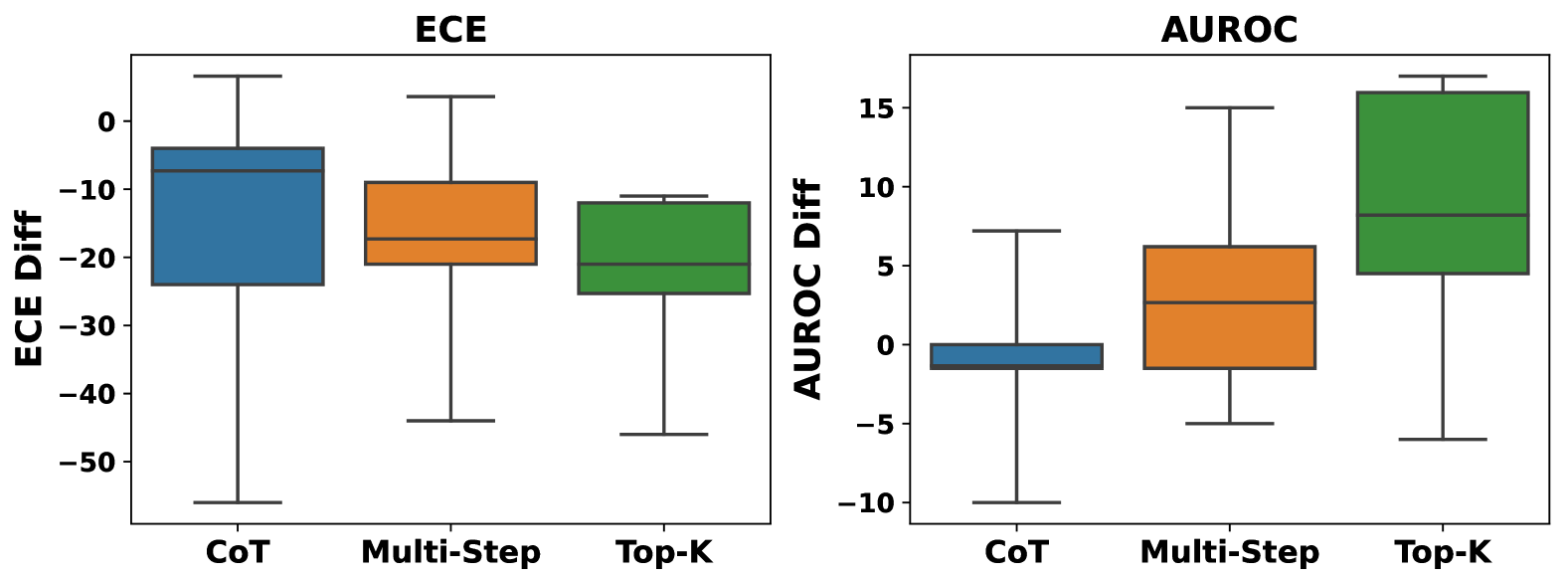
The image presents two box plots side-by-side, comparing the distributions of "ECE Diff" (Expected Calibration Error Difference) and "AUROC Diff" (Area Under the Receiver Operating Characteristic Curve Difference) across three different methods: "CoT" (Chain-of-Thought), "Multi-Step", and "Top-K". The box plots visually summarize the central tendency, spread, and skewness of the data for each method and metric.
### Components/Axes
**Left Plot (ECE):**
* **Title:** ECE
* **Y-axis:** ECE Diff, with scale markers at 0, -10, -20, -30, -40, and -50.
* **X-axis:** Categorical, representing the three methods: CoT, Multi-Step, and Top-K.
**Right Plot (AUROC):**
* **Title:** AUROC
* **Y-axis:** AUROC Diff, with scale markers at -10, -5, 0, 5, 10, and 15.
* **X-axis:** Categorical, representing the three methods: CoT, Multi-Step, and Top-K.
**Legend (Implicit):**
* CoT: Represented by blue boxes.
* Multi-Step: Represented by orange boxes.
* Top-K: Represented by green boxes.
### Detailed Analysis
**Left Plot (ECE Diff):**
* **CoT (Blue):** The box extends from approximately -24 to -8. The median is around -14. The upper whisker extends to approximately 2, and the lower whisker extends to approximately -56.
* Trend: The ECE Diff for CoT is centered around -14, with a wide spread indicating high variability.
* **Multi-Step (Orange):** The box extends from approximately -21 to -12. The median is around -16. The upper whisker extends to approximately 4, and the lower whisker extends to approximately -44.
* Trend: The ECE Diff for Multi-Step is centered around -16, with a moderate spread.
* **Top-K (Green):** The box extends from approximately -21 to -11. The median is around -16. The upper whisker extends to approximately 2, and the lower whisker extends to approximately -46.
* Trend: The ECE Diff for Top-K is centered around -16, with a moderate spread.
**Right Plot (AUROC Diff):**
* **CoT (Blue):** The box extends from approximately -2 to 0. The median is around -1. The upper whisker extends to approximately 8, and the lower whisker extends to approximately -10.
* Trend: The AUROC Diff for CoT is centered around -1, with a moderate spread.
* **Multi-Step (Orange):** The box extends from approximately -1 to 4. The median is around 2. The upper whisker extends to approximately 15, and the lower whisker extends to approximately -5.
* Trend: The AUROC Diff for Multi-Step is centered around 2, with a wide spread.
* **Top-K (Green):** The box extends from approximately 4 to 10. The median is around 8. The upper whisker extends to approximately 17, and the lower whisker extends to approximately -3.
* Trend: The AUROC Diff for Top-K is centered around 8, with a wide spread.
### Key Observations
* For ECE Diff, all three methods have negative median values, indicating a general tendency to underestimate the calibration error. CoT has the widest spread.
* For AUROC Diff, Top-K shows a significantly higher median value compared to CoT and Multi-Step, suggesting better performance in terms of discrimination.
### Interpretation
The box plots provide a comparative view of the performance of three different methods (CoT, Multi-Step, and Top-K) based on two metrics: ECE Diff and AUROC Diff.
* **ECE Diff:** The negative values across all methods suggest that, on average, these methods tend to underestimate the true calibration error. The wider spread for CoT indicates that its performance is more variable compared to Multi-Step and Top-K.
* **AUROC Diff:** Top-K stands out with a higher median AUROC Diff, implying that it generally provides better discrimination compared to the other two methods. The spread of the data suggests that the performance of Multi-Step and Top-K can vary significantly.
In summary, while all methods show a tendency to underestimate calibration error, Top-K appears to offer better discrimination performance based on the AUROC metric. The variability in performance, as indicated by the spread of the box plots, should also be considered when selecting a method for a specific application.