\n
## Diagram: Sequence of Taps & Reference Numbers
### Overview
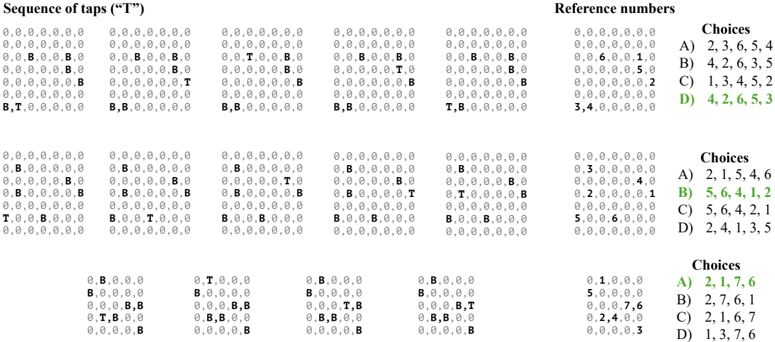
The image presents a series of diagrams depicting sequences of taps, represented by the letters "T" and "B", alongside corresponding reference numbers and multiple-choice options. The diagrams are arranged in a grid-like structure, with three distinct rows of sequences. Each sequence is followed by a set of reference numbers and four choices labeled A, B, C, and D.
### Components/Axes
The diagram consists of the following components:
* **Tap Sequences:** Represented by arrangements of "T" and "B" characters.
* **Reference Numbers:** Numerical sequences associated with each tap sequence.
* **Choices:** Multiple-choice options (A, B, C, D) with numerical lists.
There are no explicit axes in the traditional sense, but the arrangement of elements creates a visual structure.
### Detailed Analysis or Content Details
**Row 1:**
* **Sequence 1:** 0,0,0,0,0,0,0,0; 0,B,B,0,0,0,B,0; 0,0,0,0,0,0,0,0; 0,0,0,0,0,0,0,0; 0,0,0,0,0,0,0,0; 0,0,0,0,0,0,0,0
* **Reference Numbers 1:** 0,0,0,0,0,0,0,0; 0,0,0,0,0,0,0,0; 0,0,0,0,0,0,0,0; 0,0,0,0,0,0,0,0; 0,0,0,0,0,0,0,0; 0,0,0,0,0,0,0,0
* **Choices 1:** A) 2, 3, 6, 5, 4; B) 4, 2, 6, 3, 5; C) 1, 3, 4, 5, 2; D) 4, 2, 6, 5, 3
* **Sequence 2:** 0,0,0,0,0,0,0,0; 0,B,B,0,0,0,B,0; 0,0,0,0,0,0,0,0; 0,0,0,0,0,0,0,T; 0,0,0,0,0,0,0,0; B,T,0,0,0,0,0,0
* **Reference Numbers 2:** 0,0,0,0,0,0,0,0; 0,0,0,0,0,0,0,0; 0,0,0,0,0,0,0,0; 0,0,0,0,0,0,0,0; 0,0,0,0,0,0,0,0; 3,4,0,0,0,0,0,0
* **Choices 2:** A) 4, 2, 6, 3, 5; B) 5, 6, 4, 1, 2; C) 5, 6, 4, 2, 1; D) 2, 4, 1, 3, 5
**Row 2:**
* **Sequence 3:** 0,0,0,0,0,0,0,0; 0,B,B,0,0,0,B,0; 0,0,0,0,0,0,0,0; 0,0,0,0,0,0,0,T; 0,0,0,0,0,0,0,0; T,0,0,B,B,0,0,0
* **Reference Numbers 3:** 0,0,0,0,0,0,0,0; 0,3,0,0,0,0,0,0; 0,2,0,0,0,0,0,0; 0,2,0,0,0,0,0,0; 0,0,0,0,0,0,0,0; 5,0,0,0,0,0,0,0
* **Choices 3:** A) 2, 1, 5, 4, 6; B) 2, 7, 6, 1; C) 2, 1, 6, 7; D) 1, 3, 7, 6
* **Sequence 4:** 0,0,0,0,0,0,0,0; 0,B,B,0,0,0,B,0; 0,0,0,0,0,0,0,0; 0,0,0,0,0,0,0,T; 0,0,0,0,0,0,0,0; B,0,0,T,T,0,0,0
* **Reference Numbers 4:** 0,0,0,0,0,0,0,0; 0,3,0,0,0,0,0,0; 0,2,0,0,0,0,0,0; 0,2,0,0,0,0,0,0; 0,0,0,0,0,0,0,0; 1,0,0,0,0,0,0,0
* **Choices 4:** A) 2, 1, 7, 6; B) 1, 3, 7, 6; C) 1, 3, 4, 5; D) 1, 3, 7, 6
**Row 3:**
* **Sequence 5:** 0,B,0,0,0,0,0,0; 0,T,0,0,0,0,0,0; B,B,0,0,0,0,0,0; 0,0,B,B,0,0,0,0; 0,0,0,0,0,0,0,0; 4,0,0,0,0,0,0,0
* **Reference Numbers 5:** 0,1,0,0,0,0,0,0; 0,3,0,0,0,0,0,0; 0,2,4,0,0,0,0,0; 0,2,4,0,0,0,0,0; 0,0,0,0,0,0,0,0; 0,0,0,0,0,0,0,0
* **Choices 5:** A) 2, 1, 7, 6; B) 1, 3, 7, 6; C) 1, 3, 4, 5; D) 1, 3, 7, 6
### Key Observations
The diagram presents a pattern-matching exercise. Each sequence of "T" and "B" taps is associated with a set of reference numbers and a multiple-choice question. The choices likely represent different interpretations or classifications of the tap sequences. The reference numbers may be related to the positions or characteristics of the "T" and "B" taps within each sequence.
### Interpretation
This diagram appears to be part of a cognitive assessment or a test of pattern recognition. The task likely involves identifying the correct multiple-choice option based on the given tap sequence and reference numbers. The "T" and "B" taps could represent different actions or stimuli, and the sequences may encode specific information or rules. The choices could represent different categories, classifications, or responses to the tap sequences. Without further context, it is difficult to determine the exact meaning of the diagram, but it clearly demonstrates a structured approach to evaluating cognitive abilities or pattern recognition skills. The consistent format across rows suggests a standardized test or assessment.