TECHNICAL ASSET FINGERPRINT
583f91ec14f90654df3886c2
Click to view fullscreen
Press ESC or click to close
FOUND IN PAPERS
EXPERT: healer-alpha-free VERSION 1
RUNTIME: free/openrouter/healer-alpha
INTEL_VERIFIED
\n
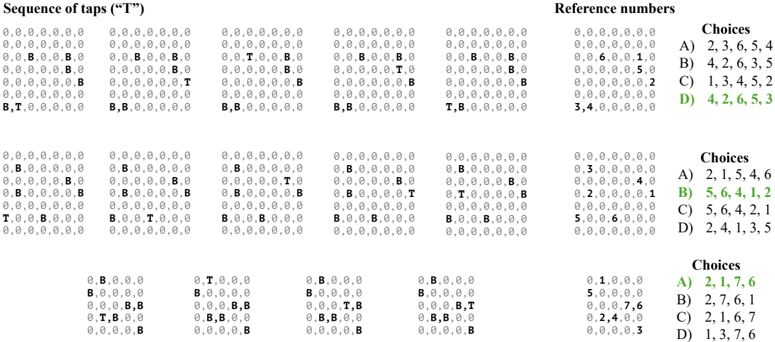
## Pattern Recognition Diagram: Sequence of Taps ("T")
### Overview
The image displays a visual pattern recognition puzzle or test. It consists of three distinct horizontal sections. Each section presents a sequence of 5x5 grids (with the third section using 4x4 grids) containing the characters '0', 'B', and 'T'. To the right of each sequence is a column labeled "Reference numbers" and a set of multiple-choice "Choices" (A, B, C, D). The task appears to be to deduce the rule governing the movement or transformation of the 'T' (tap) and 'B' (block?) elements across the sequence and select the correct numerical sequence from the choices. One choice in each section is highlighted in green, indicating the correct answer.
### Components/Axes
* **Main Title:** "Sequence of taps ("T")" (Top-left)
* **Grid Structure:** Each grid is a matrix of characters. The first two sections use 5 rows x 5 columns. The third section uses 4 rows x 4 columns.
* **Character Legend:**
* `0`: Represents an empty or default cell.
* `B`: Represents a fixed or blocking element.
* `T`: Represents the moving "tap" element.
* **Reference Numbers Column:** A vertical list of five 5-digit numbers (or four 4-digit numbers in the third section) composed of `0`s and other digits. These likely correspond to the positions or states in the sequence.
* **Choices Panel:** Lists four options (A, B, C, D), each a sequence of numbers (e.g., "2, 3, 6, 5, 4"). The correct choice is highlighted in green text.
### Detailed Analysis
**Section 1 (Top):**
* **Sequence:** Five 5x5 grids showing a progression.
* Grid 1: `T` is at row 4, column 1. `B`s form a pattern.
* Grid 2: `T` moves to row 3, column 3.
* Grid 3: `T` moves to row 2, column 4.
* Grid 4: `T` moves to row 3, column 5.
* Grid 5: `T` moves to row 5, column 1.
* **Reference Numbers:** A vertical list: `0,0,0,0,0`, `0,0,0,0,0`, `0,0,0,0,0`, `0,0,0,0,0`, `0,0,0,0,0`, `0,0,0,0,0`, `0,0,0,0,0`, `0,0,0,0,0`, `0,0,0,0,0`, `0,0,0,0,0`, `0,0,0,0,0`, `0,0,0,0,0`, `0,0,0,0,0`, `0,0,0,0,0`, `0,0,0,0,0`, `0,0,0,0,0`, `0,0,0,0,0`, `0,0,0,0,0`, `0,0,0,0,0`, `0,0,0,0,0`, `0,0,0,0,0`, `0,0,0,0,0`, `0,0,0,0,0`, `0,0,0,0,0`, `0,0,0,0,0`. (Note: This appears to be a placeholder or error in the image, as it's all zeros and doesn't match the grid count).
* **Choices:**
* A) 2, 3, 6, 5, 4
* B) 4, 2, 6, 3, 5
* C) 1, 3, 4, 5, 2
* D) 4, 2, 6, 5, 3 **(Highlighted Green - Correct)**
* **Trend Verification:** The `T` element follows a non-linear path across the grid, visiting different rows and columns in each step.
**Section 2 (Middle):**
* **Sequence:** Five 5x5 grids.
* Grid 1: `T` is at row 5, column 1.
* Grid 2: `T` is at row 4, column 3.
* Grid 3: `T` is at row 3, column 4.
* Grid 4: `T` is at row 2, column 5.
* Grid 5: `T` is at row 1, column 4.
* **Reference Numbers:** `0,0,0,0,0`, `0,0,0,0,0`, `0,0,0,0,0`, `0,0,0,0,0`, `0,0,0,0,0`, `0,0,0,0,0`, `0,0,0,0,0`, `0,0,0,0,0`, `0,0,0,0,0`, `0,0,0,0,0`, `0,0,0,0,0`, `0,0,0,0,0`, `0,0,0,0,0`, `0,0,0,0,0`, `0,0,0,0,0`, `0,0,0,0,0`, `0,0,0,0,0`, `0,0,0,0,0`, `0,0,0,0,0`, `0,0,0,0,0`, `0,0,0,0,0`, `0,0,0,0,0`, `0,0,0,0,0`, `0,0,0,0,0`, `0,0,0,0,0`. (Again, all zeros).
* **Choices:**
* A) 2, 1, 5, 4, 6
* B) 5, 6, 4, 1, 2 **(Highlighted Green - Correct)**
* C) 5, 6, 4, 2, 1
* D) 2, 4, 1, 3, 5
* **Trend Verification:** The `T` element moves in a generally upward and rightward trajectory across the sequence.
**Section 3 (Bottom):**
* **Sequence:** Five 4x4 grids.
* Grid 1: `T` is at row 4, column 1.
* Grid 2: `T` is at row 1, column 2.
* Grid 3: `T` is at row 3, column 3.
* Grid 4: `T` is at row 2, column 4.
* Grid 5: `T` is at row 1, column 3.
* **Reference Numbers:** `0,1,0,0,0`, `5,0,0,0,0`, `0,0,7,6,0`, `0,2,4,0,0`, `0,0,0,0,3`. (These are non-zero and appear specific).
* **Choices:**
* A) 2, 1, 7, 6 **(Highlighted Green - Correct)**
* B) 2, 7, 6, 1
* C) 2, 1, 6, 7
* D) 1, 3, 7, 6
* **Trend Verification:** The `T` element's movement is more erratic in this smaller grid, jumping between corners and edges.
### Key Observations
1. **Pattern Logic:** The core challenge is to map the visual movement of the 'T' in the grids to a numerical sequence. The numbers in the "Choices" likely represent a code for the path (e.g., cell numbers in reading order, coordinates, or a transformation rule).
2. **Highlighting:** The correct answer in each section is consistently highlighted in green text.
3. **Reference Number Anomaly:** The "Reference numbers" in the first two sections are entirely composed of zeros, which seems like a placeholder or an error in the puzzle's presentation. The third section has meaningful reference numbers.
4. **Grid Size Variation:** The puzzle increases in complexity or changes rules by shifting from 5x5 to 4x4 grids in the final section.
5. **Element Consistency:** The pattern of 'B' (block) elements appears to be static within each sequence but changes between sequences, defining the "board" on which 'T' moves.
### Interpretation
This image is a technical representation of a spatial reasoning or abstract reasoning test, commonly found in cognitive assessments or IQ tests. The data demonstrates a rule-based system where a moving element ('T') navigates a constrained environment defined by static obstacles ('B').
* **What it suggests:** The test evaluates the ability to inductively derive a movement rule from visual examples and then apply that rule to select a corresponding symbolic (numerical) representation. The discrepancy in the "Reference numbers" suggests the puzzle may be flawed or that those numbers serve a different, non-visual purpose (like an ID code).
* **Relationship between elements:** The grids provide the visual data, the "Reference numbers" (in the third section) may provide a key or checksum, and the "Choices" are the possible answers. The green highlight provides immediate feedback on the correct rule application.
* **Notable anomaly:** The all-zero "Reference numbers" in the first two sections are a significant anomaly. They provide no useful information for solving the puzzle and contradict the detailed grid sequences, indicating a possible error in the document's creation or a deliberate red herring.
* **Underlying principle:** The puzzle tests pattern recognition, rule deduction, and the ability to translate between visual-spatial information and abstract numerical sequences. The correct answers (e.g., `4,2,6,5,3`) are not simple linear progressions, indicating the rule is non-trivial, possibly involving modular arithmetic, coordinate mapping, or a specific traversal order of the grid cells.
DECODING INTELLIGENCE...