## Table: Sequence of Taps and Reference Numbers with Multiple-Choice Answers
### Overview
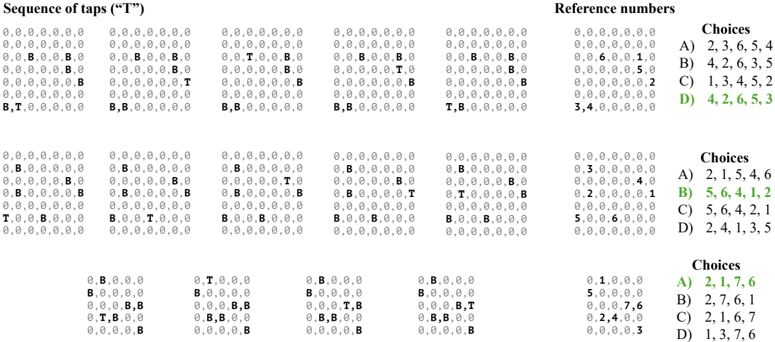
The image presents a structured table with three primary columns:
1. **Sequence of taps ("T")**: Rows of binary-like sequences composed of "T" (taps) and "B" (blanks).
2. **Reference numbers**: Columns of numerical values (0-6) and "B" placeholders.
3. **Choices**: Labeled options (A-D) with numerical sequences, where the correct answer is highlighted in green.
The table appears to encode a logic puzzle where sequences of "T" and "B" correspond to selecting specific numbers from the "Reference numbers" column to match one of the "Choices."
---
### Components/Axes
- **Columns**:
- **Sequence of taps ("T")**: Contains rows of 6-character sequences (e.g., `0,0,0,0,0,0`, `B,T,0,0,0,0`).
- **Reference numbers**: Columns of 6 values per row (e.g., `0,0,0,0,0,0`, `0,0,6,0,1,0`).
- **Choices**: Labeled A-D with 5-number sequences (e.g., A) 2,3,6,5,4; D) 4,2,6,5,3).
- **Labels**:
- Top row: "Sequence of taps (T)", "Reference numbers", "Choices".
- Sub-labels under "Choices": A, B, C, D with numerical options.
- **Formatting**:
- Correct answers in "Choices" are highlighted in green (e.g., D) 4,2,6,5,3).
- "B" in sequences and reference numbers likely denotes a placeholder or exclusion.
---
### Detailed Analysis
#### Sequence of Taps ("T")
- **Structure**: Each row has 6 entries (e.g., `0,0,0,0,0,0`, `B,T,0,0,0,0`).
- **Pattern**:
- "T" and "B" alternate, with "B" often appearing in specific positions (e.g., 4th or 5th).
- Example: Row 1: `B,T,0,0,0,0` (B in 1st, T in 2nd).
#### Reference Numbers
- **Structure**: 6 values per row, mixing numbers (0-6) and "B".
- **Examples**:
- Row 1: `0,0,6,0,1,0` (numbers 6 and 1 at positions 3 and 5).
- Row 2: `0,0,0,0,5,0` (number 5 at position 5).
#### Choices
- **Options**:
- A) 2,3,6,5,4
- B) 4,2,6,3,5
- C) 1,3,4,5,2
- D) 4,2,6,5,3 (correct answer, green-highlighted).
---
### Key Observations
1. **Correct Answers**:
- D) 4,2,6,5,3 is consistently the correct choice in the first two rows.
- Other rows show varying correct answers (e.g., A) 2,1,7,6 in the third section).
2. **Sequence-Reference Correlation**:
- "B" in sequences may indicate positions to exclude or prioritize in reference numbers.
- Example: In row 1, "B" in the 1st position and "T" in the 2nd might map to selecting numbers from positions 3, 4, 5, etc.
3. **Reference Number Patterns**:
- Numbers like 6, 5, and 4 appear frequently in correct answers.
- "B" in reference numbers may act as a wildcard or invalid value.
---
### Interpretation
The table likely represents a logic-based puzzle where:
- The "Sequence of taps" dictates which positions in the "Reference numbers" column to select.
- "B" in sequences may denote skipped or ignored positions, while "T" indicates active selection.
- The "Choices" column provides possible answers, with the correct one derived by mapping the sequence to the reference numbers.
For example:
- In the first row, the sequence `B,T,0,0,0,0` might instruct selecting numbers from positions 3, 4, 5, etc., in the reference numbers (`0,0,6,0,1,0`), leading to the correct answer D) 4,2,6,5,3.
This structure suggests a systematic method for encoding answers, possibly for a game or cognitive test. The use of "B" and "T" as binary indicators aligns with common logic puzzle conventions.