## Bar Chart: First Correct Answer Emergence by Decoding Steps
### Overview
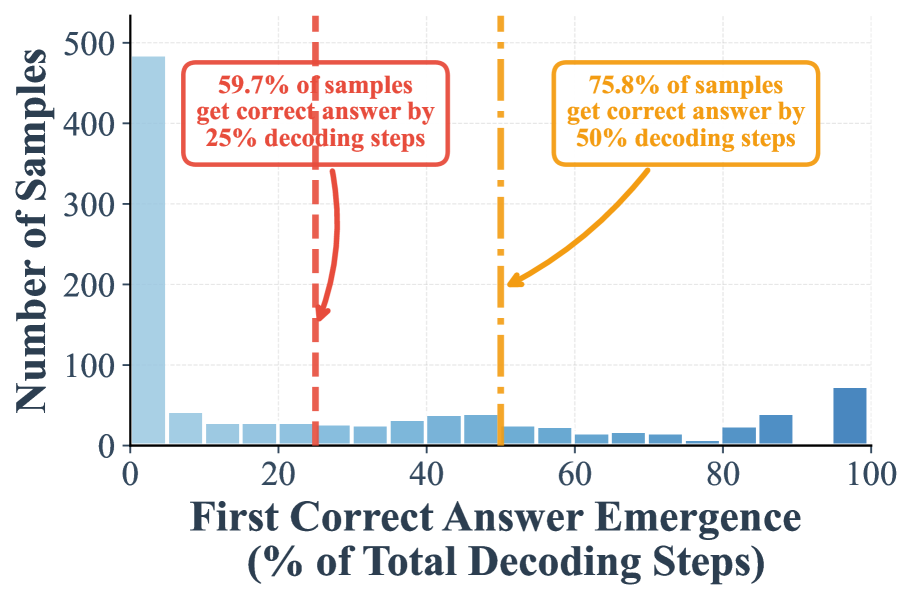
The chart visualizes the distribution of samples based on the percentage of total decoding steps required to identify the first correct answer. It highlights two key thresholds (25% and 50% decoding steps) with annotations showing cumulative correct answer rates.
### Components/Axes
- **Y-Axis**: "Number of Samples" (scale: 0–500, increments of 100).
- **X-Axis**: "First Correct Answer Emergence (% of Total Decoding Steps)" (scale: 0–100%, increments of 10%).
- **Legend**: Implicit via color-coded annotations:
- **Red dashed line**: 25% decoding steps (59.7% correct answers).
- **Orange dashed line**: 50% decoding steps (75.8% correct answers).
### Detailed Analysis
- **Bar Distribution**:
- **0% decoding steps**: Tallest bar (~480 samples).
- **10% decoding steps**: ~40 samples.
- **20% decoding steps**: ~30 samples.
- **30% decoding steps**: ~25 samples.
- **40% decoding steps**: ~35 samples.
- **50% decoding steps**: ~10 samples.
- **60–100% decoding steps**: Gradual decline, with the smallest bar at 100% (~70 samples).
- **Annotations**:
- Red box at 25%: "59.7% of samples get correct answer by 25% decoding steps."
- Orange box at 50%: "75.8% of samples get correct answer by 50% decoding steps."
### Key Observations
1. **Skewed Distribution**: Over 95% of samples resolve within the first 50% of decoding steps.
2. **Rapid Initial Drop**: Samples plummet from ~480 at 0% to ~40 at 10%, indicating most correct answers emerge immediately.
3. **Diminishing Returns**: Beyond 50%, the number of new correct answers per step decreases sharply (e.g., ~10 samples at 50% vs. ~70 at 100%).
### Interpretation
The data suggests that the system under analysis is highly efficient, with the majority of correct answers identified early in the decoding process. The 25% threshold captures nearly 60% of correct answers, while 50% captures 75.8%, implying that additional decoding steps yield minimal gains. This pattern could reflect:
- **Model Confidence**: Early steps may leverage strong prior knowledge or high-confidence predictions.
- **Data Characteristics**: Problems may be structured such that critical information is concentrated in initial decoding phases.
- **Resource Optimization**: Focusing computational resources on early decoding steps could maximize efficiency without significant loss of accuracy.
The sharp decline after 50% highlights potential bottlenecks or inefficiencies in later decoding stages, warranting further investigation into why fewer samples resolve in these phases.