# Technical Document Extraction: Neural Network Architecture Diagram
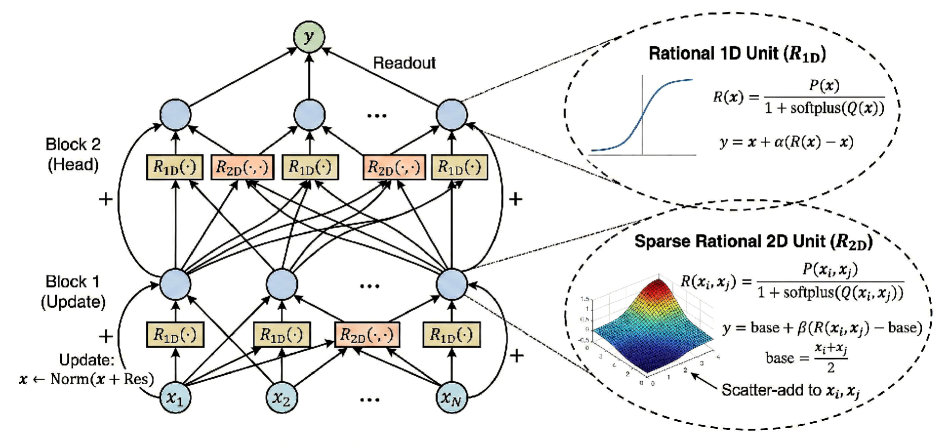
This document provides a comprehensive extraction and analysis of the provided technical diagram, which illustrates a multi-block neural network architecture utilizing 1D and 2D Rational Units.
## 1. High-Level Architecture Overview
The image depicts a hierarchical neural network structure organized into sequential processing blocks, culminating in a readout layer. The flow of data is bottom-up, with residual connections (indicated by "+" symbols and curved arrows) bypassing the functional units within each block.
### Component Segmentation
* **Input Layer:** Represented by nodes $x_1, x_2, \dots, x_N$.
* **Block 1 (Update):** The first processing stage involving 1D and 2D rational functions.
* **Block 2 (Head):** The second processing stage, mirroring the structure of Block 1 but leading to the final output.
* **Readout Layer:** Aggregates the outputs of Block 2 into a single output node $y$.
* **Functional Units:** Detailed callouts for **Rational 1D Unit ($R_{1D}$)** and **Sparse Rational 2D Unit ($R_{2D}$)**.
---
## 2. Detailed Block Analysis
### Block 1 (Update)
* **Inputs:** Receives signals from $x_1, x_2, \dots, x_N$.
* **Processing Units:**
* **$R_{1D}(\cdot)$:** Yellow rectangular blocks. These appear to process individual node features.
* **$R_{2D}(\cdot, \cdot)$:** Orange rectangular blocks. These process interactions between two nodes (e.g., between $x_2$ and $x_N$).
* **Residual Connection:** A curved arrow with a **+** sign indicates a skip connection from the input $x$ to the output of the block.
* **Update Rule Text:** `Update: x ← Norm(x + Res)`
### Block 2 (Head)
* **Inputs:** Receives the normalized output from Block 1.
* **Processing Units:** Contains a mix of $R_{1D}(\cdot)$ and $R_{2D}(\cdot, \cdot)$ units.
* **Connectivity:** Shows a dense interaction pattern where outputs from Block 1 nodes are cross-combined into the $R_{2D}$ units of Block 2.
* **Residual Connection:** Similar to Block 1, a curved arrow with a **+** sign bypasses the functional units.
### Readout
* **Process:** Arrows point from the top blue nodes of Block 2 to a single green node labeled **$y$**.
* **Label:** "Readout"
---
## 3. Functional Unit Specifications (Callouts)
### Rational 1D Unit ($R_{1D}$)
* **Visual Representation:** A 2D line plot showing a sigmoid-like (S-shaped) curve.
* **Mathematical Definition:**
$$R(x) = \frac{P(x)}{1 + \text{softplus}(Q(x))}$$
* **Output Equation:**
$$y = x + \alpha(R(x) - x)$$
*(Note: This represents a weighted residual update where $\alpha$ scales the change.)*
### Sparse Rational 2D Unit ($R_{2D}$)
* **Visual Representation:** A 3D surface plot showing a localized peak (resembling a Gaussian or bell shape) over a 2D plane.
* **Mathematical Definition:**
$$R(x_i, x_j) = \frac{P(x_i, x_j)}{1 + \text{softplus}(Q(x_i, x_j))}$$
* **Output Equation:**
$$y = \text{base} + \beta(R(x_i, x_j) - \text{base})$$
$$\text{base} = \frac{x_i + x_j}{2}$$
* **Operational Note:** An arrow points to the 3D plot with the text: **"Scatter-add to $x_i, x_j$"**. This indicates that the result of the 2D unit is distributed back to the constituent input nodes.
---
## 4. Textual Transcriptions
| Location | Original Text |
| :--- | :--- |
| Top Center | $y$ |
| Top Right | Readout |
| Left (Top) | Block 2 (Head) |
| Left (Middle) | Block 1 (Update) |
| Left (Bottom) | Update: $x \leftarrow \text{Norm}(x + \text{Res})$ |
| Bottom Nodes | $x_1, x_2, \dots, x_N$ |
| Unit Labels | $R_{1D}(\cdot)$, $R_{2D}(\cdot, \cdot)$ |
| Callout 1 Title | Rational 1D Unit ($R_{1D}$) |
| Callout 2 Title | Sparse Rational 2D Unit ($R_{2D}$) |
| Callout 2 Note | Scatter-add to $x_i, x_j$ |
---
## 5. Summary of Logic and Flow
1. **Input** $x$ enters the system.
2. **Block 1** applies 1D transformations to individual features and 2D transformations to pairs of features. The result is added back to the original input (Residual) and Normalized.
3. **Block 2** repeats this process, potentially with different weights or "Head" specific parameters.
4. The **Readout** layer performs a final aggregation of all node features to produce the scalar or vector output $y$.
5. The **Rational Units** use a specific ratio of polynomials ($P/Q$) stabilized by a softplus function to learn non-linear activations.