## Line Chart: Success Rate vs. Problem Size
### Overview
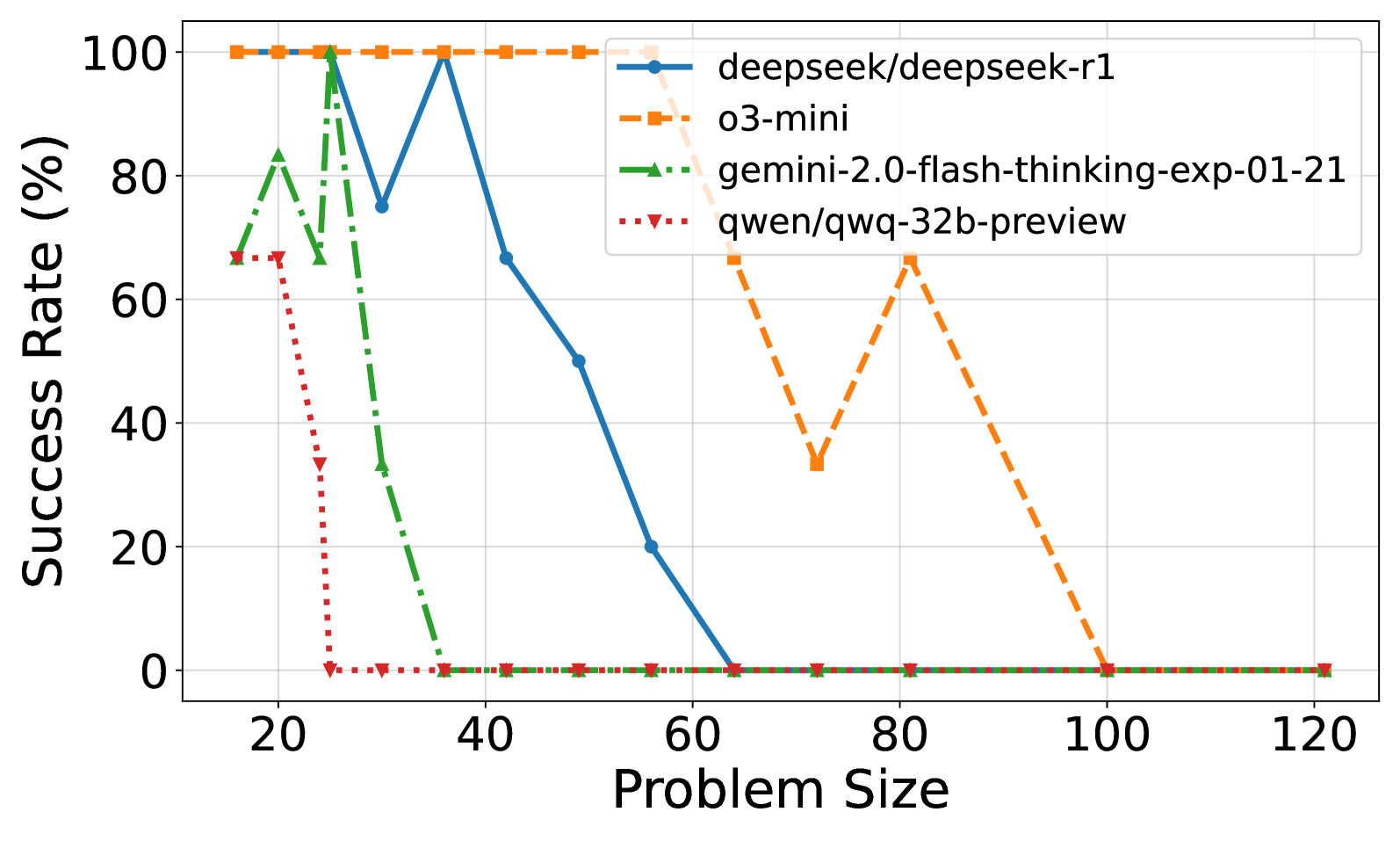
The image is a line chart comparing the success rates of four different models (deepseek/deepseek-r1, o3-mini, gemini-2.0-flash-thinking-exp-01-21, and qwen/qwq-32b-preview) across varying problem sizes. The x-axis represents the problem size, and the y-axis represents the success rate in percentage.
### Components/Axes
* **X-axis:** Problem Size, ranging from 20 to 120 in increments of 20.
* **Y-axis:** Success Rate (%), ranging from 0 to 100 in increments of 20.
* **Legend:** Located in the top-right corner of the chart.
* Blue line with circle markers: deepseek/deepseek-r1
* Orange dashed line with square markers: o3-mini
* Green dash-dot line with triangle markers: gemini-2.0-flash-thinking-exp-01-21
* Red dotted line with inverted triangle markers: qwen/qwq-32b-preview
### Detailed Analysis
* **deepseek/deepseek-r1 (Blue line with circle markers):**
* Trend: Starts at 100% success rate for problem size 20, remains at 100% until problem size 30, then decreases to approximately 75% at problem size 35, then decreases to approximately 52% at problem size 55, and finally drops to 0% at problem size 65 and remains at 0% for larger problem sizes.
* Data Points: (20, 100), (30, 100), (35, 75), (55, 52), (65, 0), (120, 0)
* **o3-mini (Orange dashed line with square markers):**
* Trend: Maintains a 100% success rate from problem size 20 to 40, then drops to approximately 33% at problem size 75, then increases to approximately 67% at problem size 80, then drops to 0% at problem size 100 and remains at 0% for larger problem sizes.
* Data Points: (20, 100), (40, 100), (75, 33), (80, 67), (100, 0), (120, 0)
* **gemini-2.0-flash-thinking-exp-01-21 (Green dash-dot line with triangle markers):**
* Trend: Starts at approximately 67% at problem size 20, increases to 100% at problem size 30, then drops to 0% at problem size 40 and remains at 0% for larger problem sizes.
* Data Points: (20, 67), (30, 100), (40, 0), (120, 0)
* **qwen/qwq-32b-preview (Red dotted line with inverted triangle markers):**
* Trend: Starts at approximately 67% at problem size 20, then drops to 0% at problem size 30 and remains at 0% for larger problem sizes.
* Data Points: (20, 67), (30, 0), (120, 0)
### Key Observations
* The deepseek/deepseek-r1 model shows a gradual decline in success rate as the problem size increases, eventually reaching 0%.
* The o3-mini model maintains a high success rate for smaller problem sizes but experiences a significant drop and fluctuation before ultimately failing.
* The gemini-2.0-flash-thinking-exp-01-21 model initially performs well but quickly drops to 0% success rate as the problem size increases.
* The qwen/qwq-32b-preview model has the poorest performance, dropping to 0% success rate very early on.
### Interpretation
The chart illustrates the performance of different models in relation to the problem size they are attempting to solve. The deepseek/deepseek-r1 model appears to be the most robust for moderately sized problems, while the other models either fail quickly or exhibit inconsistent performance. The data suggests that the deepseek/deepseek-r1 model is better at handling larger problem sizes compared to the other models, although its success rate eventually diminishes. The o3-mini model shows some potential for mid-sized problems, but its performance is not consistent. The gemini-2.0-flash-thinking-exp-01-21 and qwen/qwq-32b-preview models are not suitable for larger problem sizes based on this data.