## Diagram: Comparison of Question Answering Methods
### Overview
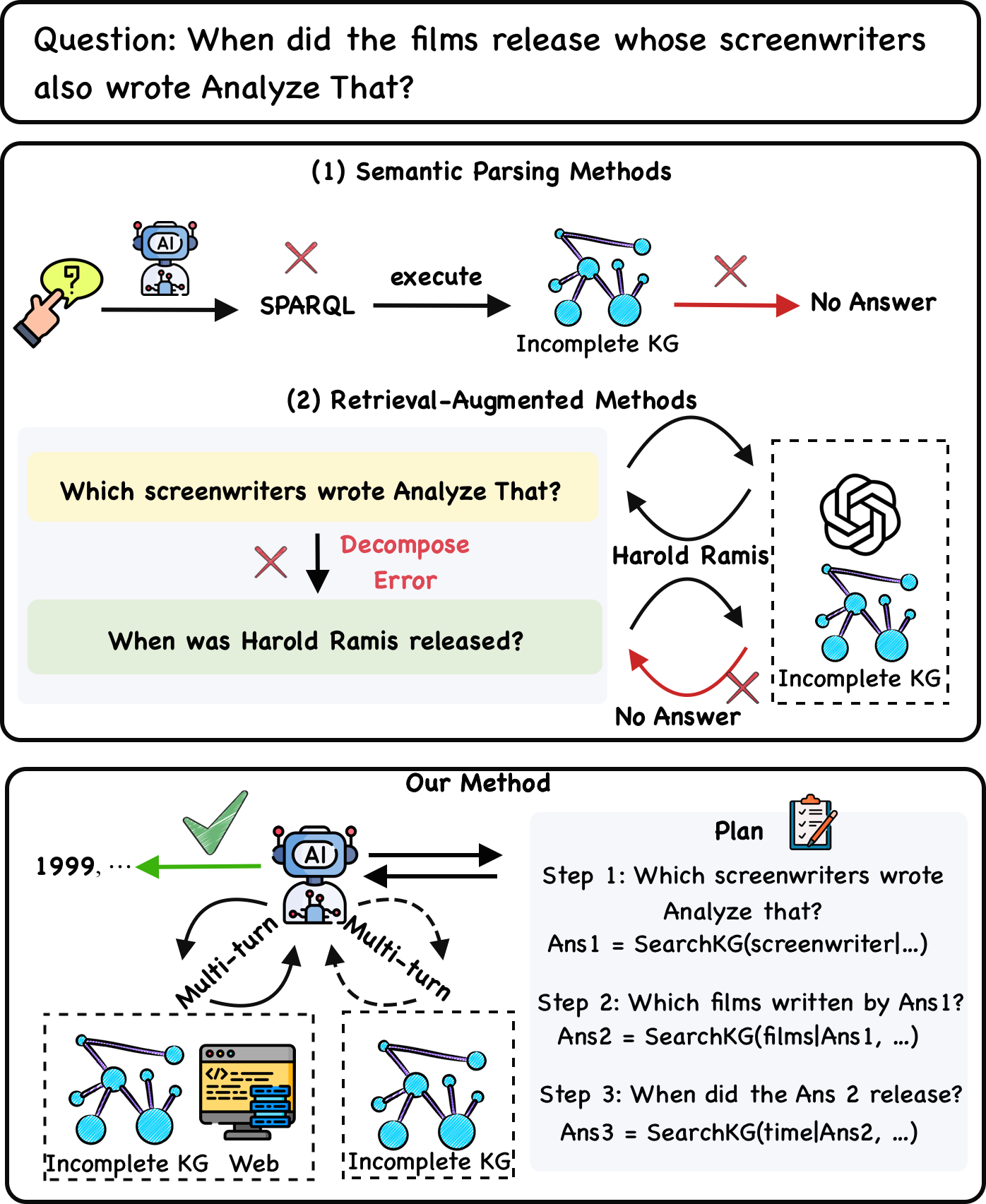
The image presents a diagram comparing three methods for answering the question: "When did the films release whose screenwriters also wrote Analyze That?". The methods compared are Semantic Parsing, Retrieval-Augmented, and "Our Method". The diagram illustrates the process flow for each method, highlighting their strengths and weaknesses.
### Components/Axes
* **Title:** Question: When did the films release whose screenwriters also wrote Analyze That?
* **(1) Semantic Parsing Methods:** Describes the first method.
* **Input:** A hand pointing to a question mark inside a speech bubble.
* **Process:** The input is processed by an AI agent, then converted to SPARQL. SPARQL is executed on an Incomplete KG (Knowledge Graph).
* **Output:** No Answer (indicated by a red "X").
* **(2) Retrieval-Augmented Methods:** Describes the second method.
* **Input:** The question "Which screenwriters wrote Analyze That?" (yellow background).
* **Process:** The question is decomposed, resulting in an error (red "X"). The question is then changed to "When was Harold Ramis released?" (green background). This is used to query a model represented by a logo similar to OpenAI's logo. The model uses Harold Ramis to query an Incomplete KG.
* **Output:** No Answer (indicated by a red "X").
* **Our Method:** Describes the third method.
* **Input:** The year "1999..." (green checkmark).
* **Process:** An AI agent processes the input using a multi-turn approach. The AI agent interacts with both an Incomplete KG and the Web.
* **Plan:** A list of steps is provided:
* Step 1: Which screenwriters wrote Analyze that? Ans1 = SearchKG(screenwriter|...)
* Step 2: Which films written by Ans1? Ans2 = SearchKG(films|Ans1, ...)
* Step 3: When did the Ans 2 release? Ans3 = SearchKG(time|Ans2, ...)
### Detailed Analysis
* **Semantic Parsing Methods:**
* The process starts with a question.
* The question is converted into a SPARQL query.
* The SPARQL query is executed against an incomplete knowledge graph (KG).
* The method fails to produce an answer.
* **Retrieval-Augmented Methods:**
* The process starts with the question "Which screenwriters wrote Analyze That?".
* The question is decomposed, but this results in an error.
* The question is changed to "When was Harold Ramis released?".
* The new question is used to query a model, which then queries an incomplete KG.
* The method fails to produce an answer.
* **Our Method:**
* The process starts with the year "1999...".
* An AI agent uses a multi-turn approach to interact with both an incomplete KG and the Web.
* The method follows a plan consisting of three steps:
* Step 1: Find the screenwriters of "Analyze That".
* Step 2: Find the films written by those screenwriters.
* Step 3: Find the release date of those films.
### Key Observations
* Both Semantic Parsing and Retrieval-Augmented methods fail to answer the question.
* "Our Method" successfully answers the question by using a multi-turn approach and interacting with both an incomplete KG and the Web.
* "Our Method" involves a plan with three steps, each involving a search of a knowledge graph (SearchKG).
### Interpretation
The diagram illustrates the limitations of traditional question-answering methods (Semantic Parsing and Retrieval-Augmented) when dealing with complex questions that require multiple steps and external knowledge. "Our Method" overcomes these limitations by using a multi-turn approach, combining knowledge from an incomplete KG with information from the Web. The success of "Our Method" highlights the importance of combining different sources of information and using a structured approach to answer complex questions. The diagram suggests that a more sophisticated approach is needed to answer complex questions that require multiple steps and external knowledge.