## Diagram: MLRA-2 Architecture
### Overview
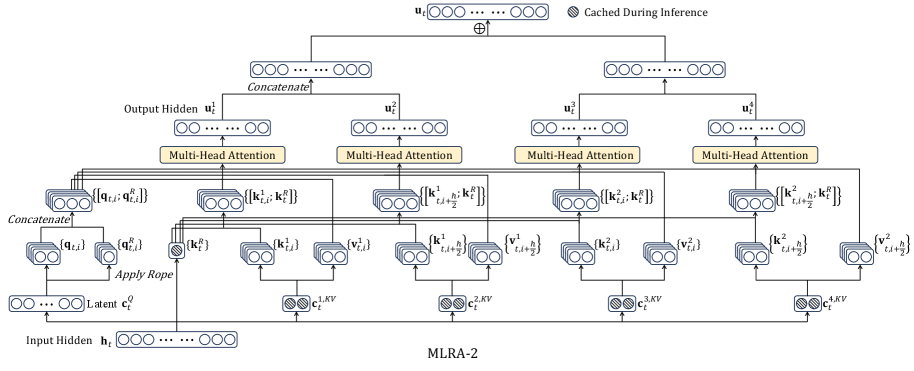
The diagram illustrates the architecture of the MLRA-2 model, a multi-stage processing pipeline for sequence data. It features input/output hidden states, multi-head attention mechanisms, concatenation operations, and cached inference states. The flow progresses from left (input) to right (output), with parallel processing paths and feedback loops.
### Components/Axes
1. **Input/Output States**:
- **Input Hidden**: `h_t` (leftmost node)
- **Output Hidden**: `u_t` (topmost node, cached during inference)
2. **Processing Blocks**:
- **Multi-Head Attention**: Four parallel blocks (labeled `u₁`, `u₂`, `u₃`, `u₄`)
- **Concatenate**: Merges outputs of attention heads
- **Apply Rope**: Positional encoding applied to latent states
3. **Latent States**:
- `c_t`, `c₁,KV`, `c₂,KV`, `c₃,KV`, `c₄,KV` (intermediate cached values)
4. **Key Vectors**:
- `k_t`, `k₁`, `k₂`, `k₃`, `k₄` (query/key vectors for attention)
- `v_t`, `v₁`, `v₂`, `v₃`, `v₄` (value vectors for attention)
5. **Legend**:
- **Cached During Inference**: Striped pattern (applies to `u_t` and latent states)
### Detailed Analysis
- **Input Flow**:
- `h_t` is split into query (`q_t`) and key (`k_t`) vectors.
- Queries and keys are processed through multi-head attention, generating intermediate latent states (`c₁,KV` to `c₄,KV`).
- **Attention Mechanism**:
- Each attention head (`u₁` to `u₄`) computes weighted sums of value vectors (`v₁` to `v₄`).
- Outputs are concatenated and passed through another attention layer to produce `u_t`.
- **Caching**:
- `u_t` and latent states (`c₁,KV` to `c₄,KV`) are marked as cached during inference, suggesting optimization for autoregressive generation.
### Key Observations
1. **Parallel Processing**: Four attention heads operate in parallel, enabling efficient computation.
2. **Positional Encoding**: `Apply Rope` indicates integration of positional information for sequence-aware modeling.
3. **Caching Strategy**: Critical states (`u_t`, `c₁,KV`–`c₄,KV`) are preserved to reduce redundant computation during inference.
4. **Feedback Loops**: Outputs from later stages (`u₃`, `u₄`) feed back into earlier attention heads, suggesting recurrent or hierarchical processing.
### Interpretation
The MLRA-2 architecture prioritizes **efficiency** and **sequence modeling**:
- **Efficiency**: Caching mechanisms (`u_t`, `c₁,KV`–`c₄,KV`) minimize recomputation, critical for long-sequence tasks.
- **Sequence Awareness**: Positional encoding (`Apply Rope`) and attention heads capture dependencies across time steps.
- **Hierarchical Design**: Parallel attention heads and feedback loops suggest a layered approach to feature extraction, balancing local and global context.
This design aligns with transformer-based models but introduces optimizations (e.g., selective caching) for specialized applications like autoregressive text generation or time-series forecasting.