## Line Graph: Correlation Function Gh vs. Distance Between Neurons
### Overview
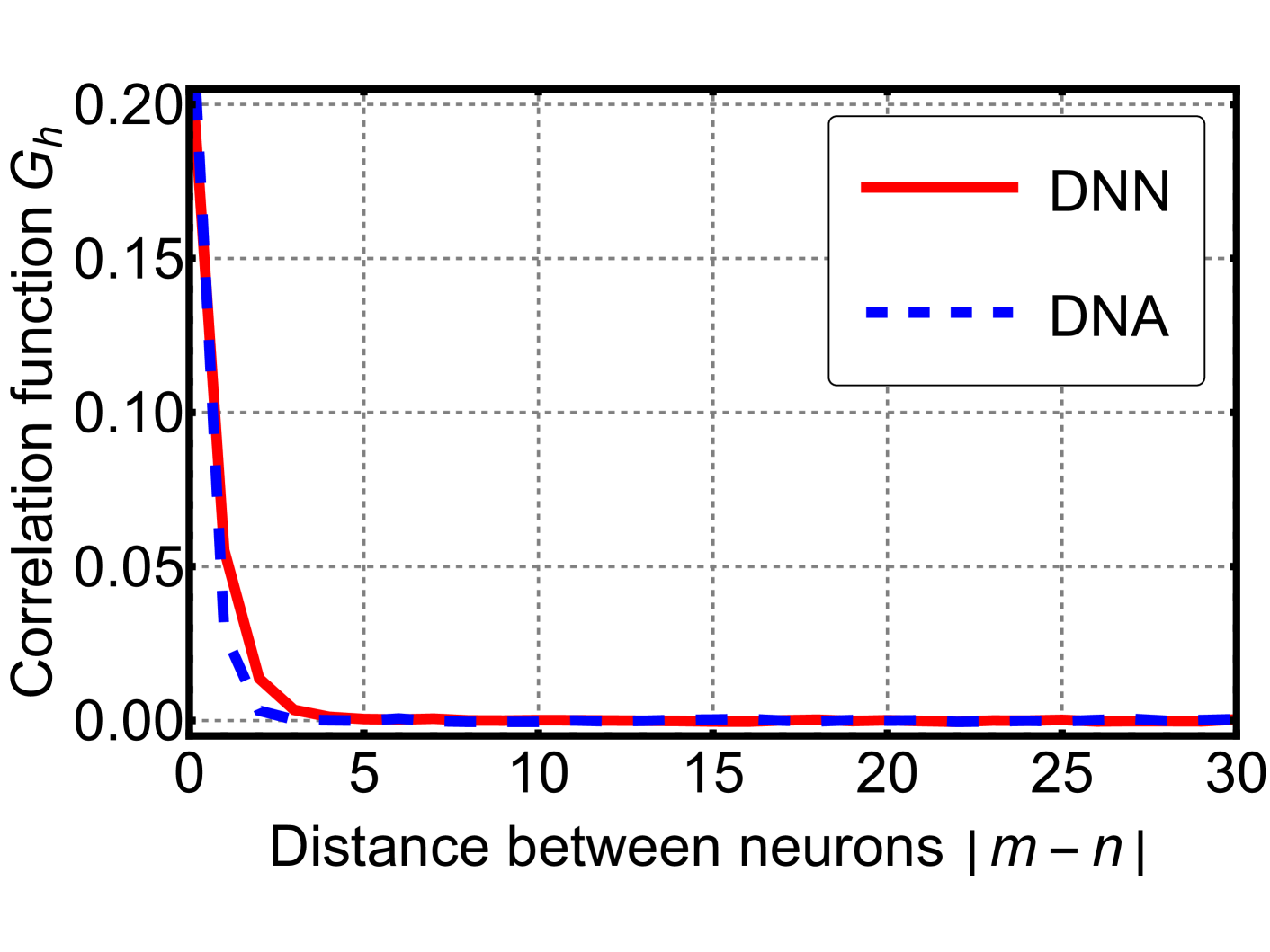
The graph compares the correlation function \( G_h \) for two systems: DNN (red solid line) and DNA (blue dashed line), plotted against the absolute distance between neurons \( |m - n| \). Both lines exhibit a sharp decline in correlation at small distances, followed by a plateau.
### Components/Axes
- **X-axis**: "Distance between neurons \( |m - n| \)" (range: 0 to 30, increments of 5).
- **Y-axis**: "Correlation function \( G_h \)" (range: 0 to 0.20, increments of 0.05).
- **Legend**: Located in the top-right corner.
- Red solid line: DNN.
- Blue dashed line: DNA.
### Detailed Analysis
1. **DNN (Red Solid Line)**:
- At \( |m - n| = 0 \): \( G_h \approx 0.20 \).
- At \( |m - n| = 5 \): \( G_h \approx 0.005 \).
- Remains near \( 0.00 \) for \( |m - n| \geq 5 \).
2. **DNA (Blue Dashed Line)**:
- At \( |m - n| = 0 \): \( G_h \approx 0.19 \).
- At \( |m - n| = 5 \): \( G_h \approx 0.002 \).
- Remains near \( 0.00 \) for \( |m - n| \geq 5 \).
3. **Trends**:
- Both lines show a steep exponential decay from \( |m - n| = 0 \) to \( |m - n| = 5 \).
- After \( |m - n| = 5 \), correlation values stabilize near zero for both systems.
- DNN consistently exhibits slightly higher \( G_h \) values than DNA at all distances.
### Key Observations
- **Rapid Decay**: Correlation diminishes sharply within the first 5 units of distance for both systems.
- **Convergence**: By \( |m - n| = 5 \), DNN and DNA correlation values are nearly indistinguishable.
- **Initial Difference**: DNN starts with a marginally higher correlation (\( 0.20 \) vs. \( 0.19 \)) at \( |m - n| = 0 \).
### Interpretation
The data suggests that both DNN and DNA exhibit strong, localized correlations at small neuron distances, with interactions decaying exponentially beyond a critical threshold (~5 units). The slight initial advantage of DNN may reflect architectural or functional differences in how these systems process spatial relationships. The near-identical decay patterns imply that both systems prioritize proximity-dependent interactions, with minimal influence at larger distances. This could have implications for optimizing neural network architectures or understanding biological DNA interaction mechanisms.