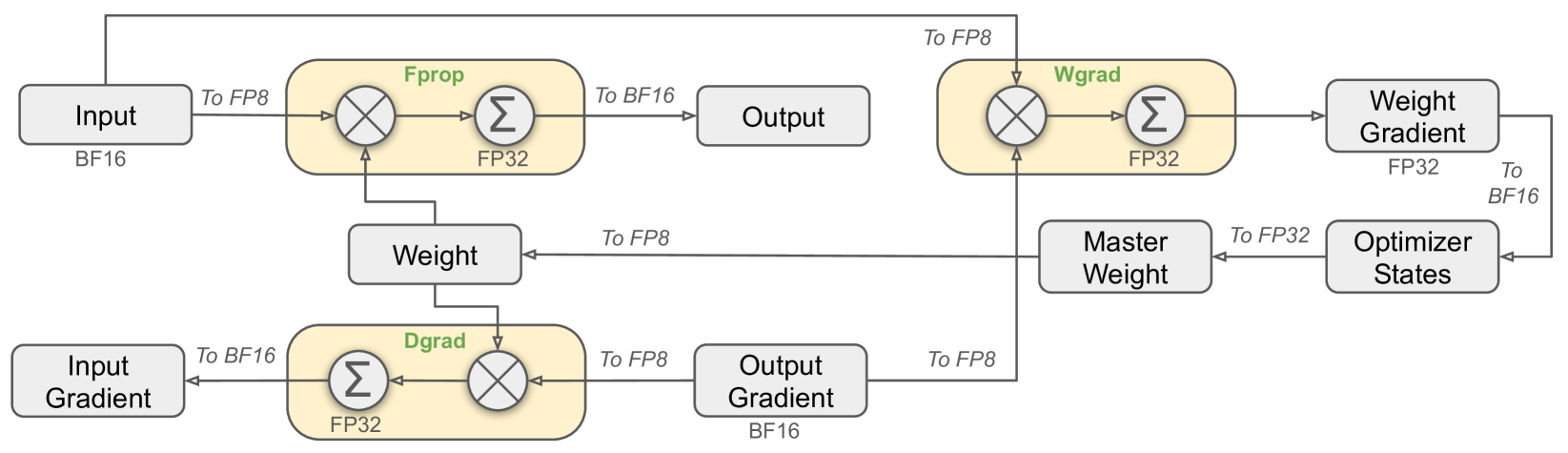
# Technical Diagram Analysis
## Components and Data Flow
1. **Input**
- Data Type: `BF16`
- Flow: `To FP8`
2. **Fprop (Forward Propagation)**
- Data Type: `FP32`
- Operations:
- `Σ` (Summation)
- `⊗` (Element-wise multiplication)
- Connections:
- `To BF16` (Output)
- `To FP8` (Weight)
3. **Output**
- Data Type: `BF16`
- Source: Fprop
4. **Weight**
- Data Type: `FP32`
- Connections:
- `To FP8` (Wgrad)
- `To FP32` (Master Weight)
5. **Wgrad (Weight Gradient)**
- Data Type: `FP32`
- Operations: `Σ`
- Connections:
- `To FP8` (Master Weight)
- `To BF16` (Optimizer States)
6. **Master Weight**
- Data Type: `FP32`
- Connections:
- `To FP32` (Optimizer States)
7. **Optimizer States**
- Data Type: `BF16`
- Source: Master Weight
8. **Input Gradient**
- Data Type: `BF16`
- Flow: `To FP32`
9. **Dgrad (Gradient Descent)**
- Data Type: `FP32`
- Operations:
- `Σ` (Summation)
- `⊗` (Element-wise multiplication)
- Connections:
- `To FP8` (Output Gradient)
10. **Output Gradient**
- Data Type: `BF16`
- Source: Dgrad
## Key Observations
- **Precision Handling**:
- `BF16` (Brain Floating Point 16-bit) used for Input/Output/Optimizer States.
- `FP32` (Single-precision Floating Point) used for intermediate computations (Fprop, Wgrad, Dgrad).
- **Data Flow Paths**:
- Forward pass: `Input (BF16) → FP8 → Fprop (FP32) → Output (BF16)`.
- Backward pass: `Input Gradient (BF16) → FP32 → Dgrad (FP32) → Output Gradient (BF16)`.
- Weight updates: `Weight (FP32) → FP8 → Wgrad (FP32) → Master Weight (FP32) → Optimizer States (BF16)`.
## Diagram Structure
- **Blocks**:
- Rectangular nodes represent computational units (e.g., Fprop, Wgrad).
- Oval nodes represent data types (e.g., BF16, FP32).
- **Arrows**:
- Indicate data flow direction.
- Labels specify precision (`To FP8`, `To BF16`, etc.).
- **Operations**:
- `Σ`: Summation across channels.
- `⊗`: Element-wise multiplication (e.g., input × weights).
## Missing Elements
- No explicit legend or colorbar present.
- No numerical data or statistical trends (pure architectural diagram).