TECHNICAL ASSET FINGERPRINT
5995626c6cebfb686667f838
Click to view fullscreen
Press ESC or click to close
FOUND IN PAPERS
EXPERT: gemini-2.0-flash VERSION 1
RUNTIME: nugit/gemini/gemini-2.0-flash
INTEL_VERIFIED
## Text Comparison: RAG Bot vs. Non-RAG Bot and Other Passages
### Overview
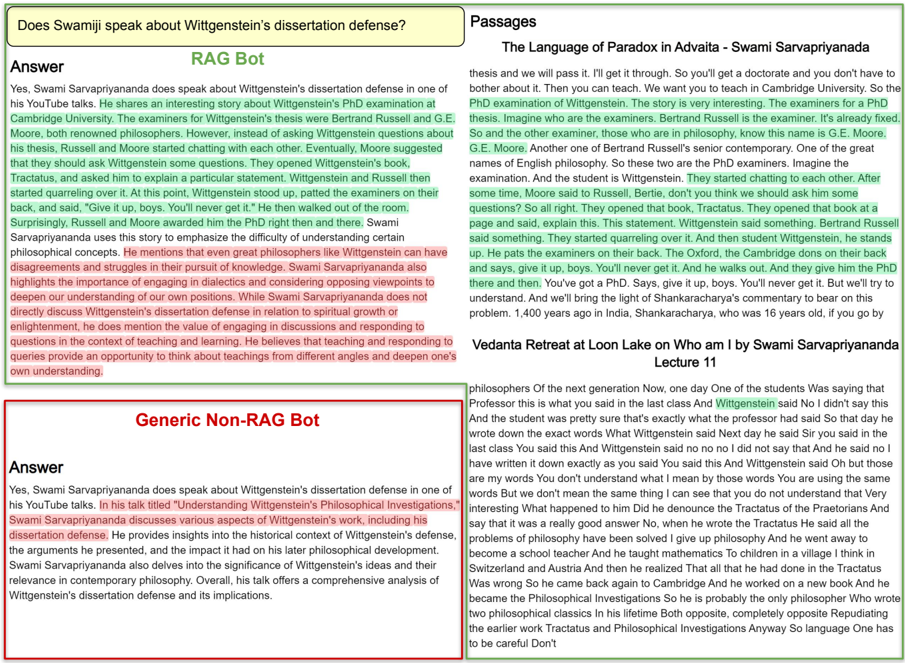
The image presents text from different sources, including responses from a RAG Bot and a Generic Non-RAG Bot to the question of whether Swamiji speaks about Wittgenstein's dissertation defense. It also includes passages from "The Language of Paradox in Advaita - Swami Sarvapriyananda" and "Vedanta Retreat at Loon Lake on Who am I by Swami Sarvapriyananda Lecture 11".
### Components/Axes
The image is divided into four main sections:
1. **RAG Bot Response:** This section contains the question and the answer provided by a RAG Bot.
2. **Generic Non-RAG Bot Response:** This section contains the answer provided by a Generic Non-RAG Bot.
3. **Passages:** This section contains text from "The Language of Paradox in Advaita - Swami Sarvapriyananda".
4. **Vedanta Retreat:** This section contains text from "Vedanta Retreat at Loon Lake on Who am I by Swami Sarvapriyananda Lecture 11".
### Detailed Analysis or ### Content Details
**1. RAG Bot Response:**
* **Question:** "Does Swamiji speak about Wittgenstein's dissertation defense?"
* **Answer:**
* Yes, Swami Sarvapriyananda does speak about Wittgenstein's dissertation defense in one of his YouTube talks.
* He shares an interesting story about Wittgenstein's PhD examination at Cambridge University.
* The examiners for Wittgenstein's thesis were Bertrand Russell and G.E. Moore, both renowned philosophers.
* Instead of asking Wittgenstein questions about his thesis, Russell and Moore started chatting with each other.
* Eventually, Moore suggested that they should ask Wittgenstein some questions.
* They opened Wittgenstein's book, Tractatus, and asked him to explain a particular statement.
* Wittgenstein and Russell then started quarreling over it.
* At this point, Wittgenstein stood up, patted the examiners on their back, and said, "Give it up, boys. You'll never get it." He then walked out of the room.
* Surprisingly, Russell and Moore awarded him the PhD right then and there.
* Swami Sarvapriyananda uses this story to emphasize the difficulty of understanding certain philosophical concepts.
* He mentions that even great philosophers like Wittgenstein can have disagreements and struggles in their pursuit of knowledge.
* Swami Sarvapriyananda also highlights the importance of engaging in dialectics and considering opposing viewpoints to deepen our understanding of our own positions.
* While Swami Sarvapriyananda does not directly discuss Wittgenstein's dissertation defense in relation to spiritual growth or enlightenment, he does mention the value of engaging in discussions and responding to questions in the context of teaching and learning.
* He believes that teaching and responding to queries provide an opportunity to think about teachings from different angles and deepen one's own understanding.
**2. Generic Non-RAG Bot Response:**
* **Answer:**
* Yes, Swami Sarvapriyananda does speak about Wittgenstein's dissertation defense in one of his YouTube talks.
* In his talk titled "Understanding Wittgenstein's Philosophical Investigations," Swami Sarvapriyananda discusses various aspects of Wittgenstein's work, including his dissertation defense.
* He provides insights into the historical context of Wittgenstein's defense, the arguments he presented, and the impact it had on his later philosophical development.
* Swami Sarvapriyananda also delves into the significance of Wittgenstein's ideas and their relevance in contemporary philosophy.
* Overall, his talk offers a comprehensive analysis of Wittgenstein's dissertation defense and its implications.
**3. Passages:**
* **Title:** The Language of Paradox in Advaita - Swami Sarvapriyananda
* **Content:**
* Thesis and we will pass it. I'll get it through. So you'll get a doctorate and you don't have to bother about it. Then you can teach. We want you to teach in Cambridge University.
* So the PhD examination of Wittgenstein. The story is very interesting. The examiners for a PhD thesis. Imagine who are the examiners. Bertrand Russell is the examiner. It's already fixed.
* So and the other examiner, those who are in philosophy, know this name is G.E. Moore. G.E. Moore. Another one of Bertrand Russell's senior contemporary. One of the great names of English philosophy. So these two are the PhD examiners. Imagine the examination.
* And the student is Wittgenstein. They started chatting to each other. After some time, Moore said to Russell, Bertie, don't you think we should ask him some questions? So all right. They opened that book, Tractatus. They opened that book at a page and said, explain this. This statement. Wittgenstein said something. Bertrand Russell said something. They started quarreling over it.
* And then student Wittgenstein, he stands up. He pats the examiners on their back. The Oxford, the Cambridge dons on their back and says, give it up, boys. You'll never get it. And he walks out. And they give him the PhD there and then. You've got a PhD. Says, give it up, boys. You'll never get it. But we'll try to understand.
* And we'll bring the light of Shankaracharya's commentary to bear on this problem. 1,400 years ago in India, Shankaracharya, who was 16 years old, if you go by
**4. Vedanta Retreat:**
* **Title:** Vedanta Retreat at Loon Lake on Who am I by Swami Sarvapriyananda Lecture 11
* **Content:**
* Philosophers Of the next generation Now, one day One of the students Was saying that Professor this is what you said in the last class And Wittgenstein said No I didn't say this
* And the student was pretty sure that's exactly what the professor had said So that day he wrote down the exact words What Wittgenstein said Next day he said Sir you said in the last class You said this And Wittgenstein said no no no I did not say that And he said no I have written it down exactly as you said You said this And Wittgenstein said Oh but those are my words You don't understand what I mean by those words You are using the same words But we don't mean the same thing I can see that you do not understand that Very interesting What happened to him Did he denounce the Tractatus of the Praetorians And say that it was a really good answer No, when he wrote the Tractatus He said all the problems of philosophy have been solved I give up philosophy And he went away to become a school teacher And he taught mathematics To children in a village I think in Switzerland and Austria And then he realized That all that he had done in the Tractatus Was wrong So he came back again to Cambridge And he worked on a new book And he became the Philosophical Investigations So he is probably the only philosopher Who wrote two philosophical classics In his lifetime Both opposite, completely opposite Repudiating the earlier work Tractatus and Philosophical Investigations Anyway So language One has to be careful Don't
### Key Observations
* Both the RAG Bot and the Generic Non-RAG Bot confirm that Swami Sarvapriyananda speaks about Wittgenstein's dissertation defense.
* The RAG Bot provides a more detailed and narrative answer, including a specific anecdote about Wittgenstein's PhD examination.
* The Generic Non-RAG Bot provides a more concise and summary-like answer.
* The "Passages" section provides a similar anecdote about Wittgenstein's PhD examination, suggesting a common source or theme.
* The "Vedanta Retreat" section presents a different anecdote about Wittgenstein and a student, highlighting the complexities of language and understanding.
### Interpretation
The image compares responses from different AI models (RAG Bot and Generic Non-RAG Bot) regarding a specific topic. The RAG Bot provides a more detailed and contextualized answer, while the Generic Non-RAG Bot offers a more concise summary. The inclusion of passages from Swami Sarvapriyananda's lectures provides additional context and insights into the topic of Wittgenstein's work and philosophical discussions. The anecdote about Wittgenstein's PhD examination appears in both the RAG Bot's response and the "Passages" section, suggesting a common source or a well-known story related to Wittgenstein's life and work. The "Vedanta Retreat" section offers a different perspective on Wittgenstein's views and the challenges of interpreting his ideas.
DECODING INTELLIGENCE...