TECHNICAL ASSET FINGERPRINT
5995626c6cebfb686667f838
Click to view fullscreen
Press ESC or click to close
FOUND IN PAPERS
EXPERT: healer-alpha-free VERSION 1
RUNTIME: free/openrouter/healer-alpha
INTEL_VERIFIED
## Comparative Analysis: RAG Bot vs. Generic Non-RAG Bot Response
### Overview
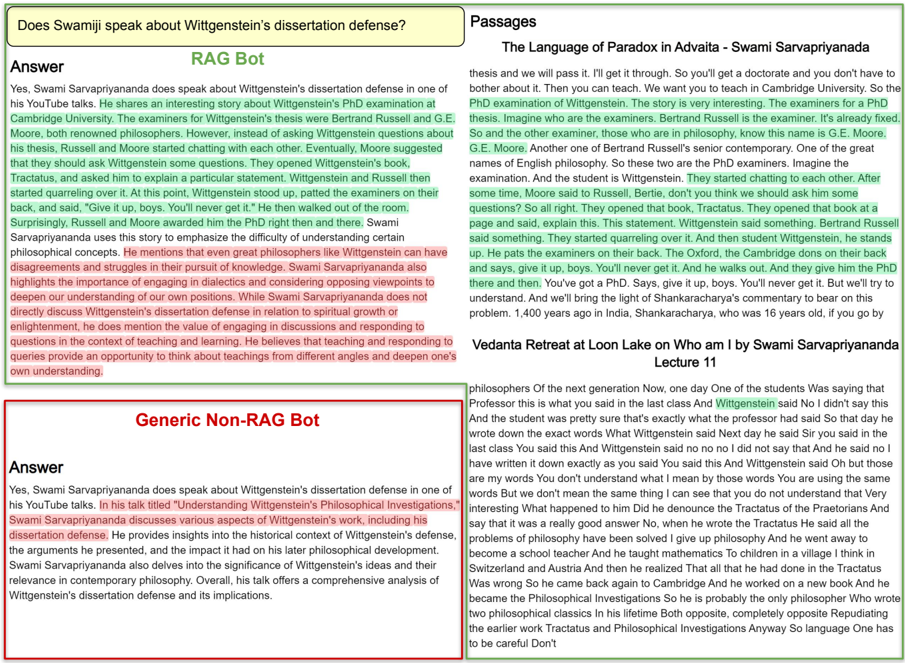
The image is a side-by-side comparison of two AI-generated answers to the same question: "Does Swamiji speak about Wittgenstein's dissertation defense?" The left panel shows the response from a "RAG Bot" (Retrieval-Augmented Generation), and the right panel shows the response from a "Generic Non-RAG Bot." The layout is designed to contrast the quality, specificity, and sourcing of the two answers. The RAG Bot's answer is detailed and includes a specific anecdote, while the Non-RAG Bot's answer is more generic. Text is highlighted in green and red to indicate correct/relevant and incorrect/irrelevant information, respectively.
### Components/Axes
The image is divided into two primary vertical panels, with an additional text box in the upper right.
**1. Left Panel (RAG Bot):**
* **Header:** "Does Swamiji speak about Wittgenstein's dissertation defense?" (in a yellow box).
* **Sub-header:** "Answer" followed by "RAG Bot" in large green text.
* **Main Text Block:** The RAG Bot's answer. Key phrases are highlighted:
* **Green Highlights:** "He shares an interesting story about Wittgenstein's PhD examination at Cambridge University.", "The examiners for Wittgenstein's thesis were Bertrand Russell and G.E. Moore...", "Russell and Moore started chatting with each other.", "Moore suggested that they should ask Wittgenstein some questions.", "They opened Bertrand Russell's book, Tractatus, and asked him to explain a particular statement.", "Wittgenstein and Russell then started quarrelling over it.", "Wittgenstein stood up, patted the examiners on the back, and said, 'Give it up, boys. You'll never get it.'", "Surprisingly, Russell and Moore awarded him the PhD right then and there.", "Swami Sarvapriyananda uses this story to emphasize the difficulty of understanding certain philosophical concepts.", "He mentions that even great philosophers like Wittgenstein can have disagreements and misunderstandings.", "This highlights the importance of engaging in dialectics and considering opposing viewpoints to deepen our understanding of our own positions."
* **Red Highlights:** "While Swami Sarvapriyananda does not directly discuss Wittgenstein's dissertation defense in relation to spiritual growth or enlightenment, he does mention the value of engaging in discussions and responding to questions in the context of teaching and learning.", "He believes that teaching and responding to queries provide an opportunity to think about teachings from different angles and deepen one's own understanding."
**2. Right Panel (Generic Non-RAG Bot):**
* **Header:** "Generic Non-RAG Bot" in large red text.
* **Sub-header:** "Answer"
* **Main Text Block:** The Non-RAG Bot's answer. Key phrases are highlighted:
* **Red Highlights:** "In his talk titled 'Understanding Wittgenstein's Philosophical Investigations,' Swami Sarvapriyananda discusses various aspects of Wittgenstein's work, including his dissertation defense.", "He provides insights into the historical context of Wittgenstein's defense, the arguments he presented, and the impact it had on his later philosophical development.", "Swami Sarvapriyananda also delves into the significance of Wittgenstein's ideas and their relevance in contemporary philosophy.", "Overall, his talk offers a comprehensive analysis of Wittgenstein's dissertation defense and its implications."
**3. Upper Right Text Box (Source Passage):**
* **Header:** "Passages" in bold.
* **Title:** "The Language of Paradox in Advaita - Swami Sarvapriyananda"
* **Sub-title:** "Vedanta Retreat at Loom Lake on Who am I? by Swami Sarvapriyananda Lecture 11"
* **Main Text Block:** A transcript of a spoken passage. The entire block is highlighted in green, indicating it is the source material for the RAG Bot's answer. The text recounts the anecdote about Wittgenstein's PhD examination, matching the story in the RAG Bot's response.
### Detailed Analysis
**RAG Bot Answer Analysis:**
* **Content:** Provides a specific, narrative-driven answer. It correctly identifies that Swamiji (Swami Sarvapriyananda) tells a story about Wittgenstein's PhD defense, names the examiners (Bertrand Russell and G.E. Moore), and describes the key event (the quarrel over the *Tractatus*).
* **Sourcing:** The answer is directly supported by the provided "Passages" text box, which contains the exact anecdote.
* **Structure:** The answer is structured as a story followed by an interpretation of its philosophical significance (highlighted in green) and a concluding note on its relation to teaching (highlighted in red, possibly indicating a less direct or tangential point).
**Generic Non-RAG Bot Answer Analysis:**
* **Content:** Provides a vague, generic summary. It claims Swamiji discusses the defense in a specific talk ("Understanding Wittgenstein's Philosophical Investigations") and offers "insights," "arguments," and "impact," but provides no specific details.
* **Sourcing:** The answer appears to be a fabricated or hallucinated summary. The specific talk title is not verified in the provided source material, and the claims are unsubstantiated.
* **Structure:** The entire answer is highlighted in red, indicating it is considered incorrect or irrelevant by the image's creator.
**Source Passage Analysis:**
* **Content:** A verbatim transcript of a spoken lecture. It contains the detailed story about Wittgenstein's examination, including dialogue and specific names.
* **Language:** English.
* **Function:** Serves as the ground truth or reference document against which the RAG Bot's answer is validated.
### Key Observations
1. **Accuracy vs. Hallucination:** The RAG Bot's answer is factually accurate based on the provided source text. The Non-RAG Bot's answer contains specific, unverifiable claims (e.g., a talk title) that are not present in the source, demonstrating a tendency to hallucinate.
2. **Specificity:** The RAG Bot provides concrete details (names, book title, dialogue). The Non-RAG Bot uses vague, generic language ("various aspects," "insights," "significance").
3. **Use of Source Material:** The RAG Bot's answer is directly derived from and supported by the "Passages" text. The Non-RAG Bot's answer does not appear to reference the provided source.
4. **Visual Coding:** The use of green and red highlights creates a clear visual dichotomy: green for correct/sourced information (RAG Bot answer and source passage) and red for incorrect/unsourced information (Non-RAG Bot answer and the tangential conclusion in the RAG Bot answer).
### Interpretation
This image is a technical demonstration or evaluation comparing two AI response generation methodologies. It argues for the superiority of Retrieval-Augmented Generation (RAG) over a generic language model for factual, source-grounded question answering.
* **What the data suggests:** The RAG system, when provided with a relevant source document, can generate a precise, detailed, and accurate answer that closely mirrors the source. The generic model, lacking a retrieval mechanism, generates a plausible-sounding but factually unsupported response.
* **How elements relate:** The "Passages" box is the key. It is the ground truth. The RAG Bot's answer is a successful extraction and synthesis from this passage. The Non-RAG Bot's answer exists in a vacuum, disconnected from the source, leading to inaccuracies. The color highlights explicitly map the relationship between the source (green) and the correct answer (green), while marking deviations (red).
* **Notable anomalies:** The red-highlighted portion at the end of the RAG Bot's answer is interesting. It suggests that even a RAG system can include tangential or less directly relevant information, which the evaluator has flagged. This indicates a nuanced evaluation beyond simple fact-checking, possibly assessing relevance to the core question.
* **Underlying message:** The image serves as a case study for why RAG is critical for applications requiring factual accuracy and verifiability (e.g., technical support, research assistance, legal or medical information). It visually argues that without grounding in a source, LLMs are prone to generating confident but incorrect information.
DECODING INTELLIGENCE...