\n
## Diagram: Logical Relationship Representation
### Overview
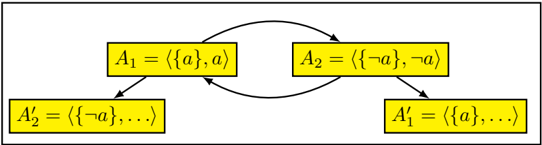
The image depicts a diagram illustrating a logical relationship between four sets: A1, A2, A1', and A2'. The sets are represented as yellow rectangles with textual content inside, and arrows indicate a directional relationship between them. The diagram appears to represent a transformation or mapping between these sets.
### Components/Axes
The diagram consists of four rectangular blocks labeled as follows:
* **A1:** `A1 = { {a}, a }`
* **A2:** `A2 = { {¬a}, ¬a }`
* **A1':** `A1' = { {a}, ... }`
* **A2':** `A2' = { {¬a}, ... }`
Two curved arrows connect the sets, indicating a cyclical relationship. The arrows originate from A1 to A2 and from A2 to A1. Two straight arrows connect A1 to A1' and A2 to A2'.
### Detailed Analysis or Content Details
The sets are defined using set notation.
* **A1** is defined as the set containing the set `{a}` and the element `a`.
* **A2** is defined as the set containing the set `{¬a}` and the element `¬a`. `¬a` represents the negation of `a`.
* **A1'** is defined as the set containing the set `{a}` and an ellipsis `...`, indicating further elements.
* **A2'** is defined as the set containing the set `{¬a}` and an ellipsis `...`, indicating further elements.
The arrows suggest a transformation or mapping. The curved arrows between A1 and A2 suggest a reciprocal relationship or a cyclical process. The straight arrows suggest a derivation or transformation from A1 to A1' and A2 to A2'.
### Key Observations
The use of negation (`¬a`) in A2 suggests a complementary or opposite relationship to A1. The ellipsis in A1' and A2' indicates that these sets contain additional elements beyond those explicitly stated. The diagram is symmetrical in its structure, with A1 and A2 being counterparts, and A1' and A2' being their respective transformations.
### Interpretation
This diagram likely represents a logical operation or a transformation within a formal system, possibly related to set theory or logic. The sets A1 and A2 could represent propositions or concepts, and the arrows represent a logical implication or derivation. The transformation from A1 to A1' and A2 to A2' could represent the application of a logical rule or operation. The cyclical relationship between A1 and A2 suggests a feedback loop or a recursive process. The ellipsis indicates that the sets are not fully defined, and there may be other elements or considerations involved.
The diagram could be illustrating a concept like complementation, negation, or a transformation within a logical framework. The specific meaning would depend on the context in which this diagram is used. It is a visual representation of a logical relationship, and the precise interpretation requires understanding the underlying logical system.