## Diagram: State Transition Diagram with Logical Sets
### Overview
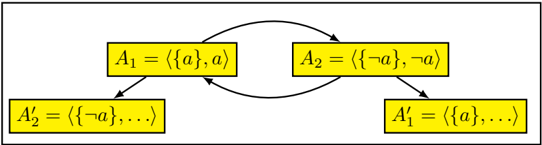
The image displays a state transition diagram consisting of four rectangular nodes (yellow boxes) connected by directed arrows. The diagram appears to represent states in a logical or computational system, possibly related to belief revision, non-monotonic reasoning, or formal argumentation. Each node contains a label (A₁, A₂, A₂', A₁') and a set defined using mathematical notation. The arrows indicate possible transitions or relationships between these states.
### Components/Axes
The diagram has no traditional axes. The components are:
1. **Nodes (Yellow Boxes):** Four rectangular boxes with black borders, filled with a solid yellow color.
2. **Labels:** Each node has a unique label placed to its left or right: `A₁`, `A₂`, `A₂'`, `A₁'`.
3. **Set Notation:** Inside each node, a set is defined using angle brackets `⟨ ⟩` and curly braces `{ }`. The notation includes logical symbols (e.g., `¬` for negation).
4. **Directed Arrows:** Four curved, black arrows connect the nodes, indicating the direction of transition or relationship.
### Detailed Analysis
**Node Content and Spatial Placement:**
* **Top-Left Node:** Labeled `A₁`. Contains the set `⟨{a}, a⟩`.
* **Top-Right Node:** Labeled `A₂`. Contains the set `⟨{¬a}, ¬a⟩`.
* **Bottom-Left Node:** Labeled `A₂'`. Contains the set `⟨{¬a}, ...⟩`. The ellipsis (`...`) suggests the set may be incomplete or continue.
* **Bottom-Right Node:** Labeled `A₁'`. Contains the set `⟨{a}, ...⟩`. The ellipsis (`...`) suggests the set may be incomplete or continue.
**Connections (Arrows):**
1. A curved arrow originates from the **right side of node A₁** and points to the **left side of node A₂**.
2. A curved arrow originates from the **bottom of node A₂** and points to the **top of node A₁**. This creates a **bidirectional cycle** between A₁ and A₂.
3. A straight arrow originates from the **bottom of node A₁** and points to the **top of node A₂'**.
4. A straight arrow originates from the **bottom of node A₂** and points to the **top of node A₁'**.
### Key Observations
1. **Symmetry and Opposition:** Nodes A₁ and A₂ are direct opposites. A₁ is associated with the proposition `a` (both as a singleton set `{a}` and as a standalone element), while A₂ is associated with its negation `¬a` (as `{¬a}` and `¬a`).
2. **Primed States:** The nodes A₂' and A₁' are labeled with a prime symbol (`'`). Their set contents mirror the core proposition of their unprimed counterparts (A₂' contains `{¬a}`, A₁' contains `{a}`) but are presented as incomplete (`...`).
3. **Transition Logic:** The diagram suggests two types of relationships:
* A **cyclic, possibly mutually exclusive or revisable relationship** between the primary states A₁ and A₂.
* A **derivative or fallback relationship** from each primary state to a "primed" version of the *opposite* state (A₁ → A₂', A₂ → A₁'). This could represent a shift to an alternative, less committed, or revised state when the primary one is challenged.
### Interpretation
This diagram likely models a system of **defeasible reasoning or belief sets**. The notation `⟨{...}, ...⟩` is reminiscent of formal argumentation frameworks or belief bases where the first element might be a set of premises and the second a conclusion or a preferred formula.
* **A₁ and A₂** represent two conflicting, stable positions: one where `a` is believed/true, and one where `¬a` is believed/true. The cycle between them could represent an argumentative conflict or a toggling between two coherent but incompatible worldviews.
* **A₂' and A₁'** appear to be **revised or alternative states**. The transition from A₁ to A₂' (which contains `¬a`) might model a process where, upon encountering evidence against `a`, the system doesn't fully adopt the strong `¬a` position of A₂ but instead moves to a weaker, possibly tentative state (A₂') that acknowledges `¬a` as a possibility. The ellipsis (`...`) strongly implies these states are under-defined or contain additional, unspecified elements.
* The overall structure suggests a mechanism for handling contradiction. Instead of a simple binary switch, the system has primary, committed states and secondary, more flexible states it can retreat to, facilitating non-monotonic reasoning where conclusions can be retracted in light of new information.
**Language:** The text in the image is **mathematical notation**. The primary language of the labels and symbols is formal logic/set theory. No natural language (e.g., English, Chinese) sentences are present.