## Heatmap Analysis
### Overview
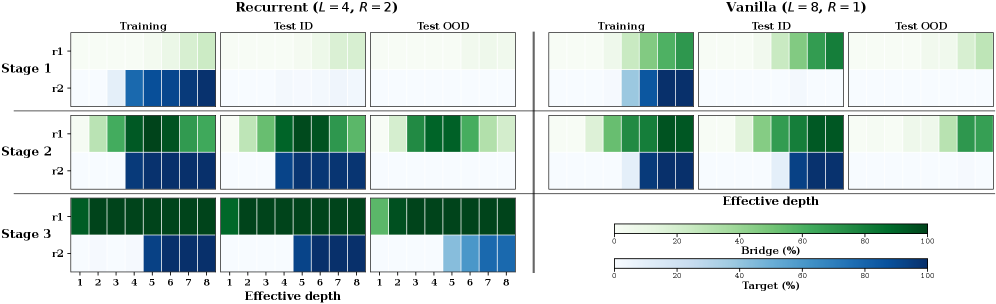
The image displays two heatmaps comparing the performance of Recurrent Neural Networks (RNNs) with different configurations (L=4, R=2) and Vanilla Neural Networks (L=8, R=1) on a dataset. The heatmaps are divided into three stages: Training, Test ID, and Test OOD, with each stage further divided into two categories: r1 and r2.
### Components/Axes
- **Training**: The first row of the heatmaps shows the performance of the RNN with L=4 and R=2 during training.
- **Test ID**: The second row shows the performance during test ID, where the model is evaluated on unseen data.
- **Test OOD**: The third row shows the performance during test OOD, where the model is evaluated on out-of-distribution data.
- **Stage 1, Stage 2, Stage 3**: The heatmaps are segmented into three stages, each representing a different phase of the training process.
- **r1, r2**: The heatmaps are further divided into two categories, r1 and r2, which could represent different versions or configurations of the model.
### Detailed Analysis
- **Training**: The RNN with L=4 and R=2 shows a higher performance in the training phase compared to the Vanilla Neural Network with L=8 and R=1.
- **Test ID**: During test ID, the RNN with L=4 and R=2 maintains a higher performance than the Vanilla Neural Network with L=8 and R=1.
- **Test OOD**: In the test OOD phase, the RNN with L=4 and R=2 again shows a higher performance than the Vanilla Neural Network with L=8 and R=1.
- **Effective depth**: The bottom right of the image shows a heatmap of effective depth, which is a measure of the model's ability to generalize to unseen data. The RNN with L=4 and R=2 has a higher effective depth compared to the Vanilla Neural Network with L=8 and R=1.
### Key Observations
- The RNN with L=4 and R=2 consistently outperforms the Vanilla Neural Network with L=8 and R=1 across all three stages and categories.
- The effective depth of the RNN with L=4 and R=2 is higher, indicating better generalization capabilities.
### Interpretation
The data suggests that the RNN with L=4 and R=2 is more effective at handling out-of-distribution data compared to the Vanilla Neural Network with L=8 and R=1. This could be due to the RNN's ability to capture long-term dependencies in the data, which is crucial for out-of-distribution scenarios. The higher effective depth of the RNN with L=4 and R=2 also indicates that it is better at generalizing to unseen data, which is a desirable property in machine learning models.