## Timing Diagram: Memory Operation Phases
### Overview
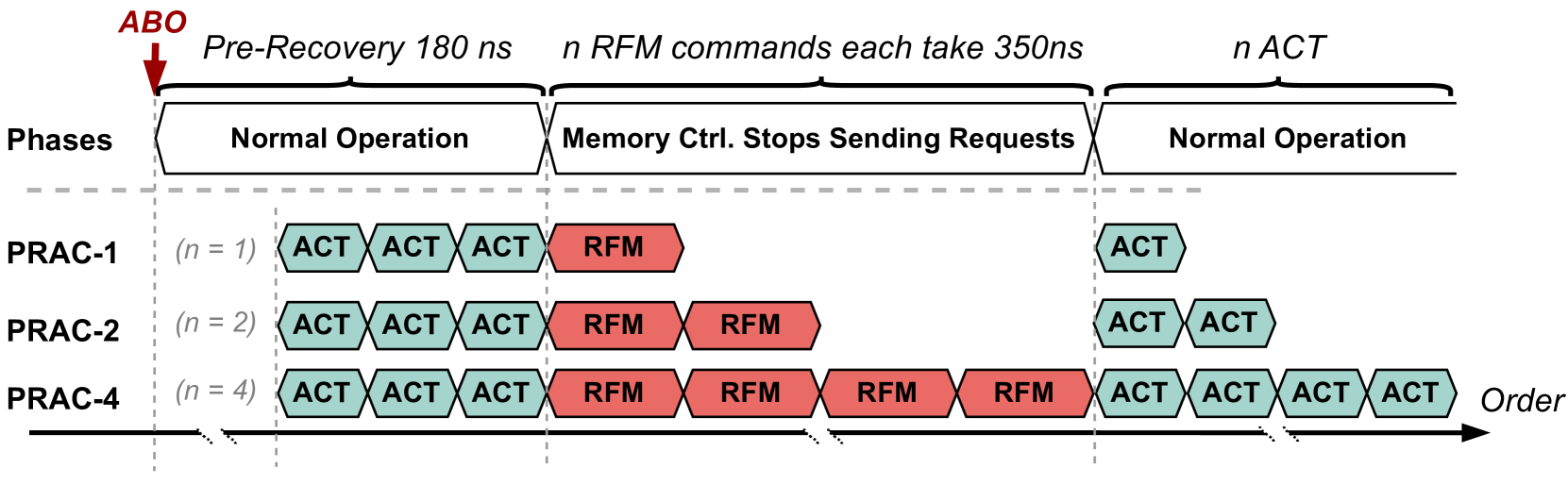
The image is a timing diagram illustrating different phases of memory operation, specifically focusing on the interaction between normal operation, memory controller requests, and the impact of RFM commands on ACT commands for different PRAC levels (PRAC-1, PRAC-2, PRAC-4). The diagram shows the sequence of ACT and RFM commands and their timing relative to the overall phases.
### Components/Axes
* **Title:** None explicitly given, but the diagram illustrates memory operation phases.
* **Horizontal Axis:** Represents time/order of operations, labeled "Order" on the right side.
* **Vertical Axis:** Represents different PRAC levels (PRAC-1, PRAC-2, PRAC-4) and phases of operation.
* **Phases:**
* Normal Operation
* Memory Ctrl. Stops Sending Requests
* Normal Operation
* **Commands:**
* ACT (represented by a light blue hexagon)
* RFM (represented by a red hexagon)
* **Timing Information:**
* Pre-Recovery: 180 ns
* n RFM commands each take 350ns
* **PRAC Levels:**
* PRAC-1 (n = 1)
* PRAC-2 (n = 2)
* PRAC-4 (n = 4)
* **ABO:** Denoted by a red arrow pointing downwards at the start of the timeline.
### Detailed Analysis
The diagram is structured into rows representing different PRAC levels, each showing a sequence of ACT and RFM commands. The top row indicates the overall phases of operation.
* **Phases:** The phases are divided into "Normal Operation", "Memory Ctrl. Stops Sending Requests", and "Normal Operation". The "Memory Ctrl. Stops Sending Requests" phase is associated with the RFM commands.
* **PRAC-1 (n = 1):** Starts with three ACT commands, followed by one RFM command, and then one ACT command.
* **PRAC-2 (n = 2):** Starts with three ACT commands, followed by two RFM commands, and then two ACT commands.
* **PRAC-4 (n = 4):** Starts with three ACT commands, followed by four RFM commands, and then four ACT commands.
* **Timing:** The "Pre-Recovery" phase is 180 ns. Each RFM command takes 350 ns. The number of ACT commands varies depending on the PRAC level.
### Key Observations
* The number of RFM commands increases with the PRAC level (1 for PRAC-1, 2 for PRAC-2, 4 for PRAC-4).
* The number of ACT commands after the RFM commands also increases with the PRAC level.
* The diagram illustrates the timing relationship between ACT and RFM commands and how they relate to the overall phases of memory operation.
### Interpretation
The diagram illustrates how different PRAC levels affect the sequence and timing of ACT and RFM commands during memory operations. As the PRAC level increases, the number of RFM commands increases, which likely corresponds to a longer "Memory Ctrl. Stops Sending Requests" phase. The diagram suggests that higher PRAC levels involve more frequent or longer periods where the memory controller stops sending requests, potentially for refresh or maintenance operations. The "Pre-Recovery" time of 180 ns likely represents a delay required before normal operation can resume after the RFM commands are completed. The diagram highlights the trade-offs between performance and maintenance in memory systems, where higher PRAC levels may provide better data integrity or reliability at the cost of increased latency due to the RFM commands.