## Diagram: XP-Asserted to Pre-XP Node Transformation
### Overview
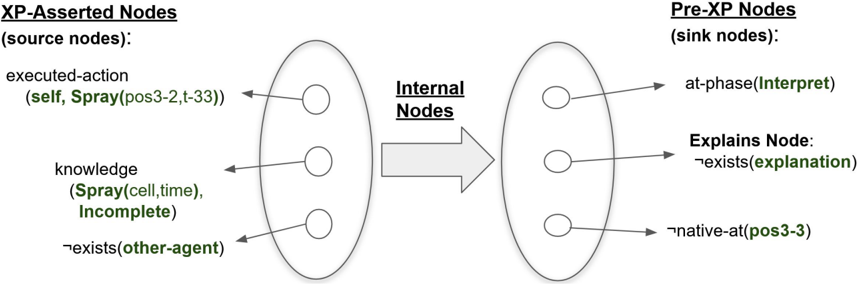
This image presents a conceptual diagram illustrating a transformation or mapping process between two sets of nodes: "XP-Asserted Nodes" (source nodes) and "Pre-XP Nodes" (sink nodes). The transformation is mediated by an implied process labeled "Internal Nodes." The diagram uses ovals to group nodes and arrows to indicate relationships and flow.
### Components/Axes
The diagram is structured horizontally into three main conceptual regions:
1. **Left Region (Source Nodes):**
* **Title:** "XP-Asserted Nodes" (underlined and bold)
* **Subtitle:** "(source nodes):"
* **Visual Element:** A large vertical oval shape, containing three smaller, unlabelled circular nodes arranged vertically.
* **Labels (pointing to the circles from the left):**
* Top node: "executed-action" followed by "(self, **Spray**(pos3-2,t-33))" (the word "Spray" is bold and green).
* Middle node: "knowledge" followed by "(**Spray**(cell,time)," (the word "Spray" is bold and green) and "Incomplete" (green).
* Bottom node: "¬exists(other-agent)" (green).
2. **Middle Region (Transformation):**
* **Title:** "Internal Nodes" (underlined and bold), positioned above a large horizontal arrow.
* **Visual Element:** A thick, light gray arrow pointing from left to right, indicating a flow or transformation from the left oval to the right oval.
3. **Right Region (Sink Nodes):**
* **Title:** "Pre-XP Nodes" (underlined and bold)
* **Subtitle:** "(sink nodes):"
* **Visual Element:** A large vertical oval shape, identical in appearance to the left oval, containing three smaller, unlabelled circular nodes arranged vertically.
* **Labels (pointing from the circles to the right):**
* Top node: "at-phase(Interpret)" (green).
* Middle node: "Explains Node:" (bold) followed by "¬exists(explanation)" (green).
* Bottom node: "¬native-at(pos3-3)" (green).
### Detailed Analysis
The diagram illustrates a mapping where specific conditions or states from the "XP-Asserted Nodes" are processed to result in specific conditions or states in the "Pre-XP Nodes."
**XP-Asserted Nodes (Source Nodes):**
* The top node represents an "executed-action" involving "self" performing a "Spray" action at a specific position "pos3-2" and time "t-33".
* The middle node represents "knowledge" related to "Spray" (with parameters "cell" and "time"), explicitly stating this knowledge is "Incomplete".
* The bottom node indicates the negation of existence of an "other-agent" (¬exists(other-agent)).
**Internal Nodes (Transformation):**
* The large arrow signifies a process or transformation step. The label "Internal Nodes" suggests that this step involves intermediate representations or computations that are not explicitly detailed but are crucial for the mapping.
**Pre-XP Nodes (Sink Nodes):**
* The top node indicates a state "at-phase(Interpret)", suggesting a specific stage in a process, likely an interpretation phase.
* The middle node is explicitly labeled as an "Explains Node" and represents the negation of existence of an "explanation" (¬exists(explanation)). This implies that at this stage, an explanation is either absent or being sought.
* The bottom node indicates the negation of "native-at(pos3-3)", suggesting that something is not natively located at position "pos3-3".
### Key Observations
* The diagram uses a consistent visual language with ovals for node groups and circles for individual nodes.
* Textual labels are used to describe the content or state of each node.
* Some text is highlighted in green, which might denote specific predicates, values, or a particular type of information within the system being modeled.
* The use of the negation symbol (¬) in multiple nodes (¬exists(other-agent), ¬exists(explanation), ¬native-at(pos3-3)) is a recurring pattern, indicating the absence or non-fulfillment of certain conditions.
* The "Explains Node" label specifically highlights the middle node in the "Pre-XP Nodes" group, drawing attention to its role in explanation.
### Interpretation
This diagram likely represents a simplified view of a knowledge-based or AI system's reasoning process, possibly related to explanation generation or cognitive modeling.
The "XP-Asserted Nodes" can be interpreted as the initial state or input facts available to the system. These facts include an observed action (`executed-action`), incomplete knowledge about a specific action (`knowledge`), and the absence of other agents.
The "Internal Nodes" represent the computational or inferential steps taken by the system to process these asserted facts. This could involve reasoning, planning, or knowledge integration.
The "Pre-XP Nodes" represent the resulting state or output of this internal processing, which then serves as input for a subsequent "XP" (Explanation Process) stage. The output indicates that the system is in an "Interpret" phase, that an "explanation" is currently absent (or being sought), and that a specific entity is not "native-at" a particular location.
The explicit mention of "Explains Node" pointing to "¬exists(explanation)" is particularly significant. It suggests that the system, having processed the initial facts, has identified a need for an explanation or has determined that an explanation is not yet available. This could be a trigger for an explanation generation module. The "Incomplete" knowledge about "Spray" in the source nodes might be directly related to the "¬exists(explanation)" in the sink nodes, implying that the lack of complete knowledge prevents the formation of a full explanation. The diagram thus illustrates a flow from observed actions and incomplete knowledge to a state where an explanation is required or missing, within an interpretive context.